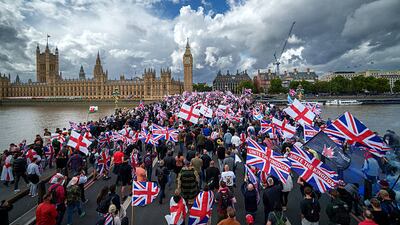

Last weekend was gloriously sunny in the south of England, and my family attended a friend’s birthday party on the outskirts of Dover.
The historic port stands beneath magnificent white chalk cliffs and has always been busy since it’s home to the shortest British sea crossing to France. There are, therefore, often long lines of lorries coming into Dover port from all over Europe, car ferries for holidaymakers and enormous cruise ships.
As I drove to the birthday party, it seemed England was at its best. Warm sunshine lit up the French coast about 40 kilometres away across a calm blue sea. Then radio news reports spoke of something much less appealing, a bizarre demonstration of about 250 men in black masks, black anoraks, black jeans and boots marching up and down, blocking the road to the port entrance.
A friend from Dover who witnessed the demonstration told me they were a far-right group from across south-eastern England. He described them as “neo-Nazis” who followed shouted commands from their leader. This port-blocking parade was potentially threatening. It mobilised Kent police and made national news headlines. The demonstrators described themselves as English “patriots” with “a fierce love for our homeland”, though why “love” involved stopping lorries and holidaymakers was not explained.

A video posted on social media by the group’s presumed “leader” dripped with vague menace: “Very, very soon, we are going to send a message that will make sure they understand that we will not go down without a fight. We will not allow our nation to be plagued in the way that it is.” It’s not clear who “they” are or who would “understand” what, or what the “plague” involved, but it sounded like classic far-right anti-immigrant whingeing mixed with threats of unspecified bad things to come.
The idea of weird masked men in black clothes shambling around a sea harbour to “defend” England would be laughable if it were not also so threatening. In recent years, far-right anti-migrant demonstrations across the UK ranged from Belfast to Southport and elsewhere. Some involved riots and arson, but many of these pretend English “patriots” also turned out to be men with criminal convictions including for domestic violence against women.
No arrests were made at Dover, and the masked mob marched to the train station and left. But this was a reminder that the traditional rather sober British political right and some new far right disruptors are a discordant, divided bunch.

The traditional Conservative party of the centre-right, led by Kemi Badenoch, suffered a big dip in the polls but is now recovering. To Ms Badenoch’s right, Nigel Farage’s Reform UK party is, however, showing signs of distress. Reform, once leading in opinion polls, is enduring damaging publicity, media investigations and political blunders. A sting by undercover reporters showed two key Reform figures, close to Mr Farage, seriously embarrassing the party over potential donations that may be considered illegal.
We shall see. Mr Farage was at least forced publicly to admit that comments by the two key aides – James Orr and Dan Jukes – filmed by the undercover team were “injudicious at best”. The party has now suspended both men. Mr Farage himself is under continuing investigation over his acceptance of a £5 million (about $6.7 million) gift from a resident of Thailand and other matters.
Moreover, Reform’s chief selling point was that it is different from the old Conservative party and “politics as usual”. Well, yes, but possibly not in a good way. Reform has slipped in opinion polls. And it’s difficult to pretend to be “new” and “different” when Reform’s key figures include former MPs who defected from the traditional Conservative party. These include Robert Jenrick and Suella Braverman, both former Conservative cabinet ministers who switched when Reform was rising in opinion polls.

Now Reform is slipping, and the Conservatives may recover, but either way the right-of-centre vote is split.
The Dover demonstrators appear way beyond the normal right-wing spectrum. In their black garb they looked like a particularly scruffy re-incarnation of the English fascist party of the 1930s, Oswald Mosley’s Blackshirts. Maybe the Dover demonstrators should be called the “Black Anoraks” or “Black Trainers” given their choice of clothing. Besides, wearing a mask on a sunny day suggests you may have something to hide. My Dover resident friend who witnessed the demonstration said he felt a real sense of threat to peace in his community.
What we can say for sure is that after a significant loss of voter support, the longstanding centre-right Conservative party appears to have stabilised. Ms Badenoch has made changes to her team and the party’s poll ratings are improving. Mr Farage’s “breaking the mould” of British politics has turned into a different question – “did he break electoral law?” And the 250 far-right masked “Black Anoraks” in Dover may seem not only a modern echo of the 1930s fascist Blackshirts but a potential threat to public order, raising serious questions about the toxic edge of British politics.