Gulf countries are among the world’s top-10 per capita remittance-sending economies, affirming the important contribution they make to elevating global living standards. New research demonstrates that part of this benefit reflects the role of financial transfers in shielding households from the negative impact of sudden income losses, and in a manner that is more dignified than traditional foreign aid.
In terms of per capita remittances, Gulf states dominate the global top-10. This can be attributed to three key factors. First, unlike many western economies, they have extremely open labour markets, meaning that expatriates from every rung of the skill ladder have the opportunity to enter the Gulf workforce, earn an income and transfer their earnings to their families back home.
The second is the mobility of capital in the Gulf. Once an expatriate receives their monthly salary, remitting that income is fast, cheap and easy. There are no economically motivated transfer caps imposed by monetary authorities, unlike many economies around the world where the state tightly restricts capital outflows.
The third is that Gulf countries have high levels of per capita income, translating to high earning potential for the incoming expatriate workers, especially when compared to the source countries or competing recipient countries. For example, a construction worker or waiter in the UAE earns multiple times what they would earn performing the same tasks in many of the Asian countries from which most of these expatriates originate, furnishing them with the liquidity they need to finance large remittances.
An ancillary factor is the generally hospitable nature of Gulf countries. The infrastructure is of high quality, the crime rates are low and particularly in the case of countries like Bahrain and the UAE, the culture is characterised by high levels of tolerance and acceptance of foreign religions and customs, reinforcing their attractiveness to prospective expatriate workers.
As a result, while countries such as Canada and the US are known as being bastions of inward immigration, their per capita outbound remittances are a small fraction of those in Gulf countries. Only small territories such as Macau and Monaco can compete with the likes of Qatar and the UAE when it comes to per capita outbound financial transfers.
-

A resident of Abu Dhabi at the Lulu Exchange in Khalidiyah Mall to send money home to India. Victor Besa / The National -

Mohammed Yayyattukavil from Kerala, India who has lived in the UAE for about 30 years, advises young people to live within their means. Antonie Robertson / The National -

Indians in the UAE are the biggest community to annually remit money to their families in their home country. Victor Besa / The National -
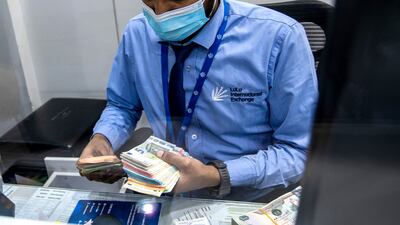
Family remittances from the UAE are strong, with an increase forecast for transfers to India and the South Asia region. Victor Besa / The National -

Indians are the largest expatriate group in the UAE with 3.4 million resident in the Emirates. Victor Besa / The National -

The UAE heads the list of non-resident remittances to India, followed by the US, Saudi Arabia and Kuwait. Victor Besa / The National


Researchers have long since established that remittances bring unique developmental benefits that foreign aid struggles to deliver. Their key property is that they are determined by the beneficiary, who also controls how the money is spent, freeing remittances from the red tape that sometimes encumbers even the most well-intentioned governmental financial assistance.
This is especially important given that households in emerging economies differ considerably in how they would like to spend their income: some prefer investing in education, others favour covering basic expenses such as rent and utilities, while others use it as seed capital for their entrepreneurial ventures. This renders the tailored, household-specific nature of remittances highly advantageous compared to the one-size-fits-all approach that foreign aid bureaucracy necessarily entails.
A recent paper by London Business School professor Dr Ludovica Ambrosino and Federal Reserve Bank of Boston scholar Dr Aditya Soenarjo digs deeper into the benefits of remittances by analysing data from more than 150 million transactions mediated by a global money transfer operator over the period 2014-2023.
Most strikingly, the researchers found that remittance flows increased by 31 per cent in the first week following a major natural disaster, demonstrating the role that remittances play in helping households that are divided between two or more countries to diffuse the impact of sudden losses of income.
For example, suppose a father from a family in the Philippines secures employment as part of a merchant ship’s crew working in Greece, using that income to support his wife and children back home. Imagine that a typhoon strikes his family’s village, causing significant damage to his home, while also undermining his wife’s ability to earn additional income. Under these circumstances, the father’s presence abroad – and his ability to earn income in a workplace unaffected by the typhoon – can provide crucial respite, as reflected in the numbers cited by Dr Ambrosino and Dr Soenarjo.
Billions of dollars of outgoing remittances from Gulf countries make a substantive contribution to these “cushioning” flows, in addition to the traditional income-boosting variety that is usually associated with international financial transfers. In both cases, beyond the headline economic benefit, a frequently overlooked one is the positive impact on personal dignity. Foreign aid, including disaster-related humanitarian relief, is essentially an unconditional donation, which is certainly preferable to being left to fend for oneself.
However, from the perspective of one’s self-worth, it is almost always preferable for one to earn the income that helps in raising one’s living standards or dealing with an unforeseen calamity. This is not idle self-indulgence: all moral systems – religious or otherwise – correctly regard human dignity as a core principle that should be supported where possible. Accordingly, by facilitating high remittances, Gulf countries should be viewed as contributors to dignified economic development in emerging economies.
The broader lesson is that the Gulf’s open labour markets do more than support domestic economic activity. Although designed primarily to advance Gulf countries’ own prosperity by addressing local labour shortages, they also enable millions of expatriate workers to protect their families against hardship and improve their long-term living standards through income that has been earned rather than bestowed.
Maintaining the openness of these labour markets, the freedom to transfer earnings and the low cost of doing so therefore allows Gulf countries to continue making an important – and dignified – contribution to global development.