


In February 2003, then-US secretary of state Colin Powell went to the UN to present the George W Bush administration’s case against Iraqi leader Saddam Hussein. His remarks were directed at two audiences: reluctant allies and unconvinced Americans.
Hawks who wanted this war termed Mr Powell’s performance “compelling and persuasive”. His calm and commanding presence, combined with a multimedia presentation of audiotapes and photographs, built a strong case for US allegations that the regime in Baghdad was not fully complying with UN’s mandates and was seeking to build a nuclear warhead.
Even though Mr Powell’s “evidence” was cherry-picked or even fabricated, and artfully presented for maximum impact, his arguments didn’t sway the majority of Americans who remained unconvinced. Most did not want a war with Iraq. They weren’t asking for proof of the Iraqi government’s brutality or evil intent. They already knew that to be true.
What they wanted to know was “why a war and why now?” In fact, they wanted answers to the very questions Mr Powell had laid out years earlier in what came to be known as the “Powell Doctrine” – six requirements before the US should engage in any foreign military conflict.
These were: were vital US interests at stake?; was the US willing and able to commit sufficient resources to win swiftly, decisively and with minimal casualties?; were the military and political objectives clearly defined and delineated?; was there the political will to sustain the commitment needed to realise the objectives?; did a reasonable expectation exist at the outset that Congress would support this commitment and would sustain that support?; and have all possible means of resolving the conflict been exhausted?
We now know that the Bush administration was not truthful in making its case for war. Saddam did not have, nor was he building, a nuclear warhead, and Iraq was not the sponsor of the 9/11 terrorist attacks on the US. However, the administration’s more significant lies were those presented to Congress seeking to address concerns expressed by the public and Congress about the war.
These included: the war would only involve a limited number of troops; US forces would be celebrated in Iraq as liberators; the war would be over in a few weeks; the troops could come home after six months; the war would cost only a few billion dollars (with the remaining costs covered by Iraqi oil revenues); extremism would be defeated; and Iraq would emerge as a beacon of democracy that would light up the whole Middle East.
The war did succeed in removing Saddam from office, but it was the unintended consequences of that war that remain with the Middle East, and the US itself, a generation later.

Thousands of Americans and hundreds of thousands of Iraqis were killed. The cost to the US treasury was more than $7 trillion. Tens of thousands of US troops suffered from injuries and trauma from their service. Iraq remains unstable. With the defeat of Saddam, Iran was unleashed and emboldened, finding a foothold in Iraq, and the sectarian extremism of Al Qaeda metastasised into ISIS that spread across the Middle East and North and West Africa.
A thoughtful analysis of the regional situation before the war’s start would have helped policymakers understand the inevitability of these unintended consequences. But because Mr Powell himself didn’t answer the very questions posed by his own doctrine, the US went blindly into Iraq. The US, the Iraqi people and the broader region are still living with the devastating and destabilising results.
This tragic history should be considered when the ongoing US-Israel war on Iran is assessed.
When announcing the initial bombing of Iran, US President Donald Trump made a similar case to the one Mr Powell and other officials made 23 years ago. He argued that Iran is seeking to build a nuclear warhead and missiles that can reach the US, has the blood of Americans on its hands, and has threatened US allies across the Middle East. And he noted the brutal treatment of the Iranian regime towards its own people. The President argued that the US and Israel seek to punish and remove the regime so the Iranian people can rise up and create a more democratic government.
Americans won’t argue with the President’s case against Iran’s domestic repression or its export of violence, though Mr Trump has bent the truth about the nuclear issues. But no matter how problematic Americans may view the Iranian regime, a majority are opposed to this war. With the Iraq war a not-too-distant memory, Americans want to know why a war is necessary? And what might be the cost, terms of engagement and expectations of success, and how will it end?
In his effort to win support from a reluctant American public, Mr Trump followed the same disingenuous path laid out by the Bush administration. He said the war would be quick because overwhelming force would be sufficient and transformative. Because the Iranian people will rise up and demand change, there’ll be no need for American boots on the ground. He assured voters that the US would not be involved in a nation-building exercise. And he claimed that America and the Middle East will be more secure after punishing the Iranians for their bad behaviour and replacing the regime.
Most of this borders on fantasy. As the war drags on, the administration has moved the goalposts.
The expected duration of four to five weeks has been extended to five months. Since the Iranian people did not rise up to overthrow the regime, the US is trying to deploy armed Iranian Kurdish units to foment civil war – with American military advisers. Mr Trump recent insistence that he pick the next head of government in Tehran, even as Iran’s Assembly of Experts was almost ready to name Mojtaba Khamenei the country’s next supreme leader, sounded a lot like nation-building.
-
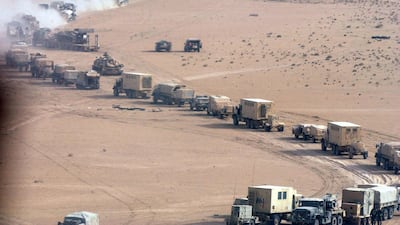
A long US military convoy moving inside an unspecified area of southern Iraq on March 21, 2003. US and British forces were poised to capture the city of Basra on day two of the war to topple President Saddam Hussein. AFP -
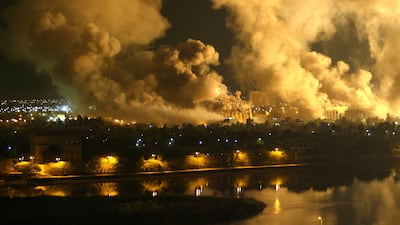
Smoke covers the presidential palace compound in Baghdad on March 21, 2003 during a massive US-led air raid on the Iraqi capital. Smoke billowed from a number of sites, including one of President Saddam Hussein's palaces, an AFP correspondent said. AFP -

Members of Britain's 16 Air Assault Brigade on patrol during a sandstorm in the deserts around the oil fields of Rumaila in southern Iraq on March 25, 2003. AFP -
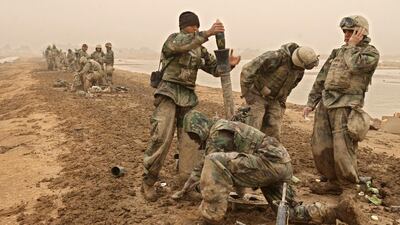
US Marines from the 2nd Batallion 8th Regiment load mortar shells into launchers in Nasiriyah, about 360 kilometres south-east of Baghdad, as they pound Iraqi positions early on March 26, 2003. AFP -
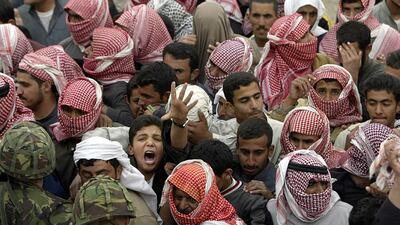
An Iraqi boy struggles amid a crowd to reach for giveaways thrown from a lorry in the southern city of Safwan on March 26, 2003. AFP -

Residents flee the burning town of Basra in southern Iraq on March 28, 2003. British soldiers said the fleeing refugees had described a city still in the grip of an Iraqi military that had hidden large amounts of artillery tanks in civilian and commercial areas. AFP -

Iraqi Republican guards cheer as they pass a wrecked US army Abrams tank, south of Baghdad, on April 6, 2003. AFP -
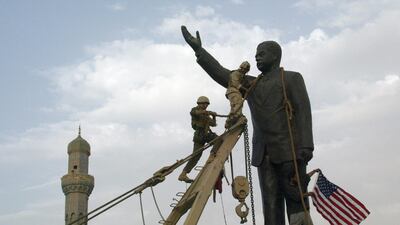
US Marines chain the head of a statue of Saddam Hussein before pulling it down in Baghdad's Firdous Square on April 9, 2003, while an Iraqi waves the US flag. US troops moved into the heart of the Iraqi capital meeting little resistance. AFP -
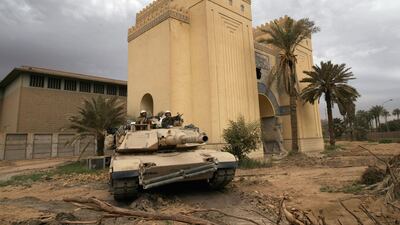
A US tank takes up position outside the plundered Iraqi National Museum in Baghdad on April 16, 2003. Getty Images -
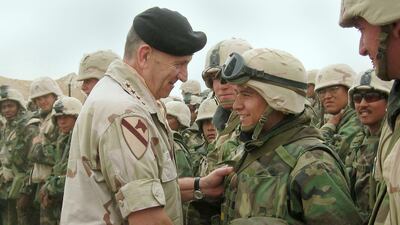
Gen Tommy Franks shakes hands with US Marines of the 1st Marine Expeditionary Force in the Iraqi city of Numaniyah, about 140 kilometres south-east of Baghdad, on April 7, 2003. Getty Images -
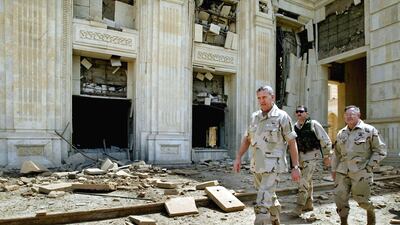
Gen Tommy Franks (c) visits a palace of Saddam Hussein in Baghdad on April 16, 2003. Getty Images -

US Secretary of Defence Donald Rumsfeld (c) is saluted by US Army Lt Gen William Wallace as he arrives at Baghdad International Airport on April 30, 2003. Getty Images -
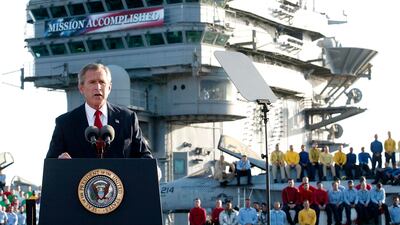
US President George W Bush addresses the nation aboard the nuclear aircraft carrier USS Abraham Lincoln on May 1, 2003. Mr Bush declared that major fighting was over in Iraq, calling it "one victory in a war on terror". AFP


Instead of making Americans and Washington’s allies more secure, US citizens were last week urged to leave the Middle East. Arab countries that had been developing ties with Iran are now embittered by Iran’s attacks on their territories and, with the instability and the economic repercussions of this war, are losing confidence in the US and pressing for an end to hostilities. Despite Israel’s daily violations of its October ceasefire with Lebanon, they took advantage of a few missile attacks engineered by elements of Hezbollah to launch a full-scale attack on that country and are now pushing Lebanon into a civil war.
Arming Iranian Kurdish groups will have consequences for Kurds in Turkey, Syria and Iraq. If the US does the same with other minority communities in Iran, the country may fracture, as happened in Libya, or worse.
Two weeks into the war, Washington’s decision to launch strikes on Iran have already proved to be costly with no clear good outcome. They have thrown the Middle East into chaos. And the tragedy is that all of this might have been avoided had the Trump administration learnt the lessons of the Iraq war debacle and been attentive to the requirements of the Powell Doctrine.

