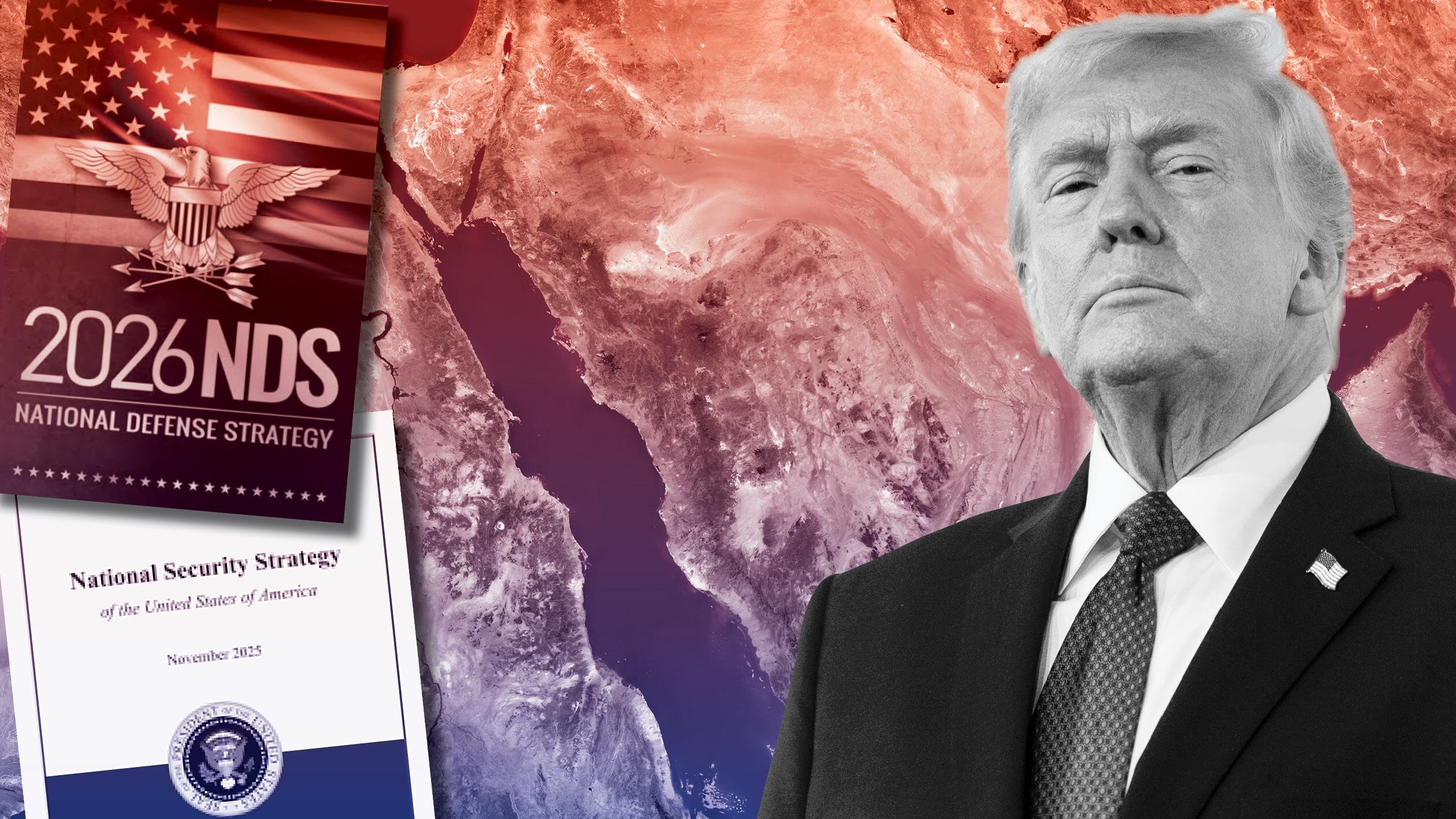

Trying to capture US President Donald Trump’s proudly unpredictable approach to foreign policy in fixed policy documents is inherently difficult. Surprise, leverage and improvisation are not bugs in Mr Trump’s world view; they are features. Yet the administration has now attempted this exercise twice: with the release of the National Security Strategy last December and the National Defence Strategy this January.
Mr Trump is unlikely to feel bound by every line in either document. He considers unpredictability a strategic asset – both against adversaries and, at times, against his own allies. Still, taken together, these texts matter. They provide the clearest available statement of the administration’s underlying world view, strategic priorities and regional intentions. They also reveal how Mr Trump’s personal instincts intersect with longer-standing currents within the American right: scepticism towards multilateralism, emphasis on sovereignty and power, and preference for transactional alliances.
Three top-line lessons emerge from reading the two documents together.
First, the US is formally stepping away from the post-1945 vision of an American-led rules-based international order towards a more openly competitive system of nation-states. Second, peace is pursued not through restraint or institution-building, but through leverage, pressure and credible force. Third, in the Middle East, the administration envisions a region anchored by Israel and the Gulf states, overseen by American power, economically integrated with the US and no longer defined primarily by conflict.
This article focuses primarily on what the NSS and NDS signal about US policy towards the Middle East, while briefly situating those signals within the administration’s broader global framework.
Both documents mark a decisive departure from the language of liberal internationalism. The NSS explicitly de-emphasises the idea of a US-led rules-based order in favour of a world of sovereign competitors, where American strength – military, economic, technological and energy – remains the ultimate guarantor of US interests.
Regionally, this world view produces a sharp hierarchy. The Western Hemisphere is treated as a sphere of near-exclusive US influence, echoing a revived Monroe Doctrine and illustrated most clearly by Washington’s recent actions in Venezuela. Great-power competition is reframed as manageable “jockeying”, rather than an existential struggle. Russia is portrayed as a limited and containable threat in Eastern Europe, with the administration taking pride in having forced European allies to raise defence spending from 2 to 5 per cent of gross domestic product. In the Asia-Pacific, the objective is to counterbalance China while avoiding direct confrontation – seeking co-existence and what the documents call a “decent peace”.
Within this re-ordered global map, the Middle East remains strategically important.
Among the five “core vital national interests” identified in the NSS, three relate directly or indirectly to this region. One is explicit: “Preventing any adversarial power from dominating the Middle East, its oil and gas resources, and the maritime chokepoints through which they pass.” Two others – “preserving freedom of navigation and secure supply chains” and “ensuring US technological leadership in areas such as AI, biotechnology and quantum computing” – are increasingly tied to Gulf partners, whose roles in energy markets, logistics and digital infrastructure, as well as mining and minerals, are growing rapidly.
The NDS reinforces this importance in both global and regional terms. Globally, it emphasises burden-sharing by allies and the need to “supercharge” the US industrial base. The Middle East figures prominently on both counts. Israel, Gulf states and Turkey are expanding their own defence capacities, while large defence purchases and direct investments – particularly from the Gulf – feed directly into Mr Trump’s ambition to strengthen American manufacturing and strategic industries.
Even in the document’s top priority – defending the US homeland – the Middle East appears. “Countering Islamic terrorism”, which continues to justify a US military presence in the region, is explicitly identified as a core task.
Where the documents address the Middle East directly, the administration’s vision is unambiguous. It centres on four pillars: a non-nuclear and strategically weakened Iran; a strong and secure Israel; deepened investment, energy and digital partnerships with the Gulf; and a region that has moved beyond chronic warfare towards integration, partly under an expanded Abraham Accords framework.
Mr Trump continues to cast himself globally as a “president of peace”. Of the eight wars he claims to have ended, three are in the Middle East: the war in Gaza, the Israel-Iran war and the Egypt-Ethiopia conflict. Central to this self-image is the promise – still unfulfilled – of ending the long-running Israeli-Arab-Palestinian conflict and putting an end to recurring confrontations with Iran.
Yet the path to peace envisioned in both documents unmistakably mixes coercion with negotiation. Mr Trump’s preferred method is hard bargaining: using pressure, sanctions, military strikes and the credible threat of further force to compel adversaries towards negotiation. The NDS explicitly celebrates Operation Midnight Hammer, which devastated Iran’s nuclear programme, and leaves no doubt that force remains firmly on the table.
Israel is held up as a model ally – willing and able to fight its own wars, with decisive US backing when needed. Gulf partners are praised for taking greater responsibility for their own defence through the acquisition and integration of US military systems. Turkey is mentioned favourably as a key actor shaping a potential post-Assad order in Syria.
At the same time, both documents stress that regional integration among US partners – through expanded Abraham Accords and security co-operation – does not replace American primacy. The US reserves the right, and retains the capacity, to take direct and decisive action to defend its interests in the region.
Iran remains central to this posture. Alongside China, Russia and North Korea, it is listed among the top four national defence concerns. The NSS and NDS argue that US strikes on Iran’s nuclear facilities, sustained sanctions, Israel’s devastating blows to Hamas and Hezbollah, and US attacks on the Houthis have significantly weakened the Islamic Republic.
While the documents reiterate Mr Trump’s bottom line – that Iran will not be allowed to acquire a nuclear weapon – they convey a degree of confidence that Tehran today poses a lesser threat than before. Notably absent are calls for regime change or urgency about negotiating a new nuclear deal, even as the possibility of renewed escalation in the days ahead remains a distinct possibility.
One element of the administration’s strategy may sit uneasily with regional partners: Mr Trump’s commitment to American energy dominance. The US is already a net energy exporter, but recent moves – most notably in Venezuela – underscore how central energy is to Mr Trump’s conception of US power. Keeping global energy prices low is treated as a strategic objective, not merely an economic one.
For several regional economies, this has already translated into fiscal pressure and the scaling back of ambitious development projects. While the strategic partnership remains strong, this is one area where US and allied interests may diverge more sharply in the years ahead.
Taken together, the NSS and NDS underscore the administration’s strong alignment with long-standing US partners in the Middle East – especially when contrasted with Washington’s increasingly fraught relations with its European allies, which nearly tipped into conflict over Greenland two weeks ago.
At the same time, it is worth returning to the caveat at the outset. These documents offer structure and clarity, but they do not constrain the President. Mr Trump’s foreign policy remains deeply personal, instinct-driven and improvisational. He will continue to deviate from the script, reshaping events as he goes. The strategies on paper tell us where the administration is inclined to go – but not necessarily how, or when, the next surprise will come.

