

Not a lot of good news stories have come out of the Palestinian territories over the past couple of years, in particular. The Trump Peace plan may represent hope for some; others have long lost any shred of optimism.
In December 2023, I was asked – and was honoured – to meet a Palestinian Authority official who had been thrust into the limelight after an Israeli attack killed more than 20 members of his extended family in Gaza. In an attempt to offer him some crumbs of comfort, I pointed out that millions of people around the world were awakening to the Palestinians’ plight and their history, and that younger generations were very strongly on their side. “I try to avoid being so pessimistic in public,” he told me, “but by the time that’s any help, I fear there won’t be any Palestine left at all.”
So the holiday season seems an appropriate moment to tell of a social enterprise that is bringing hope, security, jobs and the prospect of a brighter future to some Palestinians, at least.

A few years ago, an Iranian American called Cyrus Copeland learnt about a “freedom farm” in the West Bank that had been set up by the Palestinian Farmers Union. The model was a 1-hectare plot of previously uncultivated land, protected by a steel fence, and in a location sufficiently distant from any Israeli settlements. A total of 250 olive saplings were planted, watered by rainfall and, in the summer, an underground drip irrigation system that draws on local wells rather than pipes that could be cut off by the authorities.
-
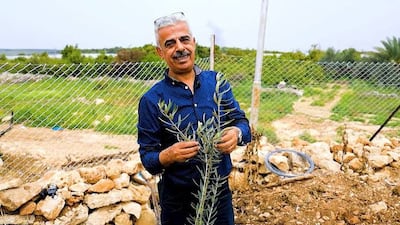
Treedom for Palestine has worked in tandem with Abbas Milhem and the Palestinian Farmers Union. All photos: Photo: Palestinian Farmers Union -
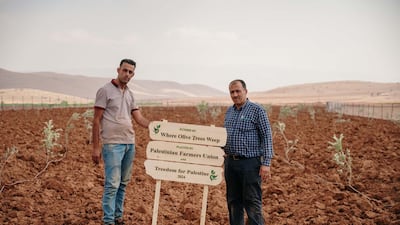
In the past year, 23 farms have been established, with a total so far of 4,000 olive trees. -
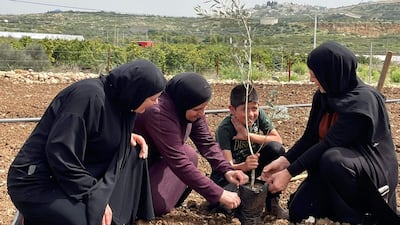
There are more than 75 freedom farms in the West Bank, turning degraded land into something useful and productive and protecting unclaimed or fallow areas from being confiscated by Israel. -
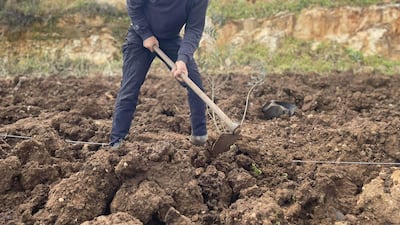
The freedom farms don’t cost much to set up, with funding coming from individual donors, foundations and philanthropists around the world.


“I came across the original farm that was planted in 2018,” Mr Copeland tells me. “It was very moving. It felt like the farm had found me.” He started a conversation with the PFU and its indomitable executive director, Abbas Milhem. “I wanted to find out how scalable this idea was,” says Mr Copeland, “not just in terms of prosperity and sustainability, but also gender equity – as women tend to do a lot of the agricultural work.”
The feedback was positive. So in 2022, Mr Copeland, an author and speaker whose early childhood was spent in Iran, founded Treedom for Palestine in partnership with the PFU. And today, there are more than 75 freedom farms in the West Bank, turning degraded land into something useful and productive – each one can bring an annual revenue of $35,000 – and protecting unclaimed or fallow areas from being confiscated by Israel.
In the past year, 23 farms were established, with a total so far of 4,000 olive trees. “That happens to be the number that had been uprooted by settlers over that time,” says Mr Copeland. “We planted back safer and smarter, more protected, and further away from settlers. Credit is due to the PFU for their very good risk assessment on that front. When we decide on a beneficiary family, we look for land that is plantable and is sufficiently distant, so that it is sustainable.”
How many freedom farms have been attacked by settlers, I ask. “It’s never happened,” says Mr Copeland, who mentions one farm specifically established for the widow of a farmer who was attacked and killed by settlers while he was working in his olive groves. “It left her husbandless, her four children fatherless, and made her the sole provider.” The new farm provides her and her children with income and security and “allows her to harvest olive trees, which had meant so much to her husband”. This also fits with Treedom’s aims for gender equity – about half the farms are planted for and by women.
Olive trees can live for 500 years, with families inheriting and caring for them, as Palestinians have done for millennia. “By using the olive tree as an agent of change, all of the noise of politics retreats into the background,” says Mr Copeland. “You plant them, they have no sense of race or religion, they just do the work that they do, with a leanness of resources, as they don’t drink as much as most trees do. And in spite of that, they end up giving an enormous amount generation after generation.”
The freedom farms don’t cost much to set up – in the low five figures in US dollars on average – with funding coming from individual donors, foundations and philanthropists around the world. In January, one was established in the West Bank city of Tulkarem in the memory of former US president Jimmy Carter, who “stood firmly supporting the struggle of the Palestinians for independence and for freedom”, as the PFU’s Mr Milhem said at the time. “I think planting olive trees that live at least 100 years old like him is a very suitable way to honour his life and his legacy,” added George Zeidan, the Carter Centre’s director in Israel and Palestine.
I’m sure Mr Carter would have agreed. It’s an inspiring story that speaks to the warmth and hearts of people like Cyrus Copeland and Treedom’s donors, but also to the resilience of Palestinians like Abbas Milhem.
In October 2023, I quoted Mr Milhem in these pages. Days after the October 7, 2023 attacks, his elderly parents-in-law, who lived in Gaza, died when Israeli rockets destroyed their house. “It is horrible. People are waiting for their death. Why is my father-in-law killed and he is 85 years old? Aren’t we equally human beings?” he said. But even amid his grief, Mr Milhem was also able to say: “We can make peace and live as good neighbours sharing the land. But only with those who believe in a just peace.”
In the circumstances, I found that astonishing. “Grace” is the word, and Mr Milhem displays it in abundance. Grace, resilience and agency – it’s worth remembering that at a time when others seem to want to determine their fate, Palestinians still possess all three.

