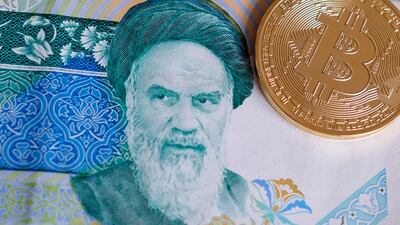

Iran’s politics has many layers, but you know things are serious when someone invokes the authority of the country’s supreme leader, Ayatollah Ali Khamenei. This week, as the cryptocurrency conference RamzAti was convened in Tehran, a top official did just that.
Mohammadreza Poorebrahimi, a University of Tehran professor who heads the economic committee of a supervisory body, said Mr Khamenei’s command was needed for cryptocurrencies to “enter the country’s economy”.
It was a curious formulation as such currencies are already a part of Iran’s economy. Close to five million Iranians now trade in them using more than 100 locally based exchanges. In addition to cryptocurrency, they also trade in gold. The Iranian rial has long been unstable, falling further in value against the US dollar as sanctions continue to ravage the national economy and instability threatens the country. At the time of writing, $1 was trading for the record amount of 1.25 million rials.
Given this, it’s not surprising that Iranians resort to gold or cryptocurrencies. While the latter can be even more unstable, they provide potential for growth. There are also stablecoins such as Tether, which is pegged to the dollar and can become an alternative mode of exchange for those loath to use the rial.
The prominence of RamzAti itself shows how central the cryptocurrency conversation has become in Iran. The meeting was attended by many high officials, such as Mohammad Reza Farzin, the Central Bank governor who had previously expressed scepticism about cryptocurrencies, the head of the Tehran stock market and a number of top MPs.
Iranian officials have realised that they can no longer simply ignore cryptocurrencies and that they must act swiftly to govern them. Mr Poorebrahimi, a former MP, recalled an incident in 2017 when the then-central bank governor told a parliamentary session that the bank “didn’t agree” with cryptocurrencies and called on people to not use them. That approach clearly hasn’t worked, Mr Poorebrahimi added.
Key organs of the state have since taken a very different attitude.
Mehdi Toghyani, vice-chair of the Parliament’s economic committee, spoke at the conference. He warned that if the cryptocurrencies trade went underground, this would threaten the rial and thus adequate laws and policies had to be put in place. He also said exchanges selling gold online could help stimulate the economy but only if this is within a regulatory framework.
The Parliament has been trying to set the scene. This past week, it passed the Development and Overcoming Obstacles Facing the Digital Economy Act. Among other provisions, it cuts red tape for digital outlets such as cryptocurrency and gold exchanges. It gives them certain legal protections. The law also attempts to promote competition and ensure that the major players in the market do not dominate it.
In September, the Central Bank passed new regulations governing cryptocurrencies. A Strategic Council for New Financial Technologies has been set up and has already met five times. Since last year, the bank’s New Technologies department has been headed by Nooshafarin Momen Vaghefi, the first woman to serve as the institution’s deputy governor.
Holding a PhD in business studies from the University of Lyon, the 52-year-old Ms Momen Vaghefi is seen by many as friendly to the cryptocurrency space. “It is hoped that she would have a positive approach in policymaking, as opposed to the pessimist approach of the regulators,” an Iranian financial website wrote.
Speaking at RamzAti, Ms Momen Vaghefi made clear that she isn’t hostile to cryptocurrencies. The Central Bank has no problem with “tokenisation”, she added, referring to the process of converting assets to tradable digital units – or tokens. She also provided the UAE, Japan, Singapore and Malaysia as examples of countries with strong crypto governance mechanisms.
But Ms Momen Vaghefi warned that the absence of a proper governance system to regulate this burgeoning space can lead to “negative consequences”. She specifically cautioned against using gold or cryptocurrencies as the main currency, saying this was a “red line” that would hurt the rial.
The use of stablecoins such as Tether is particularly concerning for many, too, particularly with its widespread adoption expected to make the rial less relevant for many Iranians. Newspaper reports have also warned that speculatory practices on the part of some online exchanges have cost many Iranians their savings. The hope, therefore, is that more regulations and a strong governance mechanism can help avoid such problems in the future.
Mahmoud Goudarzi, the head of Tehran’s stock exchange, also spoke at the event and said his organisation has been trying to break into the cryptocurrencies market for more than a year. He hopes to bring crypto-based funds and other digital assets into the stock market. “The taste of investors has changed,” Mr Goudarzi said, “and the stock exchange must be able to reflect that.”
Such backing from important institutions is likely to please those who have banked on the future of cryptocurrencies in Iran. But there is also a worry among many that the authorities could go in the opposite direction and over-regulate the sector. Some experts at RamzAti even said so. Sometimes even a lack of proper regulations is better than a faulty enforcement of a patchwork of regulations, they pointed out.
It’s important to note, however, that cryptocurrencies are not a panacea for Iran’s economic problems, particularly with the international sanctions regime still in place. As Mr Poorebrahimi pointed out, since the 12-day war with Israel and the US broke out this summer, cryptocurrency transactions involving Iran have been blocked, bringing down the total trade volume. As is generally the case, in the crypto space too, Iran’s immense potential remains unfulfilled as long as these sanctions exist.

