

A tale of two department stores. In presenting its latest set of results, Selfridges blames the “tourist tax” for deterring international shoppers, leading to a drop in sales last year.
The UK company, which owns the landmark London store and branches in Manchester and Birmingham, highlights the impact of ministers’ persistent refusal to allow overseas visitors to escape having to pay 20 per cent VAT on their purchases. Sales fell 7 per cent to £774.6 million in the 48 weeks to January 4. This is thanks, Selfridges says, to the levy being responsible for “reduced numbers of international visitors coming to the UK and shopping in Selfridges”.
In Oslo meanwhile, Steen & Strom, which lays claim to being the oldest department store in the world and Norway’s equivalent of Selfridges, reports a 27 per cent rise in tax-free sales to tourists in the first eight months of this year. “Many customers tell us they are choosing to make luxury purchases abroad rather than in London,” says David Wilkinson, executive director at Steen & Strom. The UK charge was a “large factor” behind the shop's decision to open a new refund service for tourists in June.
Steen & Strom becomes another beneficiary of the UK’s decision to reimpose the tourist tax – it was brought back in January 2021 – as more visitors opt to spend their money where they will not incur 20 per cent extra.
With her second budget looming, businesses are fearful they will be targeted by the British Chancellor, Rachel Reeves, as she desperately tries to prop up the country’s ailing public finances. Removing the tax would be a popular move on the high streets in tourist destinations.
Politically too, it would be a goal against the Tories. Bizarrely, it was the "party of business" Conservatives, led by Rishi Sunak, who reintroduced the charge. Before the Tories axed tax-free shopping, tourists from outside the EU could receive a 20 per cent VAT refund on purchases in the UK.
Now the UK has left the EU and its customs union, EU residents could also shop tax-free alongside international visitors primarily from Asia, the Middle East and the US. Lifting the tourist tax would enable the UK to offer rebates to a potential 450 million EU shoppers. It would be a genuine Brexit benefit, an advantageous point of difference between Britain and the EU. Sir Rocco Forte, the hotelier, describes it as “an enormous Brexit opportunity”.
-

Shoppers outside Selfridge's in London. The UK is losing ground to France, Italy and Spain when it comes to non-EU visitor spending because of the scrapping of VAT-free shopping, business fear. Derrick Hardman, chairman of the Association of International Retail, said: 'A big gap has opened up between the UK and its EU rivals when it comes to spending by visitors from around the world. The cause of this is no mystery – the removal of tax-free shopping by the last government is putting people off coming and spending here.' Getty Images -
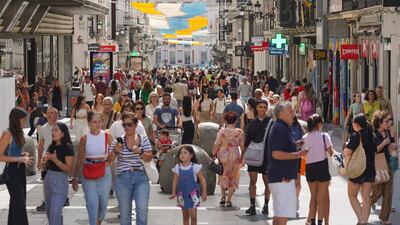
Shoppers on a busy retail street in Madrid, Spain. Spending by non-EU visitors in the UK has stagnated at just 75 per cent of pre-Covid levels in the UK, while soaring to 166 per cent of 2019 levels in Spain, 159 per cent in France and 137 per cent in Italy, according to tax-free shopping specialist Global Blue’s data for September. Non-EU visitor spending is growing year-on-year in the EU, but has plateaued in the UK. Spending by visitors from Gulf states is worst affected, down 27 per cent on 2019 levels in the UK, but up 169 per cent in France, 154 per cent in Spain and 153 per cent in Italy. Getty Images -

Almost 96 per cent of businesses in the West End, pictured above, believe international customers have moved their spending to cities such as Paris and Milan, with 81 per cent seeing fewer international visitors, according to a survey in August by the New West End Company. Getty Images -
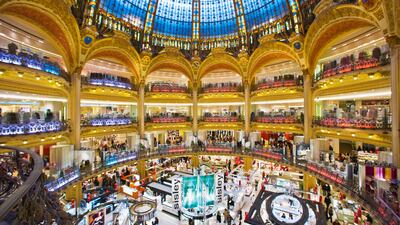
Galeries Lafayettes’s flagship store in Paris, above, achieved double-digit sales growth in the first half of 2025, as the city enjoyed a flood of tourists. International visitors to the French capital rose 9 per cent for the period, with almost 22 million non-French customers visiting the store. It is expected to exceed €2 billion in turnover this year. Getty Images -

In Italy, Rinascente stores, which has its flagship in Milan, reported a net profit of 12 per cent year-on-year for the first six months of 2025. Alamy -
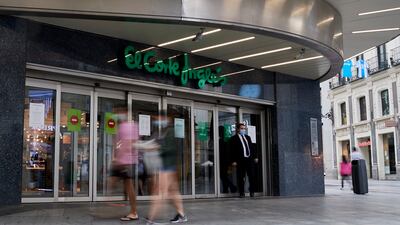
In Spain, luxury department store El Corte Ingles promotes its shops in Madrid, Barcelona, Marbella and Lisbon as key destinations for luxury shoppers, offering an instant 15 per cent tax refund with no minimum spend. The business grew 3.9 per cent in the last financial year. Getty Images -
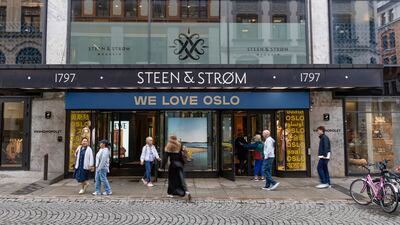
Norway’s Steen & Strom, which claims to be the oldest department store in the world, has benefited from shoppers steering clear of London. Getty Images


Tourism slump
The official figures confirm Selfridges’ experience. Tourism in Britain is suffering. The Office for National Statistics reports that inbound visits and spending in the UK are still below pre-pandemic levels, while other European nations have witnessed a rebound in both the number of foreign holidaymakers and their spending.
More than 500 UK business leaders have backed a campaign to bring back tax-free shopping for foreign visitors, arguing it would encourage more tourists to come to Britain. They include the chiefs of Harrods, Primark, Marks & Spencer and luxury brands Burberry and Mulberry.
Usually, the Labour reaction when faced with such a call from business to remove a tax would be to accuse them of promoting a vested commercial interest, of putting their profits first, ahead of public need. But ditching this tax does not benefit the business bosses directly – it doesn’t provide an immediate boost to their bank balances.
In time it may, as an uplift in tourism and consumption results, but that’s for the future. The main, instant, gain will be in persuading foreigners to visit London and the UK, and to spend – and not choose to go and buy elsewhere.
Neither would removing it cause a huge dent in the public purse. The Office for Budget Responsibility estimates that restoring VAT-free shopping would cost the UK government £2 billion in lost revenue. This, out of a total tax take of about £800bn.
The Treasury reasoning for keeping it appears to be one of ease. They argue replacing it with the same system as before is not that simple, given the new VAT-free system would now need to be open to visitors from the EU as well as from the rest of the world. Any new scheme would require drafting and would take time to legislate for and to implement.
They also maintain the new VAT-free shopping would subsidise a large amount of tourist spending that takes place without a tax relief in place. What they are saying in effect is that while their numbers may be down those tourists that do come are busy, purchasing away, and incurring a 20 per cent surcharge. Axing it would have little effect. Reeves’ Treasury it seems is not for turning.
It is surely illogical to claim that ending it would be complex. How? The tax was introduced only four years ago. The same wording that applied then can surely be used again, this time without the need to spell out an exclusion for EU visitors. All we would be doing is returning to how we were which surely ought to be relatively quick and simple.
So, the current situation prevails, a nonsense that sees a non-EU tourist on a trip around Europe, attracted to an item in a Bond Street boutique or indeed Selfridges, only for them to go and buy the same product when they visit Paris or Milan. Meanwhile, holders of EU passports, residing in Paris or Milan, can’t come to London and enjoy a 20 per cent discount. The Treasury’s stubborn refusal to budge is Britain’s loss.

