


Is the rules-based international order credible if its rules do not apply equally to all nations? The question has come to the fore yet again following the war involving Iran, Israel and the US.
The antagonists claim rules-based justification. Israel evokes self-defence allowed under the UN Charter, because Iran uses armed proxies, annihilatory rhetoric and, allegedly, hankers for nuclear weapons.
Iran denies aggressive nuclear intentions. The sceptics ask why it then purifies uranium almost to weaponisation thresholds in hidden locations. Meanwhile, does not the same international law that allows the US to militarily defend its Israeli ally, permit Iran to aid its ally, Palestine, to counter its dispossession that is consequential to failed international law?
That is how rules constructed by the victors of the Second World War are confused and abused. They promise peace and prosperity but on terms that leave many behind, while entrenching unfair power inequalities. Inevitably, historically aggrieved nations became discontented as their post-colonial self-consciousness evolves.
To appreciate how this reflects in the nuclear issue requires going back to Germany’s 1938 discovery of nuclear fission and attempted Nazi weaponisation. The Allied reaction culminated in the American atomic bombing of Hiroshima and Nagasaki in 1945. The world changed forever.
Researchers coerced by the Nazis – many of them Jewish – were grabbed by the Allies to kickstart their own nuclear enterprises. A Cold War race for “super weapons” led the Soviet Union to match US capabilities by 1949. The UK, fearing loss of great-power status, acquired nuclear weapons in 1952. French prestige necessitated catching up in 1960 by collaborating with a young Israel to “access international Jewish scientists”.
China’s fear of the US’s “atomic blackmail” during the 1950s Korean War triggered it to go thermonuclear in 1964 by trading its uranium for Soviet nuclear technology.
Perhaps it is not coincidental that the original nuclear powers are also the permanent members of the UN Security Council, the veto-wielding arbiters of the rules-based order. The fear, mistrust and paranoia on which it was founded has also paralysed it.
Once the original nuclear powers had developed their core arsenals, the rules-based system kicked in to stop others, condemning non-nuclear states to permanent second-class status. They were obliged to accede to the 1968 Treaty on the Non-Proliferation of Nuclear Weapons – or NPT – to get crucial investments and technologies for development.
A hundred-and-ninety countries are party to the NPT, including Iran but not Israel. Rules require policing and the UN produced the International Atomic Energy Agency. It was born in 1957 in the Rose Garden of the White House in expectation that it would remain connected to its birthplace, although headquartered in Vienna. Despite that, the IAEA does an honest and impartial job tracking and alerting the world on nuclear developments.
But its laudable mandate to promote peaceful uses of the atom can be at cross-purposes with its role as a “safeguards inspectorate” to verify misuse or diversion of nuclear materials. This requires state co-operation as the IAEA can’t detect “undeclared” materials and activities. The loophole allowed western allies to attack Iraq in 2003, although the IAEA found no evidence for weapons of mass destruction there.
Meanwhile, Israeli innovation of international law created a precedent for “preventive war” against potential WMD possession, by destroying an Iraqi nuclear reactor in 1981, a Syrian one in 2007, and damaging Iran’s facilities in 2010. The latest Israeli and American attacks on Iran are a consequence of gaps in the international order that allow discretion to the powerful to exercise judgment.
Such thinking drives insecure countries to extraordinary lengths to get nuclear “insurance”. Border wars with China compelled India to go nuclear in 1974, spurring rival Pakistan to do the same in 1998.
India never joined the NPT because it objects to international agreements that lessen its status in the world order. Why should sovereign India not develop nuclear capabilities if great powers do? An argument that Iran echoes and which may force its NPT departure, especially due to the recent war.
Without India, Pakistan did not join NPT either. When the US earlier kept nuclear missiles in South Korea, North Korea embarked on its own programme, confirming nuclear capability in 2005 after NPT withdrawal in 2003. Perhaps Ukraine is now regretting returning its nuclear arsenal to Russia following the 1992 Soviet break-up.
Another six nations host nuclear weapons as members of their respective military blocs – Belarus (Collective Security Treaty Organisation) and Belgium, Germany, Italy, Germany, Netherlands (Nato). Spillover fears from the Russia-Ukraine war have increased pressure on frontline Baltic states to host Nato nuclear weapons.
Fear is said to have propelled Israeli policy, too, following wars against its Arab neighbours. It is believed to have worked surreptitiously since 1967 to generate a stock of 90 nuclear warheads.
In short, the world’s nine nuclear states hold more than 12,330 warheads, 90 per cent of which are almost equally split between Russia and the US. A visit to Hiroshima and Nagasaki is enlightening to appreciate the consequences of potential deployment. One of today’s weapons dropped on a big city would cause incalculable destruction with an estimated 600,000 fatalities and millions of long-term affected.
-
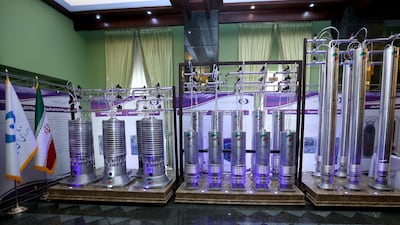
New generation Iranian centrifuges on display for Iran's National Nuclear Energy Day in Tehran, in April 2021. Iranian Presidency Office / Wana -

President Ebrahim Raisi, second right, is accompanied by Atomic Energy Organisation of Iran chief Mohammad Eslami, at Nuclear Technology Day in Tehran in April 2022. Iranian presidency / AFP -
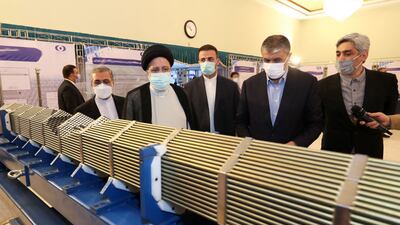
Mr Raisi and Mr Eslami at the April 2022 event. Iranian presidency / AFP -
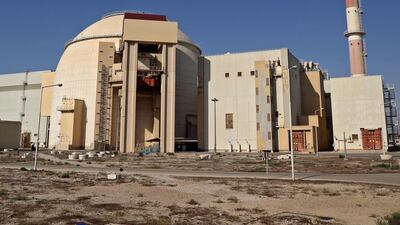
The Bushehr Nuclear Power Plant during a visit by Mr Raisi in October 2021. Iranian Presidency / AFP -
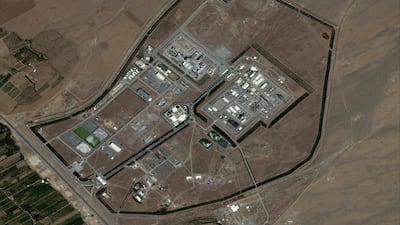
Iran's Arak Heavy Water Reactor complex, south of the capital Tehran in January 2020. Maxar Technologies / AFP -
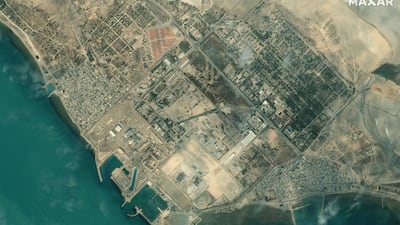
A satellite image of Iran's Bushehr Nuclear Power Plant in January 2020. Maxar Technologies / AFP -
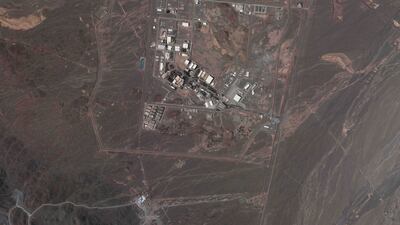
A satellite image of Iran's underground Natanz nuclear site in May 2022. Planet Labs PBC / AP -
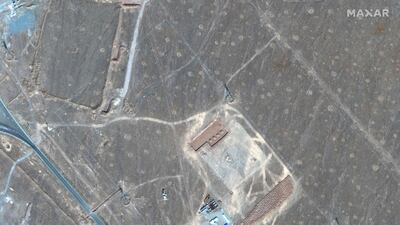
A satellite image in January 2020 of Iran's Fordow Fuel Enrichment Plant, north-east of the city of Qom. Maxar Technologies / AFP -
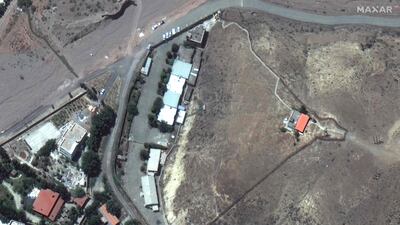
The Sanjarian nuclear centre, east of Tehran, in May 2021. Maxar Technologies / AFP


That going nuclear has existentialist consequences was the argument for rules-based deterrence during the Cold War. It worked because there were two centralised, disciplined and comparable power blocs.
That is not so in our multipolar world. Arms reduction talks have stalled, and existing nuclear powers are busy modernising their arsenals. There is concern that disgruntled non-state actors could spread terror by stealing nuclear materials to make so-called “dirty bombs”.
Past absolute taboos on nuclear weapon use have been replaced by reckless talk of the battlefield utility of short-range low-yield “tactical” weapons under decentralised command-and-control, including so-called “suitcase nukes” and neutron bombs that maximise radiation while minimising blast effects. The risk of misunderstanding and accident is further increased with nuclear states increasingly shifting doctrine from explicit “no first use” to “deliberate ambiguity”.
Nuclear strike possibilities have been raised in relation to the Russia-Ukraine and India-Pakistan conflicts. Meanwhile, although the Geneva Conventions on international humanitarian law prohibit attacks on nuclear plants because of disproportionate civilian contamination risk, there is a loophole for facilities with dual military use. Israel and the US used that to justify bombing Iranian facilities.
In January, the Doomsday Clock was moved by the Bulletin of Atomic Scientists to 89 seconds to midnight, the closest it has got to that symbolically apoplectic moment since 1947. The implied implosion of nuclear order comes at a most dangerous time, which may mark the beginning of a new World War. That is not fanciful at a time of record numbers of lengthy conflicts merging across multiple geographies, economies and technological dimensions. By transforming into “whole of society” wars of merciless intensity, they trample previous norms with impunity.
Hoping that humanity will peer down the deepening precipice and recoil in horror is not enough. Neither is restoring a nuclear order already contested on grounds of inequity. The construction of a fundamentally different, fairer rules-based international order is ever more urgent. This is not easy. A step-by-step approach is essential with many reversals expected along the way.
The war between Iran on the one side and Israel and the US on the other is a good moment to start on the long haul ahead.

