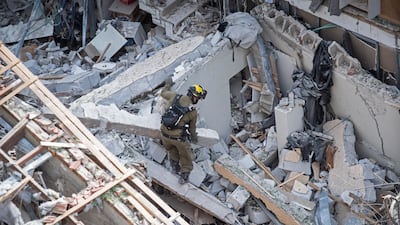
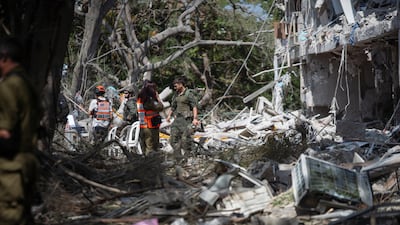
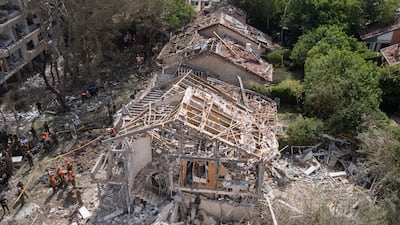
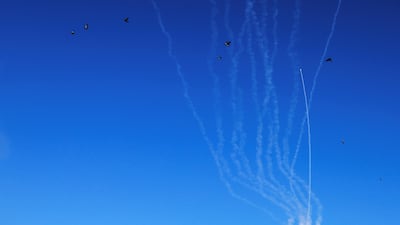
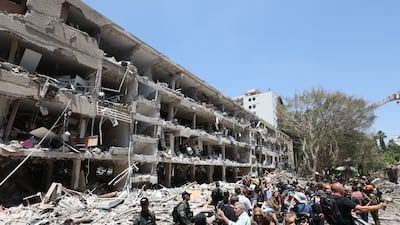
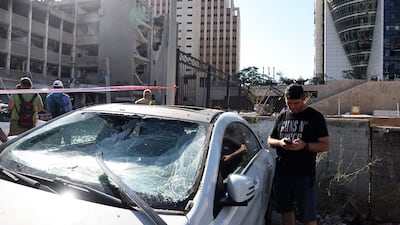
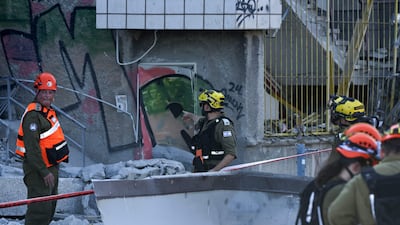
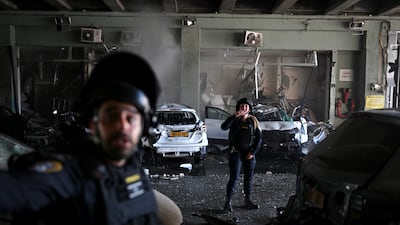
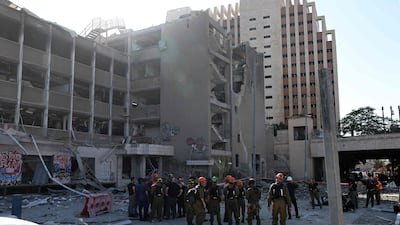
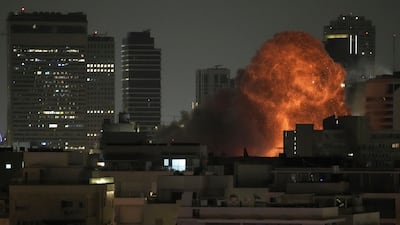
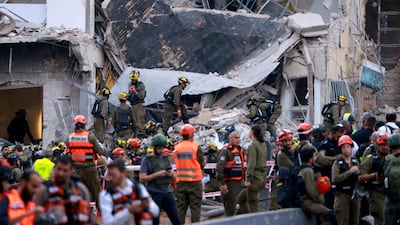
An emergency worker after missiles were launched from Iran to Israel, in Tel Aviv, on Monday. Reuters


Netanyahu's war on Iran is perilous on so many levels


Ali Alfoneh
Ali Alfoneh
  • English
  • Arabic

June 16, 2025

Israeli Prime Minister Benjamin Netanyahu has launched a high-stakes military campaign against Iran – an initiative that not only undermines US President Donald Trump’s stated objective of negotiating a diplomatic resolution to Iran’s nuclear programme, but also risks entangling the Americans in another protracted conflict in the Middle East.

This escalation imperils regional energy infrastructure, reinforces Tehran’s rationale for nuclear deterrence and inadvertently could legitimise the Islamic Republic’s long-standing narrative portraying Israel as the existential adversary of Iran and Iranians.

Mr Netanyahu’s calculus is strategically comprehensible. Deprived of its most capable non-state proxy, Lebanese Hezbollah, and with auxiliary Iran-backed militias across Syria and Iraq demonstrating operational ineffectiveness, Iran finds itself unable to impose credible deterrent costs on Israel. Its indigenous missile capabilities remain largely incapable of penetrating multi-layered and integrated air defence systems of Israel and its allies. Furthermore, Iran’s own air defences are porous, leaving it vulnerable to precision strikes.
From Mr Netanyahu’s perspective, this moment presents a rare opportunity. Should Iran escalate matters – by targeting regional energy assets to internationalise the crisis or retaliating against US forces in the region – Israel hopes for direct American involvement. Thus, it is plausible that Mr Netanyahu’s war aims extend beyond the degradation of Iran’s nuclear infrastructure. His objectives may include leadership decapitation, regime collapse and perhaps even the fragmentation of the Iranian state through civil strife.

Indeed, Mr Netanyahu has goaded the Iranian public to stand up against Tehran’s ruling class. And although Israeli Foreign Minister Gideon Saar later insisted that regime change is not his government’s goal, US officials have since leaked information that Mr Trump vetoed an Israeli plan to assassinate Iran’s supreme leader, Ayatollah Ali Khamenei.

In any case, Israel’s high-risk strategy against Iran could end up becoming an open-ended conflict beyond its control. Mr Netanyahu may have persuaded Mr Trump that sustained Israeli military pressure would compel Tehran to give greater concessions in the nuclear negotiations with the US. Yet Iran has suspended all talks, and Mr Khamenei – while notably omitting criticism of the US in his initial reaction – appears to be recalibrating his government’s strategic posture. Mr Trump, for his part, praised the Israeli strikes as “excellent”, but there is no clear indication that he intends to commit US forces to a full-scale regional war.

More significantly, Israel’s pre-emptive strike may have fundamentally shifted Iran’s nuclear doctrine. In the aftermath of Iraq’s invasion of Iran in 1980 and Baghdad’s use of ballistic missiles against Iranian population centres, Tehran launched its missile development programme as a deterrent. Today, the inability to deter or respond meaningfully to Israeli aggression could catalyse a similar doctrinal evolution.

This trajectory involves adopting a policy of nuclear latency or outright breakout, akin to North Korea’s path. Pyongyang’s acquisition of a rudimentary nuclear arsenal – despite global isolation and sanctions – enabled it to deter foreign intervention and preserve regime continuity. Iran’s probable goal will be to assemble – and potentially test – a nuclear device to alter the regional strategic balance.

A dual-capacity arsenal, capable of both signalling and retaliation, would enable Tehran to deter future existential threats. However, this would mean absorbing sustained Israeli strikes, overcoming technical blows to its nuclear programme, surviving leadership decapitation attempts, navigating potential ethnic insurgencies backed by external actors, and enduring severe economic attrition for a prolonged period – potentially six to 12 months.

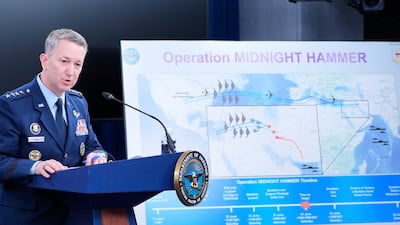
  • Gen Dan Caine, Chairman of the Joint Chiefs of Staff, holds a press conference at the Pentagon after the US military struck three sites in Iran. AP
    Gen Dan Caine, Chairman of the Joint Chiefs of Staff, holds a press conference at the Pentagon after the US military struck three sites in Iran. AP
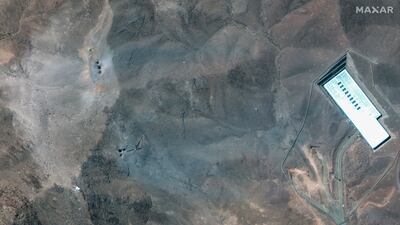
  • A handout satellite image made available by Maxar Technologies shows craters and ash on a ridge at the Fordow underground uranium enrichment following US air strikes. EPA
    A handout satellite image made available by Maxar Technologies shows craters and ash on a ridge at the Fordow underground uranium enrichment following US air strikes. EPA
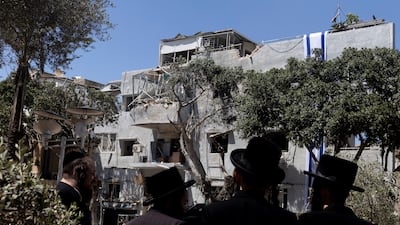
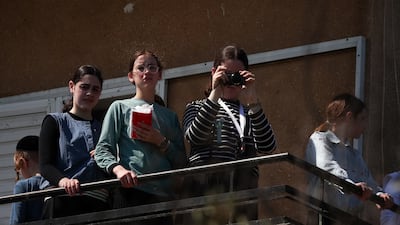
  • Ultra-Orthodox Jewish men look in shock at a building ruined in an Iranian missile strike in Haifa, Israel. Getty Images
    Ultra-Orthodox Jewish men look in shock at a building ruined in an Iranian missile strike in Haifa, Israel. Getty Images
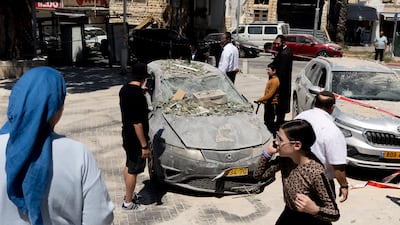
  • Cars damaged in Haifa. Getty Images
    Cars damaged in Haifa. Getty Images
  • Debris in Tel Aviv. Israel was hit by a wave of aerial attacks from Iran after the US entered the war overnight and bombed several Iranian nuclear sites. Getty Images
    Debris in Tel Aviv. Israel was hit by a wave of aerial attacks from Iran after the US entered the war overnight and bombed several Iranian nuclear sites. Getty Images
  • Emergency workers search for survivors in the Ramat Aviv neighbourhood of Tel Aviv, after it was bombed. Getty Images
    Emergency workers search for survivors in the Ramat Aviv neighbourhood of Tel Aviv, after it was bombed. Getty Images
  • Residential buildings destroyed at the site of an Iranian air strike in Ramat Aviv. Getty Images
    Residential buildings destroyed at the site of an Iranian air strike in Ramat Aviv. Getty Images
  • Missiles launched from Iran are intercepted over Tel Aviv. Reuters
    Missiles launched from Iran are intercepted over Tel Aviv. Reuters
  • Israeli emergency teams at the site of an Iranian missile strike on a residential complex in Tel Aviv. EPA
    Israeli emergency teams at the site of an Iranian missile strike on a residential complex in Tel Aviv. EPA
  • People look at a site bombed in Haifa. Reuters
    People look at a site bombed in Haifa. Reuters
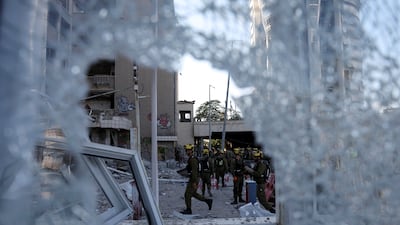
  • Israeli emergency personnel at a building hit by an Iranian missile strike, in Haifa. Reuters
    Israeli emergency personnel at a building hit by an Iranian missile strike, in Haifa. Reuters
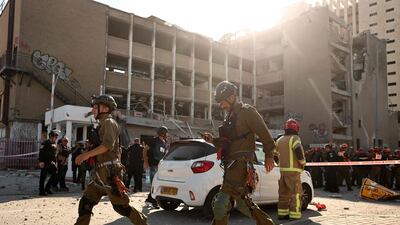
  • Israeli emergency personnel at a building hit by an Iranian missile strike, in Haifa. AFP
    Israeli emergency personnel at a building hit by an Iranian missile strike, in Haifa. AFP
  • A car hit by a missile launched from Iran, in Haifa. AFP
    A car hit by a missile launched from Iran, in Haifa. AFP
  • Israeli emergency personnel at a building hit by an Iranian missile strike, in Haifa. AFP
    Israeli emergency personnel at a building hit by an Iranian missile strike, in Haifa. AFP
  • Israeli emergency personnel at a building hit by an Iranian missile strike, in Haifa. AFP
    Israeli emergency personnel at a building hit by an Iranian missile strike, in Haifa. AFP
  • Israeli emergency personnel at a building hit by an Iranian missile strike, in Haifa. AFP
    Israeli emergency personnel at a building hit by an Iranian missile strike, in Haifa. AFP
  • Israeli emergency personnel at a building hit by an Iranian missile strike, in Haifa. AFP
    Israeli emergency personnel at a building hit by an Iranian missile strike, in Haifa. AFP
  • People gather outside a damaged building in Haifa. Reuters
    People gather outside a damaged building in Haifa. Reuters
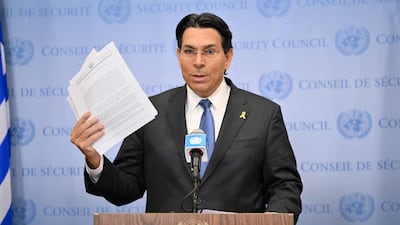
  • Israeli ambassador to the UN in Geneva addresses and emergency session. AFP
    Israeli ambassador to the UN in Geneva addresses and emergency session. AFP
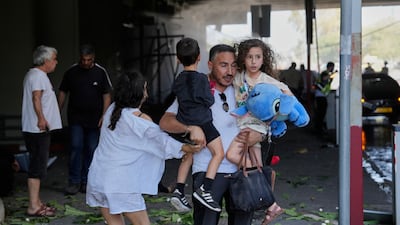
  • Israelis flee an Iranian missile strike in the port city of Haifa. AP Photo
    Israelis flee an Iranian missile strike in the port city of Haifa. AP Photo
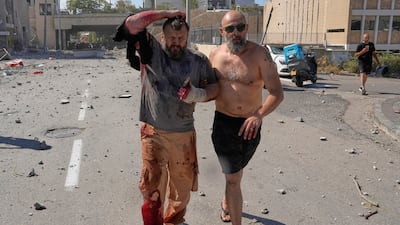
  • An injured man is helped after an Iranian missile strike in Haifa. AP Photo
    An injured man is helped after an Iranian missile strike in Haifa. AP Photo
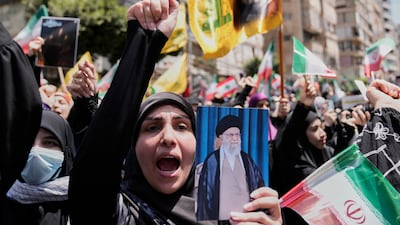
  • A protester holds up a portrait of Iran's supreme leader Ayatollah Ali Khamenei at a demonstration against Israeli attacks on Iran, in Beirut, Lebanon. AP Photo
    A protester holds up a portrait of Iran's supreme leader Ayatollah Ali Khamenei at a demonstration against Israeli attacks on Iran, in Beirut, Lebanon. AP Photo
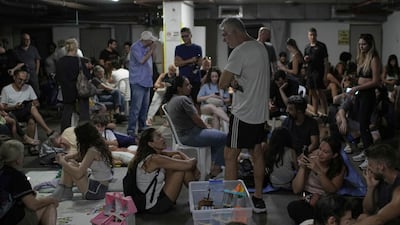
  • People take shelter as air raid sirens warn of incoming Iranian strikes in Tel Aviv. AP Photo
    People take shelter as air raid sirens warn of incoming Iranian strikes in Tel Aviv. AP Photo
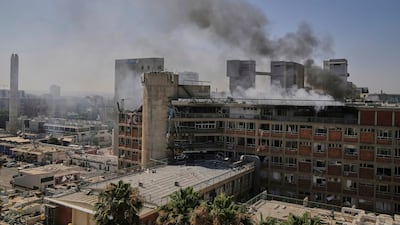
  • Smokes rises from Soroka Medical Centre, in Beersheba, southern Israel, after it was hit by an Iranian missile. AP
    Smokes rises from Soroka Medical Centre, in Beersheba, southern Israel, after it was hit by an Iranian missile. AP
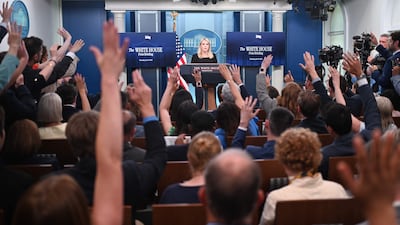
  • White House press secretary Karoline Leavitt takes questions from reporters. She said President Donald Trump would decide whether the US would join Israel’s war on Iran 'in the next two weeks'. AFP
    White House press secretary Karoline Leavitt takes questions from reporters. She said President Donald Trump would decide whether the US would join Israel’s war on Iran 'in the next two weeks'. AFP
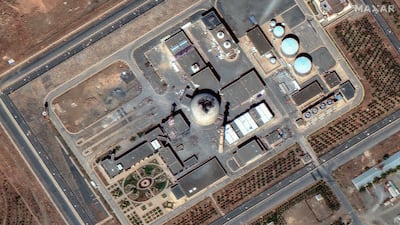
  • Iran's Arak heavy water reactor, in central Iran, after Israeli air strikes. Reuters
    Iran's Arak heavy water reactor, in central Iran, after Israeli air strikes. Reuters
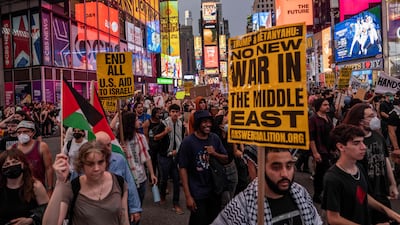
  • People march in Times Square, New York, to call on President Trump not to go to war with Iran. AFP
    People march in Times Square, New York, to call on President Trump not to go to war with Iran. AFP
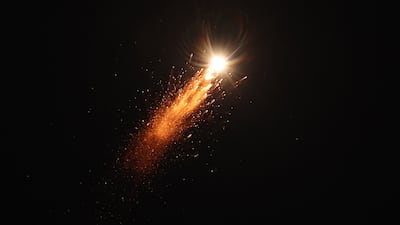
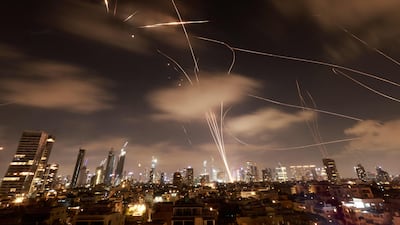
  • Israel's Iron Dome air defence system intercepts missiles fired from Iran over Tel Aviv. EPA
    Israel's Iron Dome air defence system intercepts missiles fired from Iran over Tel Aviv. EPA
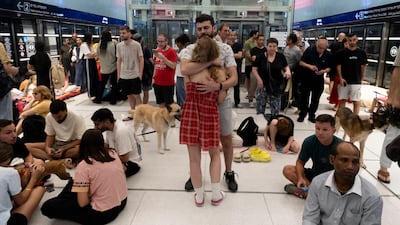
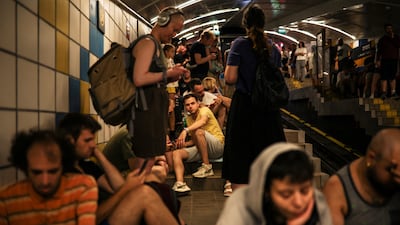
  • Israelis shelter in an underground train station in Ramat Gan after a missile warning. Getty Images
    Israelis shelter in an underground train station in Ramat Gan after a missile warning. Getty Images
  • Israeli special forces check the remains of a suspected Iranian ballistic missile in northern Israel. Reuters
    Israeli special forces check the remains of a suspected Iranian ballistic missile in northern Israel. Reuters
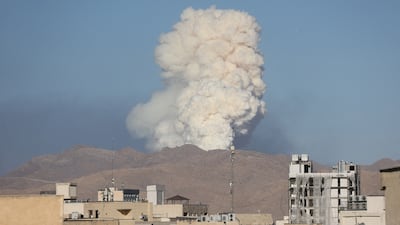
  • Smoke rises after an Israeli attack in the Iranian capital, Tehran. Reuters
    Smoke rises after an Israeli attack in the Iranian capital, Tehran. Reuters
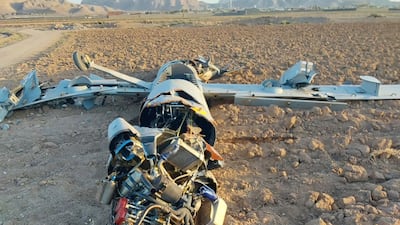
  • A picture released by Iran's armed forces claims to show an Israeli drone shot down outside the central city of Isfahan. AP
    A picture released by Iran's armed forces claims to show an Israeli drone shot down outside the central city of Isfahan. AP
  • People take cover inside a cable car tunnel in Haifa after an Iranian missile attack. Reuters
    People take cover inside a cable car tunnel in Haifa after an Iranian missile attack. Reuters
  • Israeli air defence systems fire at Iranian missiles over Tel Aviv. AFP
    Israeli air defence systems fire at Iranian missiles over Tel Aviv. AFP
  • Missiles are intercepted above Ashkelon, Israel. Reuters
    Missiles are intercepted above Ashkelon, Israel. Reuters
  • Smoke rises in Tehran. Reuters
    Smoke rises in Tehran. Reuters
  • A building burns after strikes on the Israeli city of Herzliya, near Tel Aviv. AFP
    A building burns after strikes on the Israeli city of Herzliya, near Tel Aviv. AFP
  • An Iranian missile causes an explosion in Tel Aviv. AP
    An Iranian missile causes an explosion in Tel Aviv. AP
  • Rescuers sift through the remains of a damaged building in Tel Aviv after a barrage of Iranian rockets. AFP
    Rescuers sift through the remains of a damaged building in Tel Aviv after a barrage of Iranian rockets. AFP
  • A wounded man is treated after an explosion in Tehran. AP
    A wounded man is treated after an explosion in Tehran. AP

This scenario recalls the incremental degradation of the Iraqi state in the 1990s, which ultimately culminated in a full-scale US ground invasion to remove Saddam Hussein. Barring a comparable deployment of US ground forces in Iran, the Islamic Republic’s coercive apparatus may be sufficient to retain control over any potential domestic unrest.

In parallel, Iran may adjust its asymmetric deterrence doctrine by shifting focus from hardened Israeli targets to vulnerable energy and commercial assets in the Arabian Gulf. Regional hydrocarbon infrastructure could be targeted as part of a coercive strategy to compel de-escalation. Tehran may be willing to absorb reciprocal attacks against its own oil infrastructure in exchange for imposing strategic and economic costs on its Arab neighbours and the global energy market in the hope of mobilising international pressure on Israel to stop the war.

Moreover, Mr Netanyahu may have inadvertently resolved a core ideological problem within the Islamic Republic’s anti-Israel narrative. Iran and Israel, historically non-contiguous and without direct territorial disputes, have long had a pragmatic history of co-operation – both under the Pahlavi monarchy and even during the early years of the Islamic Republic, when Israel supplied Iran with US-origin arms during the Iran-Iraq War from 1980 to 1988.

The Islamic Republic’s anti-Zionist posture often rang hollow with ordinary Iranians, who struggled to identify a direct threat from Israel. Now, with Israeli munitions striking Tehran, killing civilians and targeting critical infrastructure, Israel’s role as an adversary has acquired visceral legitimacy among the Iranian populace.

Ultimately, Iran’s decision-making in the coming weeks will be driven by regime survival imperatives in an increasingly precarious operating environment. Mr Netanyahu’s gamble may have thrown Israel, Iran and the entire region in an open-ended conflict beyond Israel’s control.


57%20Seconds
%3Cp%3E%3Cstrong%3EDirector%3A%3C%2Fstrong%3E%20Rusty%20Cundieff%0D%3Cbr%3E%3Cstrong%3EStars%3A%20%3C%2Fstrong%3EJosh%20Hutcherson%2C%20Morgan%20Freeman%2C%20Greg%20Germann%2C%20Lovie%20Simone%0D%3Cbr%3E%3Cstrong%3ERating%3A%20%3C%2Fstrong%3E2%2F5%0D%3Cbr%3E%0D%3Cbr%3E%3C%2Fp%3E%0A
The President's Cake

Director: Hasan Hadi

Starring: Baneen Ahmad Nayyef, Waheed Thabet Khreibat, Sajad Mohamad Qasem 

Rating: 4/5

Dhadak 2

Director: Shazia Iqbal

Starring: Siddhant Chaturvedi, Triptii Dimri 

Rating: 1/5

Name: Peter Dicce

Title: Assistant dean of students and director of athletics

Favourite sport: soccer

Favourite team: Bayern Munich

Favourite player: Franz Beckenbauer

Favourite activity in Abu Dhabi: scuba diving in the Northern Emirates 


UPI facts

More than 2.2 million Indian tourists arrived in UAE in 2023
More than 3.5 million Indians reside in UAE
Indian tourists can make purchases in UAE using rupee accounts in India through QR-code-based UPI real-time payment systems
Indian residents in UAE can use their non-resident NRO and NRE accounts held in Indian banks linked to a UAE mobile number for UPI transactions

THE SPECS

Engine: 3.6-litre V6

Transmission: eight-speed automatic

Power: 285bhp

Torque: 353Nm

Price: TBA

On sale: Q2, 2020

PROFILE OF STARZPLAY

Date started: 2014

Founders: Maaz Sheikh, Danny Bates

Based: Dubai, UAE

Sector: Entertainment/Streaming Video On Demand

Number of employees: 125

Investors/Investment amount: $125 million. Major investors include Starz/Lionsgate, State Street, SEQ and Delta Partners

Turkish Ladies

Various artists, Sony Music Turkey 

In numbers: China in Dubai

The number of Chinese people living in Dubai: An estimated 200,000

Number of Chinese people in International City: Almost 50,000

Daily visitors to Dragon Mart in 2018/19: 120,000

Daily visitors to Dragon Mart in 2010: 20,000

Percentage increase in visitors in eight years: 500 per cent

Zodi%20%26%20Tehu%3A%20Princes%20Of%20The%20Desert
%3Cp%3E%3Cstrong%3EDirector%3A%20%3C%2Fstrong%3EEric%20Barbier%26nbsp%3B%3C%2Fp%3E%0A%3Cp%3E%3Cstrong%3EStarring%3A%20%3C%2Fstrong%3EYoussef%20Hajdi%2C%20Nadia%20Benzakour%2C%20Yasser%20Drief%3C%2Fp%3E%0A%3Cp%3E%3Cstrong%3ERating%3A%3C%2Fstrong%3E%204%2F5%3C%2Fp%3E%0A

Expert input

If you had all the money in the world, what’s the one sneaker you would buy or create?

“There are a few shoes that have ‘grail’ status for me. But the one I have always wanted is the Nike x Patta x Parra Air Max 1 - Cherrywood. To get a pair in my size brand new is would cost me between Dh8,000 and Dh 10,000.” Jack Brett

“If I had all the money, I would approach Nike and ask them to do my own Air Force 1, that’s one of my dreams.” Yaseen Benchouche

“There’s nothing out there yet that I’d pay an insane amount for, but I’d love to create my own shoe with Tinker Hatfield and Jordan.” Joshua Cox

“I think I’d buy a defunct footwear brand; I’d like the challenge of reinterpreting a brand’s history and changing options.” Kris Balerite

 “I’d stir up a creative collaboration with designers Martin Margiela of the mixed patchwork sneakers, and Yohji Yamamoto.” Hussain Moloobhoy

“If I had all the money in the world, I’d live somewhere where I’d never have to wear shoes again.” Raj Malhotra

Brief scores:

Manchester City 3

Aguero 1', 44', 61'

Arsenal ​​​​​1

Koscielny 11'

Man of the match: Sergio Aguero (Manchester City)

RESULT

Chelsea 2

Willian 13'

Ross Barkley 64'

Liverpool 0

Mercer, the investment consulting arm of US services company Marsh & McLennan, expects its wealth division to at least double its assets under management (AUM) in the Middle East as wealth in the region continues to grow despite economic headwinds, a company official said.

Mercer Wealth, which globally has $160 billion in AUM, plans to boost its AUM in the region to $2-$3bn in the next 2-3 years from the present $1bn, said Yasir AbuShaban, a Dubai-based principal with Mercer Wealth.

Within the next two to three years, we are looking at reaching $2 to $3 billion as a conservative estimate and we do see an opportunity to do so,” said Mr AbuShaban.

Mercer does not directly make investments, but allocates clients’ money they have discretion to, to professional asset managers. They also provide advice to clients.

“We have buying power. We can negotiate on their (client’s) behalf with asset managers to provide them lower fees than they otherwise would have to get on their own,” he added.

Mercer Wealth’s clients include sovereign wealth funds, family offices, and insurance companies among others.

From its office in Dubai, Mercer also looks after Africa, India and Turkey, where they also see opportunity for growth.

Wealth creation in Middle East and Africa (MEA) grew 8.5 per cent to $8.1 trillion last year from $7.5tn in 2015, higher than last year’s global average of 6 per cent and the second-highest growth in a region after Asia-Pacific which grew 9.9 per cent, according to consultancy Boston Consulting Group (BCG). In the region, where wealth grew just 1.9 per cent in 2015 compared with 2014, a pickup in oil prices has helped in wealth generation.

BCG is forecasting MEA wealth will rise to $12tn by 2021, growing at an annual average of 8 per cent.

Drivers of wealth generation in the region will be split evenly between new wealth creation and growth of performance of existing assets, according to BCG.

Another general trend in the region is clients’ looking for a comprehensive approach to investing, according to Mr AbuShaban.

“Institutional investors or some of the families are seeing a slowdown in the available capital they have to invest and in that sense they are looking at optimizing the way they manage their portfolios and making sure they are not investing haphazardly and different parts of their investment are working together,” said Mr AbuShaban.

Some clients also have a higher appetite for risk, given the low interest-rate environment that does not provide enough yield for some institutional investors. These clients are keen to invest in illiquid assets, such as private equity and infrastructure.

“What we have seen is a desire for higher returns in what has been a low-return environment specifically in various fixed income or bonds,” he said.

“In this environment, we have seen a de facto increase in the risk that clients are taking in things like illiquid investments, private equity investments, infrastructure and private debt, those kind of investments were higher illiquidity results in incrementally higher returns.”

The Abu Dhabi Investment Authority, one of the largest sovereign wealth funds, said in its 2016 report that has gradually increased its exposure in direct private equity and private credit transactions, mainly in Asian markets and especially in China and India. The authority’s private equity department focused on structured equities owing to “their defensive characteristics.”

THE CLOWN OF GAZA

Director: Abdulrahman Sabbah 

Starring: Alaa Meqdad

Rating: 4/5

Updated: June 18, 2025, 10:18 AM