

The Gaza Humanitarian Foundation began its first deliveries of aid to Gazans on Tuesday. The resignation of its chief executive on Sunday cast a new spotlight on this aid initiative for Palestinians, which was already courting controversy for weeks.
The Geneva-based GHF, apparently initiated by Israel with US backing, relies on security contractors to protect and deliver aid to several hubs inside Gaza even as Israel continues its military operations there. The idea is that “verified” Palestinian recipients of aid can come to these hubs to receive family rations. GHF’s backers say it will ensure reliable food provision without looting or diversion to Hamas. It plans to start with addressing the needs of a million people before expanding coverage to all 2.2 million Gazans.
The plan has been roundly criticised by most of the international aid community, as well as the UN, for circumventing existing humanitarian agencies and putting aid delivery in the hands of a mercenary force. They charge the GHF with a lack of humanitarian experience and potentially encouraging more internal displacement, thereby advancing Israel’s objective to clear and control a large chunk of Gaza. The securitised approach also supposedly contravenes the basic humanitarian principles of humanity, neutrality, impartiality and independence.
Understanding the sudden entry of the GHF into the picture requires some reflection on the impasse that led us here. A broader look at the history of securitised humanitarian work also helps us to examine the GHF in a more sober light.
As things stand, a lasting solution to this conflict – which has roots that reach far beyond its proximate cause on October 7, 2023 – remains elusive, despite several mediation processes. Gazans bear the brunt as the distinction between combatant and civilian is lost, not least because of the tactics deployed in a highly congested urban theatre. That includes Hamas waging armed resistance from within civilian concentrations, while Israel tries to dislodge them through overwhelming force that causes immense collateral damage. In such “whole of society” conflicts, civilian protection and humanitarian provision become tools of war, despite the prohibitions of international humanitarian law under the Geneva Conventions.
Israel justifies having placed severe impediments on aid delivery throughout the war, including repeated blockades of Gaza, as a permissible security imperative. It claims that Hamas diverts humanitarian aid for war-sustaining purposes. Meanwhile, limited access by impartial external observers and media mean that the extent of suffering is hotly disputed as part of a parallel information war that has deeply polarised the world.
Nevertheless, the consequential suffering is undoubtedly immense. More precise statistics would be useful for advocacy purposes but are unnecessary to design practical assistance strategies. We already know the needs are overwhelming on every front.
But established humanitarian agencies of the UN and Red Cross Red Crescent systems as well as major NGOs are struggling with access. A key reason is the breakdown of relations with Israel.
UN leaders have taken a strong stance in attributing Gazan suffering to Israeli policies. While that is factually correct, Israel construes that as incompatible with UN obligations to remain neutral and impartial through discharging its aid obligations in silence. But as the UN has been heavily criticised in other crises for not standing up for the values and norms it champions, it has become more outspoken in Gaza on the wrongs it perceives.
That enrages and triggers retaliation from Israel. Accordingly, it has banned UNRWA, the largest aid body servicing Palestinians, alleging that some of its staff are Hamas militants or sympathisers. That was proved correct by the UN’s own investigations but whether this implicates a small number of workers or is a widescale problem is disputed. It is even more controversial against the backdrop of another contested narrative that Hamas built its offensive capabilities by profiting from diverted UNRWA resources over many decades.
In any case, Gaza aid agencies, including the volunteer-driven Palestinian Red Crescent, are mostly staffed by locals, and it is inhuman to expect them to remain stonily neutral while experiencing the humiliation and destruction heaped daily on their families and communities.
If Israel mistrusts and obstructs established humanitarian agencies, how do we mitigate the intense suffering in Gaza? Pressure from governments without concrete action to curb Israel has achieved little more than brief fighting pauses and trickles of aid.
Criticisms of the GHF are all understandable. But that does not mean that any alternative approach has presented itself, and in the meantime Gazans’ urgent need for supplies is beyond question.
It is also important to say that humanitarians already have a long record of working alongside military actors after countless disasters, for example, earthquakes, floods and cyclones, or during civil strife. The UN Office for the Co-ordination of Humanitarian Affairs has a Military and Civil Defence Unit, and several militaries have dedicated civilian and humanitarian affairs battalions. Most countries give roles to their militaries in national emergency management plans following humanitarian principles. Indeed, it is a statutory requirement of national Red Cross and Red Crescent societies to assist their authorities.
-
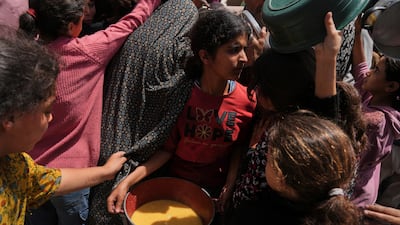
Palestinians struggle to get donated food at a community kitchen in Jabalia, northern Gaza Strip. AP -
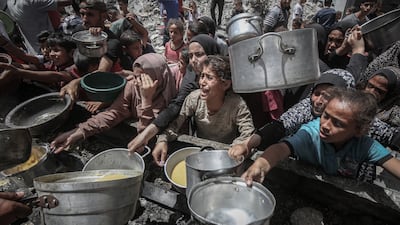
Displaced Palestinians reach out with pans to collect cooked food from a community food kitchen in Jabalia. Bloomberg -
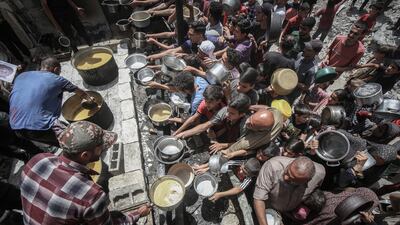
International pressure has mounted on Israel to restart aid. Bloomberg -
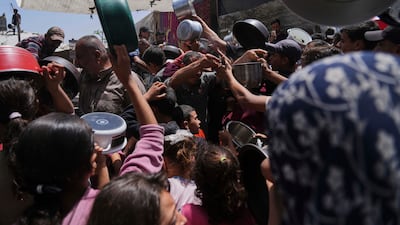
Supplies of donated food are running short. AP -
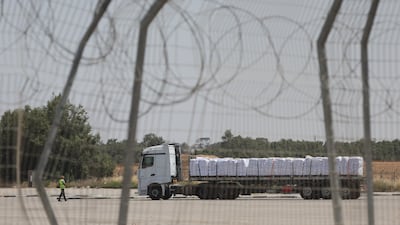
An aid truck at the Kerem Shalom crossing after the Israeli cabinet approved the entry of nine aid trucks into Gaza. EPA -
Aid loaded on one of three World Food Programme aid trucks crossing into Gaza at Kerem Shalom. EPA -
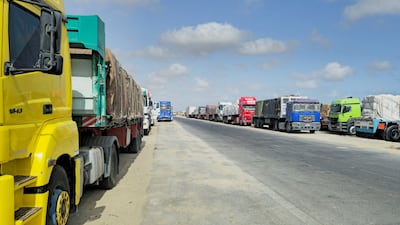
Trucks loaded with aid continue to wait in the Egyptian city of Al Arish, 45 kilometres west of the Gaza border. Reuters -
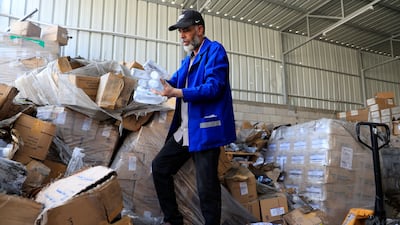
A Palestinian staff member inspects the medicine warehouse in Nasser Hospital after an Israeli strike in Khan Younis. Reuters


Wars create additional complexity, but humanitarians have worked routinely with militaries as, for example, with Nato in “hearts and minds” campaigns in Kosovo and Afghanistan or with UN peacekeepers delivering lifesaving assistance in South Sudan, Darfur, Congo, Mozambique, Sierra Leone, Somalia and numerous other “multi-mandated” UN and African Union missions. Co-operation with occupying military forces is common, as, for example, earlier in Iraq and East Timor and now, in Russian-controlled areas of Ukraine.
More generally, humanitarians routinely liaise with armed actors to negotiate access, protection and preventing fatal misunderstandings. The GHF approach is not dissimilar to what happens elsewhere. And, if heavily criticised Israel is belatedly willing to discharge its obligations as occupying power through this route, the greater interest of Gazans lies in allowing this to happen.
The critique around humanitarian principles should reflect contemporary realities. Take, for example, “independence”. All agencies operate with the consent of national or other controlling authorities, and nearly all rely on funding by donors whose conditions require adherence. There is no absolute humanitarian independence.
The “neutral” and “impartiality” principles require aid delivery strictly according to need without discriminating against anybody. These principles are practically tested less by whether or not access to an area is granted and more by whether the controlling authority selects or excludes individual beneficiaries. In Gaza, everyone is needy and if the GHF is told who to help or not by the Israeli military, these principles will be violated.
But, even in that case, if assistance reaches some desperate people, it is unethical to stop that happening because others are denied. The moral duty then is to help whoever can be reached while continuing to advocate for others.
Of course, there is the risk of co-option into the Israeli policy of forced displacement. However, practical humanitarianism is not about ideals. It is about selecting the least bad of available options at a time of existentialist threat to Gazans some of whom have already starved to death while most others are extremely hungry. That necessitates no effort spared and no possibility left un-explored to save them, as required by the fundamental principle of “humanity”.
People struggling for their survival should not become the theatre for endless debate on the intricacies of humanitarian principles, important as they are. The GHF approach raises legitimate concerns but the initiative deserves a chance while carefully and critically monitoring its progression.

