

Hayat Tahrir Al Sham’s march to power in Syria late last year took everyone, including the militant group itself, by surprise. However, now that it finds itself as the governing authority, the group is faced with the daunting task of ensuring that the country has the stability required to move forward.
Over a couple of weeks from late December to early January, I travelled to Syria to meet civil society leaders, analysts, NGO leaders, researchers and ordinary citizens. The aim was to walk away with a better lay of the land regarding several themes, including the challenges in consolidating stability and security in a country that has just emerged from a nearly-14-year civil war. The conflict has torn at the nation’s social fabric, leaving it in some of the most dire economic conditions imaginable.
The thoughts of those I met are instructive to understand the key threats facing stability in Syria as it moves into the post-Assad and post-Baath era (this not even counting the conflict between the Syrian Democratic Forces and the Turkish-backed Syrian National Army [SNA] in the north and north-east).
The first of the two main risks is that of different armed factions of the SNA, and some armed factions from the south, resisting HTS demands placed upon them to disarm and integrate into the new Syrian armed forces.
Many of these factions appear to desire stability, yet some don’t accept HTS as the state. They consider it to be just another faction, and indeed one in which about 25 per cent of its fighters are foreigners. Accordingly, they are unlikely to hand over their weapons and integrate into a future national army without retaining the power to act as independent units within that army. In a similar vein, Druze fighters are refusing to hand over their weapons because they argue that no state currently exists, and therefore no source of protection exists for them.
-
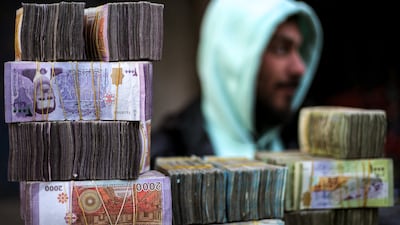
Stacks of Syrian banknotes are piled on a currency trader's stall at a market in Manbij, in Syria's northern Aleppo province. All photos: AFP -
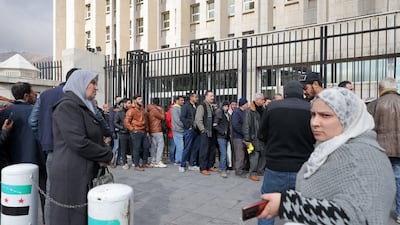
People queue outside the main headquarters of the country's central bank in Damascus as they wait to exchange US dollars at prices lower than the black market. -
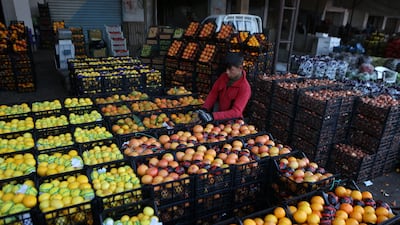
A Syrian fruit seller in the north-west Idlib province. -
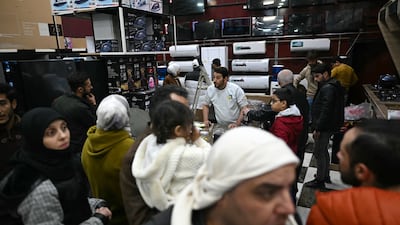
A busy shop in Al Dana, in Idlib province. The Syrian pound has been disappeared from the markets since the fall of the Assad regime. -
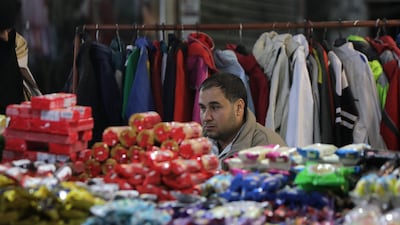
A market stall in Aleppo province in 2021, 10 years after the uprising against former president Bashar Al Assad began. -
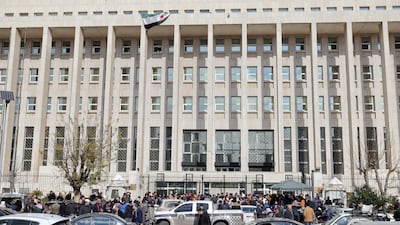
People queue outside the main headquarters of the central bank in Damascus. Mr Al Assad's government fell in December. -

Since the downfall of the Assad regime, general prices of goods have come down by up to 30 per cent in large urban centres including Damascus. -

Petrol is sold by the side of a road in Damascus. -
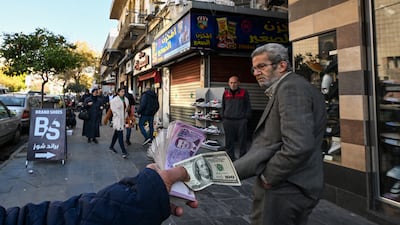
Use of the US dollar is starting to increase in Syria, as confidence in the national currency remains low. -
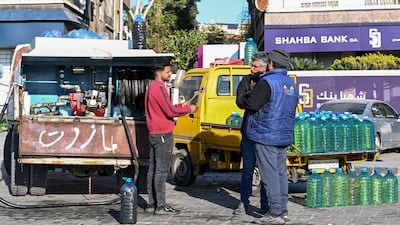
A man sells petrol in Damascus. The HTS-led government aims to show it can fuel an economic recovery in Syria. -
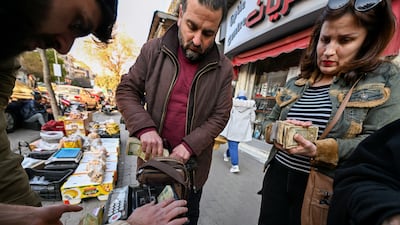
A currency trader exchanges Syrian pounds for customers in Damascus. The value of the currency has fluctuated in recent weeks.


The trajectory of this impasse will largely come down to two factors. First is the manner in which the new Syrian security apparatus is formed in the coming months. Second is the speed and extent to which reconstruction funding enters the country.
Regarding the first dynamic, HTS, despite continuing to assert that the new security apparatus will be centralised, has in practice seemingly begun to allow a level of decentralisation to occur. Over the course of January, a notable number of SNA factions from Aleppo were integrated into the new Ministry of Defence in what appeared to be their pre-existing form, as opposed to having to dissolve. There were also reports of a similar process being under way with some of the southern armed groups in Deraa, although this was then denied by HTS officials. If this opportunity were to be extended to the Druze and remaining SNA factions, this could solve some of the impasse.
As for the second dynamic, SNA factions will need funds that are expected to come in for reconstruction, for them to sustain their authority in the areas they continue to control. Given that HTS will almost inevitably be the gatekeeper of this funding process, any financing that comes in will give Damascus leverage over the remaining SNA factions in trying to integrate them into the armed forces.
This future equation presents a more compelling set of incentives for the factions in question to what currently exists.
The second of the two main risks pertains to tensions between the Alawites – the sect to which Mr Al Assad’s family belongs and which constituted the majority of the former regime – and HTS as well as the rest of society.
Many Alawites now feel threatened, disenfranchised and humiliated due to the sharp decline in their fortunes since the fall of the Assad government and the absence of a leader or armed group representing their interests. Some of them are said to be keeping lines of communication with Iran open, with a view to restore Tehran’s greatly reduced influence in Syria. In a similar vein, numerous Syrian mafias remain tightly connected to Hezbollah.
Revenge killings against Alawites are a further destabilising factor. Until there is a transitional justice or reconciliation pathway presented to provide an alternative method for Syrians’ grievances to be pursued vis-a-vis the Assad loyalists, these revenge killings will be hard to eradicate.
Aside from being too small to lead this transitional justice process, the HTS-led administration lacks the legitimacy and mandate to do so because it wasn’t elected. Interim President Ahmad Al Shara has pledged to form a technocratic government that represents Syria's diverse communities. Such an administration will then need to work with the spectrum of civil society to establish a legitimate process.
The ability to tackle the two aforementioned challenges will lie in the nature of the transitional government. If it is truly representative and inclusive, and is formed in consultation with a national dialogue mechanism – such as the prospective National Dialogue Conference that Mr Al Shara has set in motion – this will expedite the process to reach a point where the necessary foundations of a legitimate, inclusive state are met to assuage the above mentioned concerns of the many militias.
It will also speed up the process of reaching a stage where foreign entities feel satisfied enough to start allocating reconstruction funding, thus mollifying the various armed factions. Furthermore, it will mean creating the foundations needed to start pursuing a viable reconciliation process, thus beginning to mend the fissures in society that have become so destabilising.
For relevant regional and international states desirous of Syrian stability, influencing HTS to enable such a representative and inclusive transitional government is, therefore, critical.

