


To describe the foreign policy of US President Donald Trump, Chinese Foreign Minister Wang Yi resorted to allegory.
Speaking in Munich last week, the veteran diplomat reflected on the upheaval in transatlantic relations that Washington has triggered. “No matter which way the wind blows – north, south, east, or west – we will remain calm and unshakable,” he said.
It would be a misinterpretation of the Chinese position to read this as Beijing taking a sanguine and non-involved role as the Trump revolution in international affairs takes shape.
For some thoughts on this, I turned to the leading Chinese think tank analyst Wang Huiyao, who was also in Munich. What was palpable was the view from Beijing is that a new world is emerging, one that could very quickly establish a G2 power dynamic. G2 is shorthand for “group of two” and would amount to a displacement of the western bloc's G7.
For completeness, I should say the wider G20 of nations would probably stick around as a platform to augment the G2, should this ever formalise.
Back to Dr Wang. When we spoke in Munich, he saw two essential elements of Mr Trump’s impact on the world. One was that the US President’s controversial demands of Europe, including a takeover of Denmark’s Greenland and talks with Russia on Ukraine, were a consolidation of American control over the Western Hemisphere.
The second concerned the tariff wars that are emerging from the White House. Here, Dr Wang's view was that China will need to deal better with an American President bent on bargaining as part of his efforts to build a new economic order.
The Chinese are encouraged that the second Trump administration seems better-grounded on economic matters than the first one, particularly as it has close ties with leading business figures that are deeply involved in China’s economy.
With this process of rebalancing coming to the fore in dramatic fashion, there is a strong impression that Beijing is open to the changes emanating from Washington. For now, it appears that China does not see Mr Trump to be creating a hostile dynamic between the two superpowers.
This outlook could not be more different from the thinking prevalent across Europe. US Vice President JD Vance gave a landmark speech that represented a challenge to the continent not seen since Russian President Vladimir Putin pivoted Moscow away from the West in his 2007 keynote address at the same forum.
By opening direct talks with Mr Putin on Ukraine, Mr Trump had Europeans asking if the US security umbrella that was established after the Second World War had been withdrawn. Mr Vance delivered what amounted to a one-two punch.
By laying into how European political systems deal with the rise of extremist parties and voices, Mr Vance demonstrated that the current US leadership can become destabilising for politics on the continent. That unsettling fear has triggered French President Emmanuel Macron into calling a meeting of other leaders in Paris to try to thrash out a united response to Washington's Ukraine policy.
From a Chinese perspective, this larger Trump agenda creates opportunities.
When Foreign Minister Wang was asked about curtailing China’s reliance on Russian oil and gas, he brushed it off saying that no other country was ready to supply Beijing’s needs.
China’s interest in the peace talks over Ukraine may be limited, but it will have important reasons to stay engaged. Dr Wang also saw a bigger role for Beijing in the Middle East as a result of the ceasefire talks over Gaza. For one thing, the Asian superpower can deepen its historic role as a supporter of Arab and Palestinian positions.
-
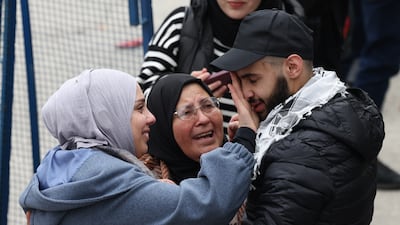
A Palestinian released from Israeli detention is welcomed on arrival in Ramallah, in the occupied West Bank. EPA -
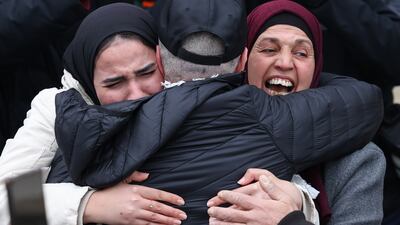
A Palestinian embraces loved ones in Ramallah after being released from an Israeli jail. EPA -
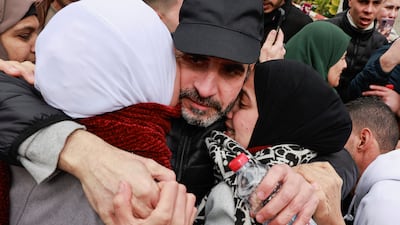
Families reunite as dozens of Palestinians arrive in Ramallah, after being released from Israeli prisons. Reuters -

Palestinian prisoners are greeted by their loved ones. AP Photo -
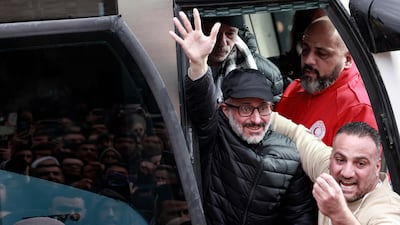
A former Palestinian prisoner released by Israel waves to a cheering crowd. AFP -
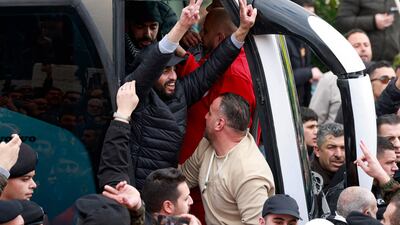
A former Palestinian prisoner released by Israel flashes the victory sign. AFP -
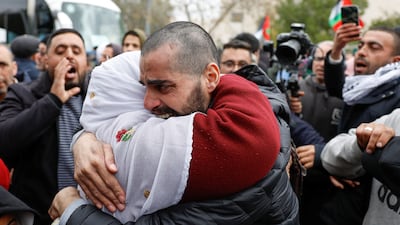
A freed Palestinian prisoner is greeted by a loved one. Reuters -

Left to right, Ohad Ben Ami, Or Levy and Eli Sharabi are the latest hostages to be released. AFP -

Mr Ami was held in Gaza since the deadly October 7, 2023 attack. Reuters -

Mr Sharabi is released by Hamas militants. Reuters -

Michal Cohen, front left, the mother of Ohad Ben Ami, joins other relatives to celebrate Ohad's release from captivity. Getty Images -

Families and supporters celebrate the release of Ohad Ben Ami and Eli Sharabi, who were taken from Kibbutz Be'eri and held in Gaza since the October 7, 2023 attack. Reuters -

Relatives of Israeli hostage Eli Sharabi watch on television preparations for his release. AFP -
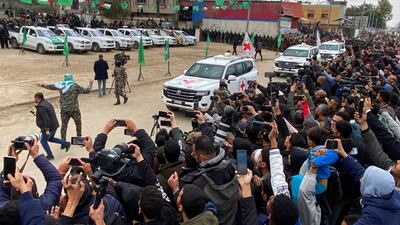
The Red Cross team arrives ahead of the release of hostages. Reuters -
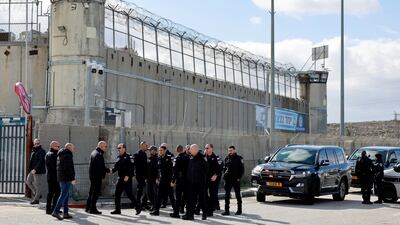
Members of Israeli forces gather outside the Israeli military prison, Ofer. Reuters -

In Tel Aviv, people wait to watch a livestream on a big screen reporting on the release of Israeli hostages Eli Sharabi, Or Levy and Ohad Ben Ami, to be transferred from Hamas to the Red Cross. EPA -
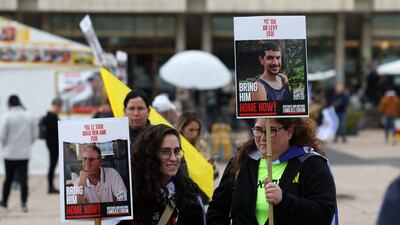
Supporters in Tel Aviv hold posters bearing a pictures of Ohad Ben Ami, left, and Or Levy, two of three Israeli hostages to be released by Hamas. AFP -
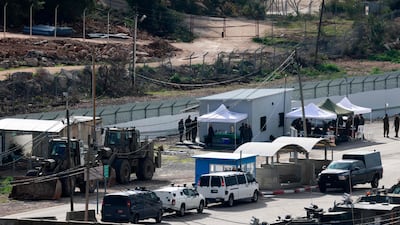
Israeli troops and vehicles inside Ofer military prison, between Ramallah and Beituniya in the occupied West Bank, awaiting the release of Palestinian detainees as part of an exchange on February 8. AFP


Reconstruction requirements across the region will create openings for Chinese infrastructure expertise, as it could in time in Ukraine, should Beijing maintain a presence in that process.
There is another version of the power relationships to consider at this juncture. That is a world comparable to the Three Kingdoms period in China two millennia ago. This is a period when the dissolution of the Han dynasty led to the emergence of three blocs that fought one another several times. It was an era of feudal lords carving out spheres of influence and jockeying for supremacy.
As the Europeans regrouped in Paris on Monday, the Chinese could have hoped that the situation benefits it as well. With friction dominating the transatlantic relationship, how likely is Europe to align with the US on trade barriers to China? The American push to contain Chinese technology, particularly its electric vehicles, relies on Europe supplementing Washington with tough barriers of its own.
Insiders who detect the march towards a G2 world see Mr Trump’s approach as moving the US off a collision course with its rising power rival, China. In doing so, he has dramatically upended nearly 80 years of US-European cohesion.
For the Chinese, this works on many levels. It potentially elevates Beijing's place globally but also gives it more say on high-priority issues such as the conflicts in Ukraine and the Middle East. For now, Europe may be unsettled but as in the Three Kingdoms era, it is the third leg in the equation.
What is certain is that the Washington-Beijing dynamic has entered a new phase, just as surely as the now-ragged transatlantic partnership.

