


In the days leading up to Iran’s missile attacks against Israel on Tuesday, the country’s political class was polarised along predictable lines.
Centrists and reformists urged caution and pleaded with the government to not fall into Israeli Prime Minister Benjamin Netanyahu’s trap by getting drawn into a war with his government. Hardliners, on the other hand, attacked the reformist President Masoud Pezeshkian over Tehran’s lack of response to Israel’s war against Hezbollah in Lebanon.
Such arguments are meaningless because decisions on the most important matters, particularly over foreign policy, are not made by the president but by the supreme leader, Ayatollah Ali Khamenei, and the national security council. But politics is often not conducted in good faith, and this didn’t stop the hardliners from focusing their attacks on Dr Pezeshkian.
They were particularly incensed when the President and some of his cabinet colleagues said that Iran had delayed its response to Israel’s killing of Hamas leader Ismail Haniyeh, in Tehran in July, to give the US-mediated Gaza ceasefire talks a chance to succeed. Amir-Hossein Sabeti, a former TV presenter-turned-MP, asked how Dr Pezeshkian could trust an adversary like America. In his posts on X, Mr Sabeti used a hashtag that succinctly showed his position: “If we don’t hit, they will.”
Other legislators joined him in calling for a swift attack on Israel. Sharyan, a coalition of hardline MPs, issued a statement, criticising “the hurtful delay” in responding to Israel and said that “too much silence by some officials” had helped “weaken the international resistance front in Lebanon and Palestine”. One academic, meanwhile, called for all airliners heading to Israel to be targeted.

However, the discourse changed almost as soon as Tehran launched its missile attacks on Israel on Tuesday night, with almost the entire political class rallying around the flag.
This included reformists such as Mahmud Sadeghi, a former MP who has previously been prosecuted for his critiques of the government, who tweeted a picture of the Iranian flag and used a verse from the Quran – “… if someone has attacked you, attack him just as he attacked you … ” – to demonstrate his backing. This is a departure from Mr Sadeghi’s previous stance, when just a few days ago, he had said that he understood those who wanted Iran to show a decisive response to Israel as well as those “who urge caution and restraint”.
Mohammad Taghi Karoubi, the son of a leader from the country’s dissident movements who has been under house arrest since 2011, also defended the attacks, when he said: “Iran using its right of legitimate defence.” Hessameddin Ashena, who once advised former president Hassan Rouhani, made a series of posts on X expressing triumph, including one in English: “New Regional Order.” Again, this comes as a surprise because just days ago, Mr Ashena had attacked the hardliners for their criticism of those who urged caution.
The mood inside Parliament on Wednesday morning was one of jubilation, with Speaker Mohammad Baqer Qalibaf promising an even harsher retaliation were Israel to respond to the attacks. MPs chanted slogans such as “Death to America” and “Death to Israel”.
And yet none of this suggests that Iran’s political class, or the citizenry that it claims to represent, is still united on the issue of war and peace.
-

Israel's missile-defence systems intercept rockets above the city of Ashkelon. Reuters -
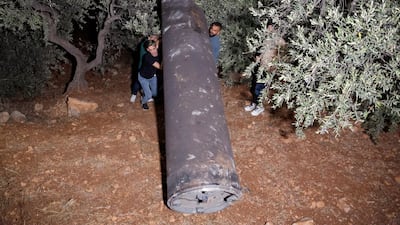
Palestinians investigate a missile shell in Tubas, in the West Bank. Reuters -
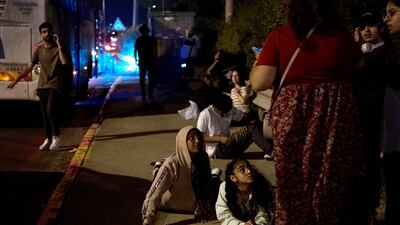
Israelis wait to reboard their bus after missiles launched from Iran were intercepted in the skies over Rosh Haayin. AP -

A resident shows the Tzofar incoming rocket alert app on their phone in Tel Aviv. Getty Images -
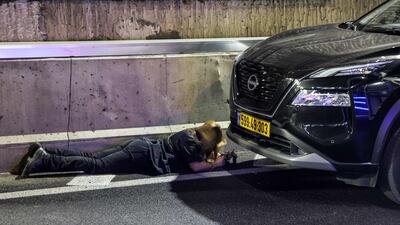
A man takes cover behind a car in Tel Aviv. AFP -
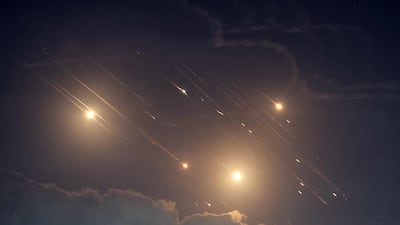
Missiles are intercepted near the city of Baqa Al Gharbiya in northern Israel. AFP -
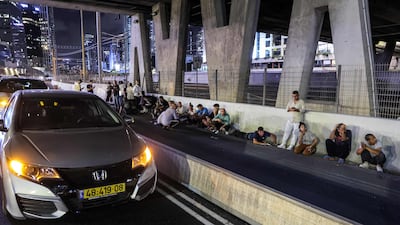
People take cover under a bridge in Tel Aviv. AFP -

People take shelter during the air raid alert in central Israel. Reuters -

Missiles are intercepted over Tel Aviv. AFP -
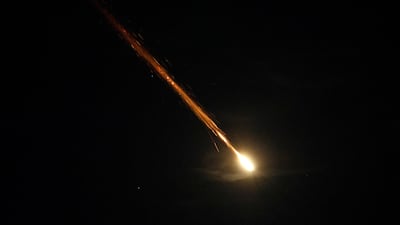
A rocket flies in the sky above Ashkelon. Reuters -
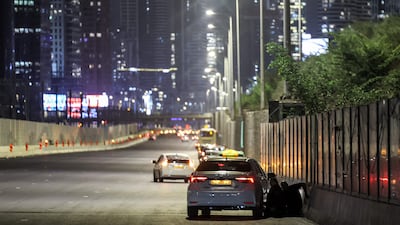
People take cover behind a car in Tel Aviv. AFP -

Missiles are intercepted above Tel Aviv. AFP


Already on Wednesday morning, some newspapers were urging caution about getting into a broader war. The centrist Arman newspaper published an article headlined, “Extremists are using the Lebanon War”, in which it accused the hardliners of “urging a direct war with the Israeli regime without having in mind a rational policy and the current conditions of the country”.
There are also those who have yet to publicly comment on the attacks, such as Heshmatollah Falahatpisheh, a former chair of Iran’s parliamentary foreign policy committee. Last week, he used the hashtag “no to war”, strongly asserting that “no war will benefit the Iranian nation”.
On a societal level, there is an anti-war chorus that is growing across the country. As Iranian missiles rained on Israel on Tuesday, many took to social media to warn about conflict. Some also shared their memories of the devastating Iran-Iraq War of the 1980s.
“For me, war reminds me of my father being in a mental hospital for twenty years, us meeting him on Wednesday, people’s look of pity and my mother’s quiet tears,” a student in Tehran wrote. “As a victim of war from Abadan, let me tell you: never be happy for any war, anywhere in the world,” the journalist Mandana Sadeghi wrote.
With mutual escalations between Israel and Iran expected to continue over the coming days, the anti-war voice is expected to get only stronger – as are the clashes inside the political class about the way ahead for the country.

