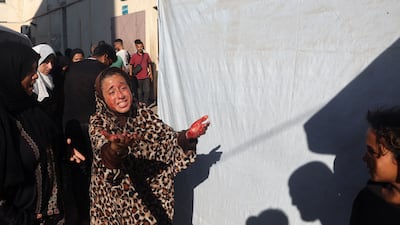
Destruction in Deir El Balah in the central Gaza Strip this month. AFP


Despite a possible Doha deal for Gaza, an all-out regional war can't be ruled out


  • English
  • Arabic

August 18, 2024

Whether the ongoing Doha talks to end the war in Gaza succeed or fail, the spectre of military strikes between Israel, Iran and their proxies remains a possibility. This is because turning verbal agreements into written commitments is neither an easy nor a swift process.

Side agreements may already account for the need for controlled retaliatory military operations while de-escalation guarantees are being formulated and documented. These skirmishes may take a new form, but they won’t necessarily escalate into a full-scale war if the negotiations in Doha succeed.

However, if those talks collapse – which may or may not happen by the time of publication – the threat of war will increase.

Yet even then, the conflict will probably neither be prolonged nor extensive, no matter how severe the retaliatory strikes are. Instead, this may serve as a prelude to major deals after the destruction, with Lebanon, in particular, standing on the brink.

So what compromises could emerge in Doha? And what will the military landscape look like if the ceasefire negotiations on Gaza fail?

The US Department of Defence is bolstering its military footprint in the Middle East. Its message to all stakeholders is clear: America will not flee from a war in the region. Instead, it will intervene alongside Israel if Iran initiates an all-out conflict, or if matters spiral out of control due to a decision or miscalculation by Hezbollah in Lebanon, the Houthis in Yemen, or any of the Iran-backed factions in Iraq.

The Iraqi government has clearly understood this message and, through Foreign Minister Fuad Hussein, postponed the announcement of an end to the US-led international coalition’s mission in the country due to recent regional developments. During a joint news conference in Ankara with his Turkish counterpart, Hakan Fidan, Mr Hussein said Baghdad opposes any wars in the region.

Biden is pushing the region’s stakeholders towards tactical agreements rather than longstanding political solutions

Essentially, Iraq has joined Egypt and Jordan in adopting a neutral stance on the war in Gaza, limiting its support to Palestinian civilians and advocating for a ceasefire in the enclave. Only Lebanon has acquiesced to Hezbollah and Iran’s appropriation of its sovereign decision-making, linking its fate to the Gaza war.

In other words, the support front for Hamas in Gaza isn’t led by Israel’s neighbouring states but by the Tehran-led “resistance axis”.

The US administration under President Joe Biden says it is doing everything possible to reach a ceasefire in Gaza and secure guarantees for all the stakeholders. It does not want to entangle Washington in a war against Iran and its proxies, a situation Israeli Prime Minister Benjamin Netanyahu and public sentiment inside Israel might be inclined to push it towards.

Despite the Biden administration’s frustrations with the Netanyahu government, US military aid to Israel continues – which, rather than ceasing, is only likely to increase. Washington expects the Middle East’s leaders to understand its strategic alliance with Israel and what it requires.

But the Biden team has adopted short-term pragmatism by pushing the region’s stakeholders towards tactical agreements regarding Gaza, such as an exchange of captives and prisoners, rather than towards longstanding political solutions, including the creation of a Palestinian state and a comprehensive settlement.

It also understands Iran’s central role in Hamas’s decision-making because the latter controls the support front and the potential expansion of the war. Therefore, it is engaging in negotiations with Tehran through third parties, using the following premise: facilitate the Doha negotiations, and we will open a new chapter in US-Iran relations.

The Biden team also recognises the need to save face for Iran, Hezbollah and Israel by allowing for agreed-upon military strikes that are limited and symbolic.

The real danger lies in Israel continuing to target senior figures in Hezbollah or Hamas, which could escalate the shadow war and disrupt the rules of engagement that govern military operations. If either Israel or Hezbollah breaks these rules, a serious war could bring devastation to Lebanon. For the US won’t restrain Israel if Hezbollah decides not to follow the rules of engagement.

  • An injured father comforts his daughter. AFP
    An injured father comforts his daughter. AFP
  • The school playground, in a screengrab from video. AP
    The school playground, in a screengrab from video. AP
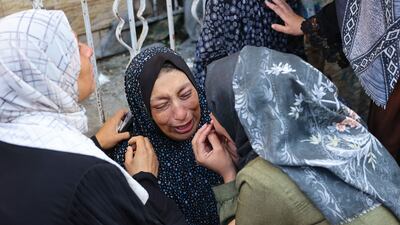
  • A woman identifies a family member among the dead. AFP
    A woman identifies a family member among the dead. AFP
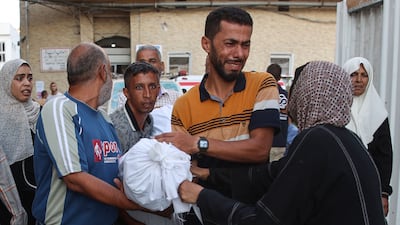
  • People at a Gaza city hospital carry the body of a family member killed in a strike on a school housing displaced Palestinians. AFP
    People at a Gaza city hospital carry the body of a family member killed in a strike on a school housing displaced Palestinians. AFP
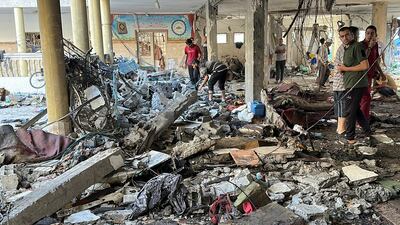
  • The destroyed school. Reuters
    The destroyed school. Reuters
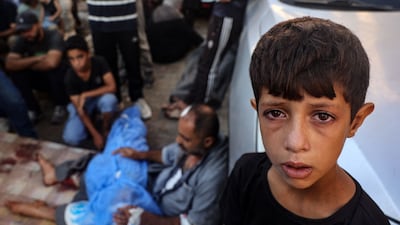
  • A child at Al Aqsa Martyrs hospital in Deir Al Balah on August 10, in front of a man cradling the body one a family member, killed in an Israeli strike on their home in Nuseirat, Gaza. AFP
    A child at Al Aqsa Martyrs hospital in Deir Al Balah on August 10, in front of a man cradling the body one a family member, killed in an Israeli strike on their home in Nuseirat, Gaza. AFP
  • An injured girl at Al Aqsa Martyrs hospital. AFP
    An injured girl at Al Aqsa Martyrs hospital. AFP

Meanwhile, secret talks with Tehran, also involving key Arab powers, aim to achieve the major deal that the Biden administration has sought for months.

Such a deal would leave a significant mark on Mr Biden’s legacy and give Vice President Kamala Harris’s presidential campaign against Donald Trump a lift. Even if Washington only contains rather than resolves the Gaza war, this would be considered a half-success that ultimately benefits the governing Democratic Party.

There has been a measure of pragmatism in the Doha talks. For example, Yahya Sinwar’s leadership of Hamas hasn’t deterred Washington from proceeding with the negotiations. Instead, it views Mr Sinwar’s power and decision-making as centralised – and, therefore, currently useful.

The containment principle adopted by the Biden administration may be necessary as a pragmatic step towards achieving a ceasefire, prisoner exchange and a technical, non-political agreement to extinguish the fire and halt the attrition. If the Netanyahu government secures the release of Israeli hostages, it could help the Prime Minister in a future election in Israel and possibly insulate him from trials in his own country. However, it also means that he will have to eat his words and accept Mr Sinwar’s leadership in Gaza.

Meanwhile, the Biden team is working on a deal that could lead Saudi Arabia to normalise relations with Israel. The problem is that the US lacks the clear strategy needed to force Israel to accept a two-state solution. And even if it is achieved, the grand deal will not succeed as long as the US is prepared to appease Iran by legitimising its proxies at the expense of sovereignty in Lebanon, Iraq, Yemen and Syria.

During Barack Obama’s presidency, Arab countries were excluded from American negotiations with Tehran under the pretext that these talks were strictly aimed at tackling the latter’s nuclear weapons programme. In reality, Iran imposed political conditions, chief among them being to preserve its regional role through its proxies and affiliated militias.

This time, however, the Arab powers have little interest in agreeing to secret US-Iran deals if they ultimately serve to undermine sovereignty in the Arab world.


Important questions to consider

1. Where on the plane does my pet travel?

There are different types of travel available for pets:

  • Manifest cargo
  • Excess luggage in the hold
  • Excess luggage in the cabin

Each option is safe. The feasibility of each option is based on the size and breed of your pet, the airline they are traveling on and country they are travelling to.


2. What is the difference between my pet traveling as manifest cargo or as excess luggage?

If traveling as manifest cargo, your pet is traveling in the front hold of the plane and can travel with or without you being on the same plane. The cost of your pets travel is based on volumetric weight, in other words, the size of their travel crate.

If traveling as excess luggage, your pet will be in the rear hold of the plane and must be traveling under the ticket of a human passenger. The cost of your pets travel is based on the actual (combined) weight of your pet in their crate.


3. What happens when my pet arrives in the country they are traveling to?

As soon as the flight arrives, your pet will be taken from the plane straight to the airport terminal.

If your pet is traveling as excess luggage, they will taken to the oversized luggage area in the arrival hall. Once you clear passport control, you will be able to collect them at the same time as your normal luggage. As you exit the airport via the ‘something to declare’ customs channel you will be asked to present your pets travel paperwork to the customs official and / or the vet on duty. 

If your pet is traveling as manifest cargo, they will be taken to the Animal Reception Centre. There, their documentation will be reviewed by the staff of the ARC to ensure all is in order. At the same time, relevant customs formalities will be completed by staff based at the arriving airport. 


4. How long does the travel paperwork and other travel preparations take?

This depends entirely on the location that your pet is traveling to. Your pet relocation compnay will provide you with an accurate timeline of how long the relevant preparations will take and at what point in the process the various steps must be taken.

In some cases they can get your pet ‘travel ready’ in a few days. In others it can be up to six months or more.


5. What vaccinations does my pet need to travel?

Regardless of where your pet is traveling, they will need certain vaccinations. The exact vaccinations they need are entirely dependent on the location they are traveling to. The one vaccination that is mandatory for every country your pet may travel to is a rabies vaccination.

Other vaccinations may also be necessary. These will be advised to you as relevant. In every situation, it is essential to keep your vaccinations current and to not miss a due date, even by one day. To do so could severely hinder your pets travel plans.

Source: Pawsome Pets UAE

The bio

Date of Birth: April 25, 1993
Place of Birth: Dubai, UAE
Marital Status: Single
School: Al Sufouh in Jumeirah, Dubai
University: Emirates Airline National Cadet Programme and Hamdan University
Job Title: Pilot, First Officer
Number of hours flying in a Boeing 777: 1,200
Number of flights: Approximately 300
Hobbies: Exercising
Nicest destination: Milan, New Zealand, Seattle for shopping
Least nice destination: Kabul, but someone has to do it. It’s not scary but at least you can tick the box that you’ve been
Favourite place to visit: Dubai, there’s no place like home

The five pillars of Islam

1. Fasting

2. Prayer

3. Hajj

4. Shahada

5. Zakat 

Mercer, the investment consulting arm of US services company Marsh & McLennan, expects its wealth division to at least double its assets under management (AUM) in the Middle East as wealth in the region continues to grow despite economic headwinds, a company official said.

Mercer Wealth, which globally has $160 billion in AUM, plans to boost its AUM in the region to $2-$3bn in the next 2-3 years from the present $1bn, said Yasir AbuShaban, a Dubai-based principal with Mercer Wealth.

Within the next two to three years, we are looking at reaching $2 to $3 billion as a conservative estimate and we do see an opportunity to do so,” said Mr AbuShaban.

Mercer does not directly make investments, but allocates clients’ money they have discretion to, to professional asset managers. They also provide advice to clients.

“We have buying power. We can negotiate on their (client’s) behalf with asset managers to provide them lower fees than they otherwise would have to get on their own,” he added.

Mercer Wealth’s clients include sovereign wealth funds, family offices, and insurance companies among others.

From its office in Dubai, Mercer also looks after Africa, India and Turkey, where they also see opportunity for growth.

Wealth creation in Middle East and Africa (MEA) grew 8.5 per cent to $8.1 trillion last year from $7.5tn in 2015, higher than last year’s global average of 6 per cent and the second-highest growth in a region after Asia-Pacific which grew 9.9 per cent, according to consultancy Boston Consulting Group (BCG). In the region, where wealth grew just 1.9 per cent in 2015 compared with 2014, a pickup in oil prices has helped in wealth generation.

BCG is forecasting MEA wealth will rise to $12tn by 2021, growing at an annual average of 8 per cent.

Drivers of wealth generation in the region will be split evenly between new wealth creation and growth of performance of existing assets, according to BCG.

Another general trend in the region is clients’ looking for a comprehensive approach to investing, according to Mr AbuShaban.

“Institutional investors or some of the families are seeing a slowdown in the available capital they have to invest and in that sense they are looking at optimizing the way they manage their portfolios and making sure they are not investing haphazardly and different parts of their investment are working together,” said Mr AbuShaban.

Some clients also have a higher appetite for risk, given the low interest-rate environment that does not provide enough yield for some institutional investors. These clients are keen to invest in illiquid assets, such as private equity and infrastructure.

“What we have seen is a desire for higher returns in what has been a low-return environment specifically in various fixed income or bonds,” he said.

“In this environment, we have seen a de facto increase in the risk that clients are taking in things like illiquid investments, private equity investments, infrastructure and private debt, those kind of investments were higher illiquidity results in incrementally higher returns.”

The Abu Dhabi Investment Authority, one of the largest sovereign wealth funds, said in its 2016 report that has gradually increased its exposure in direct private equity and private credit transactions, mainly in Asian markets and especially in China and India. The authority’s private equity department focused on structured equities owing to “their defensive characteristics.”

Updated: August 20, 2024, 6:11 AM