


Iran’s President-elect Masoud Pezeshkian made a notable gesture by addressing the Arab world through an article published on an Arab website. Along with another article published in English in an Iranian newspaper that outlined his vision for relations with the West, this has signalled his desire for openness and a breakthrough in Tehran’s foreign relations.
Relations between Tehran and its neighbours have been strained over the past years. Dr Pezeshkian’s gestures should be viewed optimistically and should prompt careful observations of the signals coming out of Iran these days in order to reshape the regional landscape. However, given the challenging reality, these messages must be approached with a realistic, even with hyper-realistic, perspective.
In his message to Arabs, Dr Pezeshkian rightfully emphasised the need for co-operation and solidarity among countries in the region, which share a common destiny based on solid moral, religious and cultural foundations. This is more than just a noble call. The Arabs have made similar calls multiple times over the past years, but that was not sufficient to resolve the region’s ongoing tensions. This might be because the call does not take into account the unique character of Iran’s political system. The desired dialogue – which everyone is advocating for – should occur between official state institutions that carry sovereign authority unmatched by any other entity. The problem with any dialogue with Iran lies in the uncertainty that the government has the mandate to negotiate on all contentious issues.
Therefore, Dr Pezeshkian must demonstrate to Arab partners that his government possesses this authority. Additionally, he must show that the outcomes and decisions resulting from dialogue with this government will be binding to all Iranian institutions, including revolutionary bodies that have previously disregarded agreements made by the government/state with international parties. Dr Pezeshkian should first strive to convince Iran’s political institutions to grant the government full authority on sovereign issues and ensure that all entities in Iran are committed to the outcomes of any dialogue between the government and foreign parties.
To initiate a successful dialogue between Iran and the Arabs, Tehran must address the pervasive militia phenomenon that obstructs progress in regional relations and economic co-operation. There is no doubt that Iran is at the forefront of this issue; it is the regional power supporting these militias, which is used to achieve its regional goals instead of fostering cooperative ties with other countries of the region.
Neutralising the power of these non-state actors is essential to ensuring they do not undermine the pursuit of peace and regional development. The key to breaking the cycle of regional turmoil and violence lies in shifting the logic of regional interaction and competition. Rather than prioritising geopolitical concerns, which have prevailed over the last two decades, the focus should be on geo-economic priorities for the next two decades, where the potential for most regional development plans lies.The world is on the verge of moving beyond the era of centralised geopolitical conflicts.
The wars in Ukraine and Gaza are remnants of an old era that is gradually fading. It is inevitable that we shift to a geo-economic era, where geopolitical competition and military conflicts are expected to decrease, driven by the intertwining of global economic interests and growing interdependence.
-

Palestinian militants from Hamas march during a rally in Nuseirat refugee camp in Gaza, April 1, 2005. Reuters -

Iraqi Shiite militia groups chant slogans against ISIS in Tikrit, 130km north of Baghdad. AP -
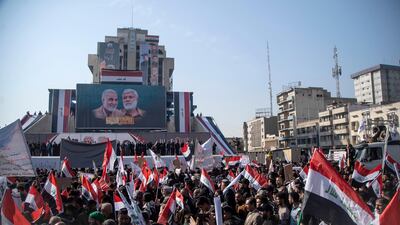
Images of Iranian general Qasem Soleimani and Iraqi militia leader Abu Mahdi Al Muhandis are emblazoned across the exterior of Baghdad's Turkish Restaurant building. Haider Husseini / The National -
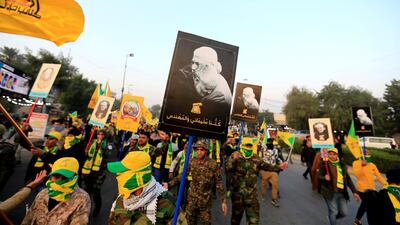
Kataib Hezbollah Iraqi militia gather ahead of the funeral of the Iraqi militia commander Abu Mahdi al-Muhandis, who was killed in an air strike in Baghdad in 2020. Reuters -

Fighters of the Hashed Al Shaab sit in the back of a heavily-armed vehicle carrying a rocket launcher on February 18, 2017. AFP -

Hamas militia members march after they evacuated Gaza's streets in 2006. Reuters -

Palestinian militants from the military wing of Hamas march during a Hamas rally in Gaza in 2005. Reuters -

Hamas parade at a rally in Gaza city on November 14, 2003. Reuters -
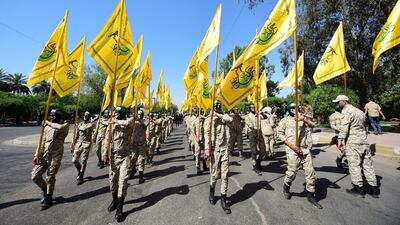
Fighters of Al Nujaba carry their flags and march during an anti-Israel rally in Baghdad, 2019. EPA -

Forces march as they hold their flag and posters of Iraqi and Iranian Shiite spiritual leaders. AP -

A Houthi militant attends a parade held by newly recruited Houthi fighters in Sanaa, Yemen, January 1, 2017. REUTERS/Khaled Abdullah -

Houthi men watch as newly recruited militants parade in Yemen's capital Sanaa, in 2015. Reuters -

Houthi militants ride on the back of a patrol truck at the site of a gathering in Yemen's capital in December, 2015. Reuters


Iran can leverage Gulf investments, Gulf development visions and advanced commercial and economic expertise in the region to revive its economy, achieve growth and bridge the significant gap between demand and production. Gulf countries, in turn, can benefit from Iran's vast market, abundant human expertise and vast natural resources through collaborative agreements. Additionally, both sides can invest in intra- and inter-regional resources. However, for Iran to realise this vision, it must take several essential steps.
It must comply with global financial regulations and resolving major disputes with the international community. It should refrain from militarising its economy and avoid viewing international and global economic projects solely through a security lens, recognising that their purpose is not to undermine Iranian security.
And it should ensure the security of investments in the Iranian market from the uncertainties of the domestic political and economic situation.
Over the past decade, Iran has been absent from emerging international corridor projects. This cannot be attributed to a conspiracy to isolate or suffocate Iran, as some leaders may imagine, but rather to the country’s lack of fundamental conditions mentioned above. These conditions represent the "normal state behaviour" that international partners expect from any country, including Iran. Had Iran pursued this constructive path, it could have attracted capital from the Gulf and various other regions into its markets, creating an environment conducive to achieving growth and profitability for all parties involved. Without such efforts, however, it will remain yet another unrealised dream added to a list of aspirations.
In his letter, Dr Pezeshkian emphasised the need to adopt initiatives aimed at fostering regional solidarity and ending superpower interference. Common sense supports the call for any initiative promoting regional co-operation and solidarity. However, such initiatives should consider several basic conditions to pave the way for integrated regional economic development.
First, a comprehensive approach is needed. All contentious issues should be addressed at the negotiating table, aiming for solutions that benefit all parties based on a win-win logic.
Second, there should be inclusivity. All relevant regional parties should participate equally. History shows that bilateral and inter-regional agreements, especially those favoured by Iran, can be fragile in turbulent and suspicious regional climates.
Third, all of this must be locally driven. Initiatives should originate from the conviction of regional parties, as mentioned by the Iranian president-elect. Proposals by global powers could expose the region to further international polarisation and conflicting hegemonic agendas. However, the outcomes of the dialogue can be guaranteed by major powers and international institutions.
-
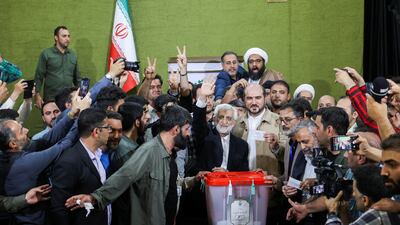
Iranian presidential candidate Saeed Jalili waves at supporters in Tehran, during the run-off election against Masoud Pezeshkian. Reuters -
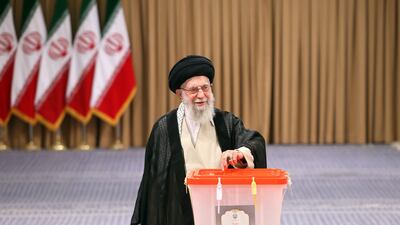
Iranian Supreme Leader Ayatollah Ali Khamenei casts his vote in the presidential election. EPA -
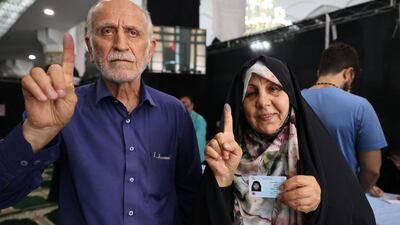
Voters show their ink-stained index fingers after casting their ballots at a polling station in Tehran. AFP -
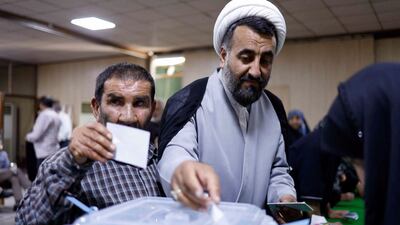
Iranians cast their ballots at the Iranian consulate in Najaf, central Iraq. Reuters -
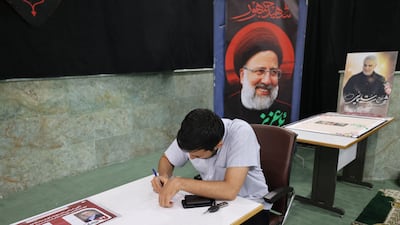
A voter prepares to cast his ballot in Tehran. AFP -
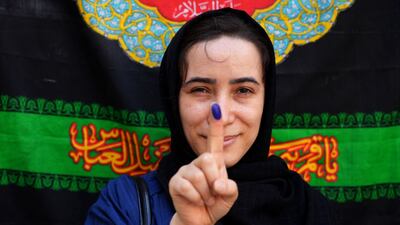
A woman shows that she has voted, at a polling station in Qarchak Varamin south-west of Tehran. AFP -
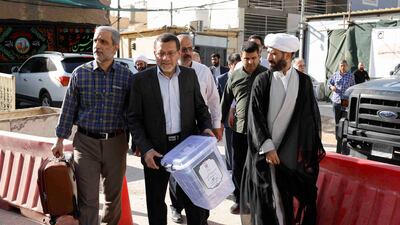
Election officials arriver at a polling station at the Iranian consulate in Najaf, central Iraq. Reuters -
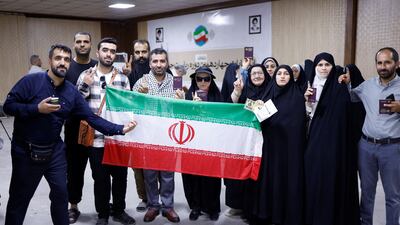
Voters hold up the Iranian flag, at Tehran's consulate in Najaf, central Iraq. Reuters -
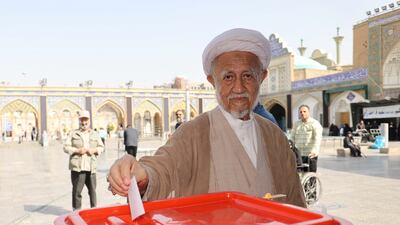
A cleric casts his ballot in Tehran. Reuters -
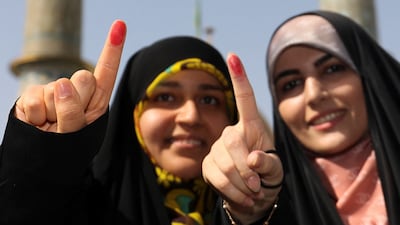
Women show they have cast their vote, in Tehran. Reuters -

A woman puts up a sign featuring images of Iranian presidential candidates Saeed Jalili and Masoud Pezeshkian, in Tehran. Reuters


There must also be equality among all participants at the dialogue table, rejecting any claim of superiority in both the international and regional systems.
These principles are straightforward yet essential for Dr Pezeshkian’s call for dialogue to succeed. They pave the way for constructive regional co-operation that can engage and benefit all stakeholders involved. By adhering to these principles, the region can return to a state of normality, reasserting the role of state institutions in the face of eroded sovereignty and increased militia influence over the past years. Furthermore, they facilitate the region's transition from an outdated geopolitical era to a new geo-economic era.
There is no doubt that the message conveyed by Dr Pezeshkian to Arab, regional and international communities offers optimism. However, a realistic approach demands situating this call within its natural context and ensuring the necessary conditions for its realistic success. This approach is crucial for any dialogue with Iran to achieve a transformative outcome that benefits all parties, mitigates regional conflicts and tensions and secures the region's involvement in future global development projects.

