In happier times, pupils attend class in a school run by UNRWA in Gaza City. The UN says 80 per cent of schools in the territory have been destroyed or damaged. AFP


The longer Gaza's pupils are out of school, the tougher it is to secure lasting peace


  • English
  • Arabic

July 16, 2024

The UNRWA, the UN Palestinian refugee agency, recently released its latest situation report. In it, the agency said that its facilities in Gaza had been attacked by Israel 453 times since the war began last October, and that more than 500 people sheltering in its buildings had been killed. The UN has also said that 80 per cent of schools in the territory have been destroyed or damaged.

This is “scholasticide” – the systematic destruction of the Palestinian educational system. The UNRWA, the lifeforce of Gaza, has been badly damaged. In my three decades of working in the Palestinian enclave, I’ve always relied on the UNRWA teachers, among others, to give me a solid picture of events on the ground. Earlier in the year, Israel attempted to slander the UNRWA by claiming its staff had ties to Hamas. An independent review found this claim to be false.

Nevertheless, the UNRWA’s aid was cut for months, and the agency is struggling to make up for this loss of international funding. This – plus the indiscriminate bombings of schools, the killing of the custodians of knowledge and Israeli soldiers torching Gazan libraries – is an attempt to deny Gazans their right to education.

Attacking schools wipes out a future generation’s potential. On my last trip to Gaza in the summer of 2021, I wrote a report on Gaza’s Generation Z – those under the age of 26. During previous trips, I always focused on the political or humanitarian situation. But on this trip, I spoke to young people. Afterwards, reviewing my dozens of interviews left me hopeful, having found so many talented, brilliant young people, despite Gaza’s deprivation. I truly believed these young people, largely down to their education and their thirst for more knowledge, would be the future leaders so badly needed in Palestine.

But that was before October 7.

Of Gaza’s pre-October 7 population of two million people, nearly two thirds were under 25. It is impossible to know how many of those energetic and committed young people I spoke to are now dead. How many have been forcibly deported from their homes, their schooling interrupted, their lives put on hold?

Those young people who might have been the ones brokering peace in the region one day are either dead or will be deprived of education

Most of the people I interviewed were multi-lingual. They spoke Arabic, sometimes Hebrew, but often flawless English despite never having left Gaza and, in many cases, a few European languages they learnt on YouTube. This was their way of opening a world that was unfairly closed to them.

The array of talent was enormous. I met computer coders at the impressive Gaza Sky Geeks, writers’ collectives like WeAreNotNumbers and the Gaza Poets’ Society, actors and dancers, solar engineers, dentists, green farmers and academics.

Each time, I walked away in awe of what they had accomplished, despite enormous obstacles. The unemployment rate at the time was close to 64 per cent, thanks to Israel and Egypt’s embargoes and border closures. And yet, these young people seemed indefatigable.

But nothing was easy. The coders couldn’t get parts for their Apple computers. The solar engineers couldn’t go to workshops outside Gaza to enhance their knowledge. The green farmers couldn’t get the tools they needed to farm the land – their water systems were routinely bombed. The female entrepreneur I met who was helping empower women with business management techniques that would make McKinsey proud couldn’t bring them to workshops in Jordan because they couldn’t get exit visas.

Yet the thing that every single one told me was how much they valued their education because it empowered them. Most were graduates of Islamic University, Al Azhar or Al Aqsa where they studied economics, literature, humanities, AI, engineering or medicine.

Islamic University was completely destroyed on October 11. Al Azhar a few days later. Al Aqsa earlier this year.

  • Pupils attend an English class at a school run by the UN relief agency for Palestinian refugees in Wehdat camp in east Amman, Jordan, on Tuesday. All photos by Khaled Yacoub Oweis / The National
    Pupils attend an English class at a school run by the UN relief agency for Palestinian refugees in Wehdat camp in east Amman, Jordan, on Tuesday. All photos by Khaled Yacoub Oweis / The National
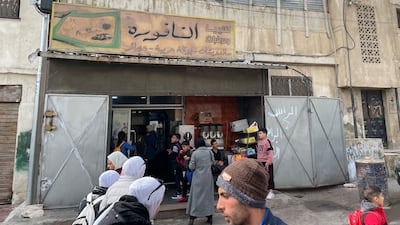
  • An ice cream and sandwich shop in Wehdat refugee camp
    An ice cream and sandwich shop in Wehdat refugee camp
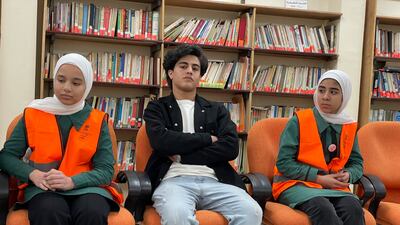
  • Pupils' representatives at the UNRWA school
    Pupils' representatives at the UNRWA school
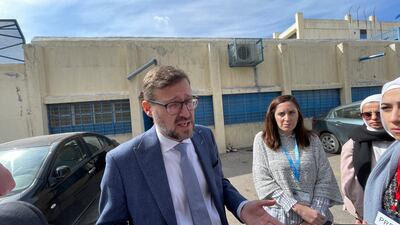
  • Olaf Becker, director of UNRWA Affairs in the Jordan field office
    Olaf Becker, director of UNRWA Affairs in the Jordan field office

Then there are the primary schools, high schools and the nursery schools that have been wiped out. Children who were learning to read, to count, to draw, to socialise with other children, have nowhere to go. Their learning has been curtailed, cut short.

About 90,000 university students have had their education suspended; it is not just Gaza – Israel has raided educational institutions in the West Bank as well.

Why is Israel targeting schools? It appears to be a long-term goal to deprive Palestinians of their right to education. Here, there is a historic link to Israeli’s assassination of Palestinian cultural and intellectual figures who were associated with the Palestine Liberation Organisation. This is nothing new.

In Gaza, the Israelis claim that Hamas hides fighters inside schools. They also accuse Hamas of using civilians as human shields. But as Ken Roth, the former director of Human Rights Watch pointed out in a recent essay on war crimes in Gaza, such actions do not justify “attacks that are indiscriminate or cause disproportionate harm to civilians”. “Palestinian civilians are still civilians even if Hamas is endangering them,” he adds.

The greatest tool for building peace is education. Without it, we have anarchy

Equally, attacks on schools breach the right to education and can constitute war crimes. Schools must be zones of peace.

However, so far in this war, hundreds of schools have been destroyed. Thousands of teachers and students have been killed. Gaza’s educational system has been ravaged and the trauma will be felt for decades to come. Those young people who might have gone far and who might have been the ones brokering peace in the region one day are either dead or will be deprived of education. The greatest tool for building peace is education. Without it, we have anarchy.

A recent open letter by Gazan academics to scholars and university administrators around the world contained a plea “to work alongside us in building our demolished universities and to refuse all plans seeking to bypass, erase or weaken the integrity of our academic institutions”.

The priorities in Gaza are to establish a complete ceasefire and a return to some kind of normal life. Schools, universities and libraries must also be rebuilt. Students must be supported. The longer pupils are out of school, the harder it will be for them to catch up, and the fewer chances we will have to reach a lasting and sustainable peace.


Kibsons%20Cares
%3Cp%3E%3Cstrong%3ERecycling%3Cbr%3E%3C%2Fstrong%3EAny%20time%20you%20receive%20a%20Kibsons%20order%2C%20you%20can%20return%20your%20cardboard%20box%20to%20the%20drivers.%20They%E2%80%99ll%20be%20happy%20to%20take%20it%20off%20your%20hands%20and%20ensure%20it%20gets%20reused%3C%2Fp%3E%0A%3Cp%3E%3Cstrong%3EKind%20to%20health%20and%20planet%3C%2Fstrong%3E%3Cbr%3ESolar%20%E2%80%93%2025-50%25%20of%20electricity%20saved%3Cbr%3EWater%20%E2%80%93%2075%25%20of%20water%20reused%3Cbr%3EBiofuel%20%E2%80%93%20Kibsons%20fleet%20to%20get%2020%25%20more%20mileage%20per%20litre%20with%20biofuel%20additives%3C%2Fp%3E%0A%3Cp%3E%3Cstrong%3ESustainable%20grocery%20shopping%3C%2Fstrong%3E%3Cbr%3ENo%20antibiotics%3Cbr%3ENo%20added%20hormones%3Cbr%3ENo%20GMO%3Cbr%3ENo%20preservatives%3Cbr%3EMSG%20free%3Cbr%3E100%25%20natural%3C%2Fp%3E%0A
Ten tax points to be aware of in 2026

1. Domestic VAT refund amendments: request your refund within five years

If a business does not apply for the refund on time, they lose their credit.

2. E-invoicing in the UAE

Businesses should continue preparing for the implementation of e-invoicing in the UAE, with 2026 a preparation and transition period ahead of phased mandatory adoption. 

3. More tax audits

Tax authorities are increasingly using data already available across multiple filings to identify audit risks. 

4. More beneficial VAT and excise tax penalty regime

Tax disputes are expected to become more frequent and more structured, with clearer administrative objection and appeal processes. The UAE has adopted a new penalty regime for VAT and excise disputes, which now mirrors the penalty regime for corporate tax.

5. Greater emphasis on statutory audit

There is a greater need for the accuracy of financial statements. The International Financial Reporting Standards standards need to be strictly adhered to and, as a result, the quality of the audits will need to increase.

6. Further transfer pricing enforcement

Transfer pricing enforcement, which refers to the practice of establishing prices for internal transactions between related entities, is expected to broaden in scope. The UAE will shortly open the possibility to negotiate advance pricing agreements, or essentially rulings for transfer pricing purposes. 

7. Limited time periods for audits

Recent amendments also introduce a default five-year limitation period for tax audits and assessments, subject to specific statutory exceptions. While the standard audit and assessment period is five years, this may be extended to up to 15 years in cases involving fraud or tax evasion. 

8. Pillar 2 implementation 

Many multinational groups will begin to feel the practical effect of the Domestic Minimum Top-Up Tax (DMTT), the UAE's implementation of the OECD’s global minimum tax under Pillar 2. While the rules apply for financial years starting on or after January 1, 2025, it is 2026 that marks the transition to an operational phase.

9. Reduced compliance obligations for imported goods and services

Businesses that apply the reverse-charge mechanism for VAT purposes in the UAE may benefit from reduced compliance obligations. 

10. Substance and CbC reporting focus

Tax authorities are expected to continue strengthening the enforcement of economic substance and Country-by-Country (CbC) reporting frameworks. In the UAE, these regimes are increasingly being used as risk-assessment tools, providing tax authorities with a comprehensive view of multinational groups’ global footprints and enabling them to assess whether profits are aligned with real economic activity. 

Contributed by Thomas Vanhee and Hend Rashwan, Aurifer

Three ways to get a gratitude glow

By committing to at least one of these daily, you can bring more gratitude into your life, says Ong.

  • During your morning skincare routine, name five things you are thankful for about yourself.
  • As you finish your skincare routine, look yourself in the eye and speak an affirmation, such as: “I am grateful for every part of me, including my ability to take care of my skin.”
  • In the evening, take some deep breaths, notice how your skin feels, and listen for what your skin is grateful for.
What can victims do?

Always use only regulated platforms

Stop all transactions and communication on suspicion

Save all evidence (screenshots, chat logs, transaction IDs)

Report to local authorities

Warn others to prevent further harm

Courtesy: Crystal Intelligence

War and the virus
The specs

Engine: 8.0-litre, quad-turbo 16-cylinder

Transmission: 7-speed auto

0-100kmh 2.3 seconds

0-200kmh 5.5 seconds

0-300kmh 11.6 seconds

Power: 1500hp

Torque: 1600Nm

Price: Dh13,400,000

On sale: now

Indoor cricket in a nutshell

Indoor cricket in a nutshell
Indoor Cricket World Cup - Sept 16-20, Insportz, Dubai

16 Indoor cricket matches are 16 overs per side
8 There are eight players per team
9 There have been nine Indoor Cricket World Cups for men. Australia have won every one.
5 Five runs are deducted from the score when a wickets falls
4 Batsmen bat in pairs, facing four overs per partnership

Scoring In indoor cricket, runs are scored by way of both physical and bonus runs. Physical runs are scored by both batsmen completing a run from one crease to the other. Bonus runs are scored when the ball hits a net in different zones, but only when at least one physical run is score.

Zones

A Front net, behind the striker and wicketkeeper: 0 runs
B Side nets, between the striker and halfway down the pitch: 1 run
C Side nets between halfway and the bowlers end: 2 runs
D Back net: 4 runs on the bounce, 6 runs on the full

COMPANY PROFILE
Name: Kumulus Water
 
Started: 2021
 
Founders: Iheb Triki and Mohamed Ali Abid
 
Based: Tunisia 
 
Sector: Water technology 
 
Number of staff: 22 
 
Investment raised: $4 million 
Updated: July 16, 2024, 4:00 AM