Raghida Dergham is the founder and executive chairwoman of the Beirut Institute, and a columnist for The National
June 30, 2024
The recent televised debate between US President Joe Biden and his rival Donald Trump has left the Democratic Party in disarray. This isn’t just due to Mr Biden’s stumbles, incoherence, sluggishness and stiffness, but also because Mr Trump was brimming with energy and confidence.
Most Americans don’t favour a weak personality, no matter how respectable and decent. While they may not admire Mr Trump’s brash and erratic nature, they desire a decisive president who doesn’t, as many Americans see it, plead with Hamas to accept his initiatives as Mr Biden does, succumb to Iranian or Israeli behaviour, or lead Nato into a potential Third World War.
This was Mr Trump’s message in the debate. Now, Democratic leaders are in a panic and possibly urgently considering Plan B for their leader just four months before the election. While it’s too early to speculate on potential candidates if Mr Biden and Vice President Kamala Harris are dropped from the ticket, this possibility cannot be dismissed entirely.
Despite the importance of domestic issues such as immigration, abortion, the economy, inflation, taxes, health care and retirement, it is important to focus on the foreign policy themes that could dominate the election campaign.
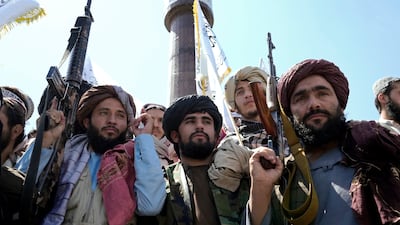
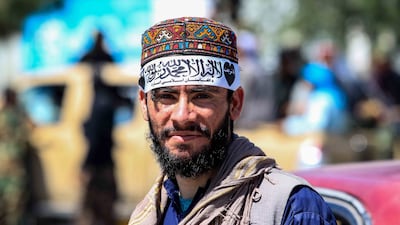
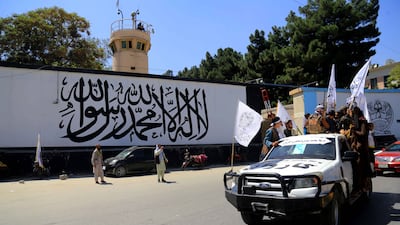
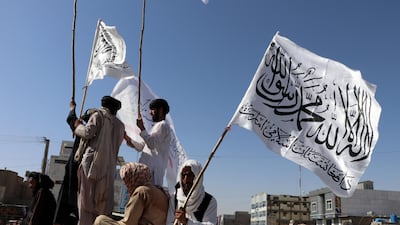
The handling of the US withdrawal from Afghanistan, which the world watched with dismay and which diminished US credibility on the world stage, will be a key issue that Mr Trump uses to criticise Mr Biden. During the debate, he described that episode as disgraceful, saying that it signalled to rival powers that America is weak, unstable, easily defeated, and unreliable for betraying its allies in the middle of the battle.
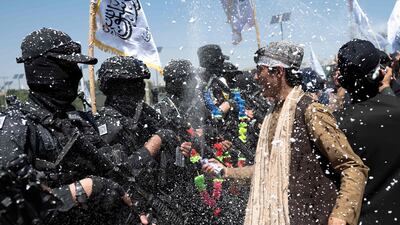
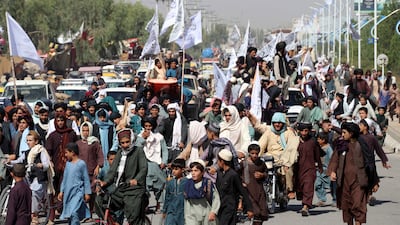
Taliban fighters and supporters celebrate at Ahmad Shah Massoud square in Kabul on August 31, 2022. AFP
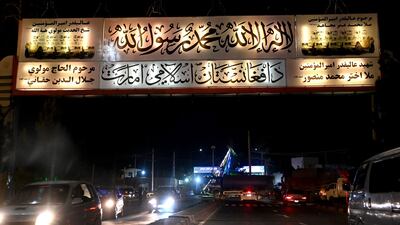
A banner hung in Kabul by Taliban authorities to mark the first anniversary of the departure of US-led foreign forces from Afghanistan. AFP
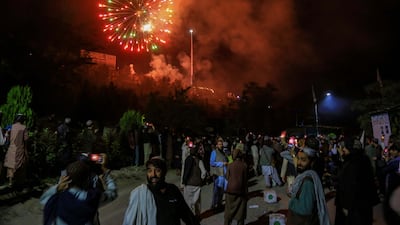
Taliban fighters set off fireworks near the former US embassy in Kabul to celebrate the anniversary. AFP
The Taliban government declared August 31 a national holiday in Afghanistan, as part of the celebrations marking the first anniversary of the end of two decades of foreign presence. EPA
Taliban fighters take to the streets to celebrate. AFP
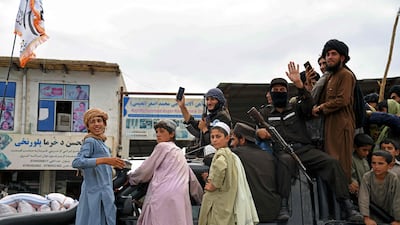
Taliban fighters in front of the US embassy in Kabul. AP Photo
Children with Taliban flags celebrate the anniversary. AP Photo
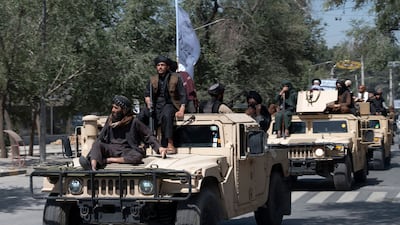
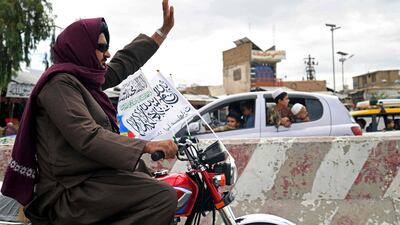
A Taliban convoy in Kabul on Wednesday. Reuters
The Taliban celebrate the first anniversary of the US withdrawal outside the former US embassy in Kabul. EPA
Taliban fighters celebrate the anniversary of the US withdrawal. EPA
Celebrations in Kandahar. EPA
A celebratory parade in Kandahar. EPA
Taliban fighters and supporters during a parade in Kandahar. AFP
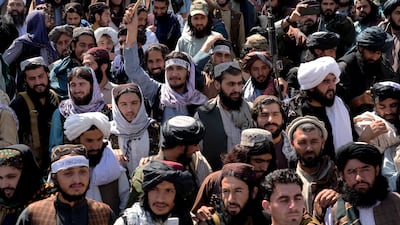
Taliban fighters and supporters in Kabul. AP Photo
A Taliban fighter during the anniversary parade in Kandahar. AFP
What matters is what remains in the minds of voters from such debates, and it does not seem to favour Biden
Mr Trump, on the other hand, boasted about killing Qassem Suleimani, the commander of Iran’s Quds Force, and Abu Bakr Al Baghdadi, the self-declared caliph of ISIS, during his time as president.
Mr Biden said he had a three-phase ceasefire plan for Gaza that was supported by the UN Security Council, the G7 and Israel, claiming that only Hamas opposes his plan. But Mr Trump’s facial expression conveyed pity for a president conceding that his proud initiative, supported globally, has been stalled by Hamas.
Mr Trump boasted that his policies bankrupted Iran, claiming that if the Biden administration had continued them, Iran wouldn’t have had the funds to finance Hamas and its October 7 attack.
Mr Biden challenged Mr Trump by saying that his administration showered Israel with all the weapons it needed, claiming “we saved Israel”. He added that the goal now is to eliminate Hamas. Mr Trump retorted by saying: “Then let them [Israel] finish the job.”
Ultimately, it is not important what each man called the other during the debate; what matters is what remains in the minds of voters from such debates, and it does not seem to favour Mr Biden.
These issues will stick during the election campaign, whether Mr Biden’s initiative succeeds or fails in achieving a phased ceasefire in Gaza to avoid a wider war that could result in an expanded conflict along the Lebanese-Israeli front, probably directed by the Iranian regime.
Iran, which is negotiating with Mr Biden’s team and hopes he remains in the White House, will now probably return to the policymaking table very concerned in the wake of the debate. The Tehran leadership is scattered, divided and confused, sometimes appearing confident in a historic deal with the Biden administration, and at other times, fudging the details as it does not want to give up its formidable proxies operating in sovereign Arab countries – these ultimately being the fulfilment of the true doctrine of the regime.
In recent times, Hezbollah’s leadership has been panicking over the possibility of a historic understanding between Iranian leaders and the Biden administration to curb Hezbollah’s appetite for a war with Israel that would mobilise all “Islamic resistance” factions. It fears an American-Iranian-Israeli deal that could sideline Hezbollah’s leadership.
Mourners carry the coffins of two Hezbollah fighters in the southern Lebanese village of Aita Al-Shaab, near the border with Israel on Saturday. AFP
Today’s panic may subside as the potential failure of Mr Biden’s initiative at the hands of Hamas will increase the Democratic Party’s insistence on unconditional support for Israel to wreak havoc as it pleases in Gaza and Lebanon, without American restraint, but with American weapons, planes, ships and ammunition.
Hezbollah secretary general Hassan Nasrallah and Hamas’s Gaza head, Yahya Sinwar, must accurately read the American political scene.
In the run-up to the presidential election, neither Republicans nor Democrats will hesitate to provide unequivocal support to Israel to eradicate Hamas and Hezbollah, particularly if they are not convinced by Mr Biden’s initiative.
Mr Sinwar must understand that Iran will not sacrifice its major interests for the 120 hostages that his group still holds. If it does, any direct Iranian-Israeli war, as unlikely as it appears at this moment, won’t be because Tehran seeks to install Mr Sinwar as a victorious leader emerging from the tunnels.
The countdown to patience is ticking. Even Arab countries trying to help Gaza are losing patience with Hamas and Mr Sinwar’s intransigence.
Returning to the Biden-Trump debate, Iran understands that the latter is a dealmaker, not a warring president; a sanctions man, not an appeaser; and a decisive leader, not a negotiator over futile bargains.
If it returns to the policymaking table following its own presidential election, which is heading to a run-off next week, Iran will probably adopt strategic patience.
No matter the differing opinions and divisions within the Iranian leadership, they are all determined to continue to use the regime’s proxies and insist on reminding them that it is Tehran that is the decision-maker and the one that calls the shots.

How to help or find other cats to adopt
There are many that often look for volunteers or other types of assistance. They include:
The company offers payments/bribes to win key contracts in the Middle East
May 2017
The UK SFO officially opens investigation into Petrofac’s use of agents, corruption, and potential bribery to secure contracts
September 2021
Petrofac pleads guilty to seven counts of failing to prevent bribery under the UK Bribery Act
October 2021
Court fines Petrofac £77 million for bribery. Former executive receives a two-year suspended sentence
December 2024
Petrofac enters into comprehensive restructuring to strengthen the financial position of the group
May 2025
The High Court of England and Wales approves the company’s restructuring plan
July 2025
The Court of Appeal issues a judgment challenging parts of the restructuring plan
August 2025
Petrofac issues a business update to execute the restructuring and confirms it will appeal the Court of Appeal decision
October 2025
Petrofac loses a major TenneT offshore wind contract worth €13 billion. Holding company files for administration in the UK. Petrofac delisted from the London Stock Exchange
November 2025
180 Petrofac employees laid off in the UAE
Disclaimer
Director: Alfonso Cuaron
Stars: Cate Blanchett, Kevin Kline, Lesley Manville
Syria v Australia
2018 World Cup qualifying: Asia fourth round play-off first leg
Venue: Hang Jebat Stadium (Malacca, Malayisa)
Kick-off: Thursday, 4.30pm (UAE)
Watch: beIN Sports HD
* Second leg in Australia scheduled for October 10
Blockchain is a form of distributed ledger technology, a digital system in which data is recorded across multiple places at the same time. Unlike traditional databases, DLTs have no central administrator or centralised data storage. They are transparent because the data is visible and, because they are automatically replicated and impossible to be tampered with, they are secure.
The main difference between blockchain and other forms of DLT is the way data is stored as ‘blocks’ – new transactions are added to the existing ‘chain’ of past transactions, hence the name ‘blockchain’. It is impossible to delete or modify information on the chain due to the replication of blocks across various locations.
Blockchain is mostly associated with cryptocurrency Bitcoin. Due to the inability to tamper with transactions, advocates say this makes the currency more secure and safer than traditional systems. It is maintained by a network of people referred to as ‘miners’, who receive rewards for solving complex mathematical equations that enable transactions to go through.
However, one of the major problems that has come to light has been the presence of illicit material buried in the Bitcoin blockchain, linking it to the dark web.
Other blockchain platforms can offer things like smart contracts, which are automatically implemented when specific conditions from all interested parties are reached, cutting the time involved and the risk of mistakes. Another use could be storing medical records, as patients can be confident their information cannot be changed. The technology can also be used in supply chains, voting and has the potential to used for storing property records.
The biog
Marital status: Separated with two young daughters
Education: Master's degree from American Univeristy of Cairo
Favourite book: That Is How They Defeat Despair by Salwa Aladian
Favourite Motto: Their happiness is your happiness
Goal: For Nefsy to become his legacy long after he is gon
The internal combustion engine is facing a watershed moment – major manufacturer Volvo is to stop producing petroleum-powered vehicles by 2021 and countries in Europe, including the UK, have vowed to ban their sale before 2040. The National takes a look at the story of one of the most successful technologies of the last 100 years and how it has impacted life in the UAE.
The number of asylum applications in the UK has reached a new record high, driven by those illegally entering the country in small boats crossing the English Channel.
A total of 111,084 people applied for asylum in the UK in the year to June 2025, the highest number for any 12-month period since current records began in 2001.
Asylum seekers and their families can be housed in temporary accommodation while their claim is assessed.
The Home Office provides the accommodation, meaning asylum seekers cannot choose where they live.
When there is not enough housing, the Home Office can move people to hotels or large sites like former military bases.
One showed 28 per cent of female students at a Dubai university reported symptoms linked to depression. Another in Al Ain found 22.2 per cent of students had depressive symptoms - five times the global average.
It said the country has made strides to address mental health problems but said: “Our review highlights the overall prevalence of depressive symptoms and depression, which may long have been overlooked."
Prof Samir Al Adawi, of the department of behavioural medicine at Sultan Qaboos University in Oman, who was not involved in the study but is a recognised expert in the Gulf, said how mental health is discussed varies significantly between cultures and nationalities.
“The problem we have in the Gulf is the cross-cultural differences and how people articulate emotional distress," said Prof Al Adawi.
“Someone will say that I have physical complaints rather than emotional complaints. This is the major problem with any discussion around depression."
Air Astana flies direct from Dubai to Almaty from Dh2,440 per person return, and to Astana (via Almaty) from Dh2,930 return, both including taxes.
The hotels
Rooms at the Ritz-Carlton Almaty cost from Dh1,944 per night including taxes; and in Astana the new Ritz-Carlton Astana (www.marriott) costs from Dh1,325; alternatively, the new St Regis Astana costs from Dh1,458 per night including taxes.
When to visit
March-May and September-November
Visas
Citizens of many countries, including the UAE do not need a visa to enter Kazakhstan for up to 30 days. Contact the nearest Kazakhstan embassy or consulate.
What is the Supreme Petroleum Council?
The Abu Dhabi Supreme Petroleum Council was established in 1988 and is the highest governing body in Abu Dhabi’s oil and gas industry. The council formulates, oversees and executes the emirate’s petroleum-related policies. It also approves the allocation of capital spending across state-owned Adnoc’s upstream, downstream and midstream operations and functions as the company’s board of directors. The SPC’s mandate is also required for auctioning oil and gas concessions in Abu Dhabi and for awarding blocks to international oil companies. The council is chaired by Sheikh Khalifa, the President and Ruler of Abu Dhabi while Sheikh Mohamed bin Zayed, Abu Dhabi’s Crown Prince and Deputy Supreme Commander of the Armed Forces, is the vice chairman.
Our legal columnist
Name: Yousef Al Bahar
Advocate at Al Bahar & Associate Advocates and Legal Consultants, established in 1994
Education: Mr Al Bahar was born in 1979 and graduated in 2008 from the Judicial Institute. He took after his father, who was one of the first Emirati lawyers