


So, in the end it came down to a tawdry deal. After years of posturing and grandstanding from both sides, in what was billed as a battle of principles, the US Justice Department has finally settled its case with Julian Assange.
Where once the WikiLeaks founder faced 17 counts of espionage, prosecutors reduced them to just one. Assange pleaded guilty to just one charge of violating the Espionage Act by obtaining and publishing classified military and diplomatic documents from 2009 to 2011.
With that, he is gone. He was taken from the Belmarsh high-security prison in London, where he’d been held for five years pending extradition to the US, and flown to the Northern Mariana Islands, just about the remotest US territory anywhere (they’re in the Pacific, but not so far from Australia).
There, he will be sentenced to 62 months, which happens to be the exact period of his incarceration in the UK. Funny, that. Because he has already served that time, he will be released automatically and return to his native country of Australia.
Finally, the Assange saga is over. Those five years, don’t forget, do not include the period he spent holed up in the Ecuadorian embassy on the run from the Swedish authorities who were pursuing him for sexual assault. That case was subsequently dropped, but the US government came for him, indicting Assange for computer hacking. No mention is made of the cost to the UK taxpayer of the policing and security operations that he sparked and lasting more than a decade.
His residing in the embassy was a public spectacle, becoming an attraction for tourists visiting nearby Harrods. Eventually, Ecuador lost what patience it still had and in 2019, expelled Assange from its premises. Whereupon he was immediately arrested by the British police on the US charge. Ever since, he’s been fighting being sent to the US.
-
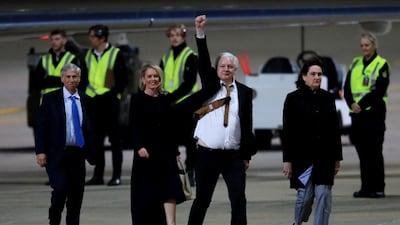
WikiLeaks founder Julian Assange arrives at Canberra Airport in Australia after being released from Belmarsh Prison in the UK, where he had been held for five years. Getty Images -
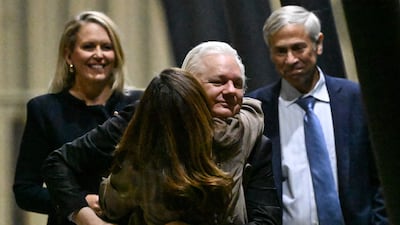
Mr Assange hugs his wife Stella Assange after arriving in Canberra. AFP -

Mr Assange waves at supporters in the Australian capital. EPA -
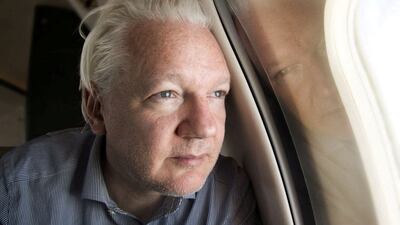
Mr Assange looks out of a plane window as he approaches Bangkok for a stopover. Reuters -
Mr Assange makes his way to board his flight out of the UK at London's Stansted Airport. AFP -

Mr Assange boards the flight to Saipan, capital of the Northern Mariana Islands, in the Western Pacific. Reuters -

Mr Assange in London after his release from Belmarsh Prison. AFP -
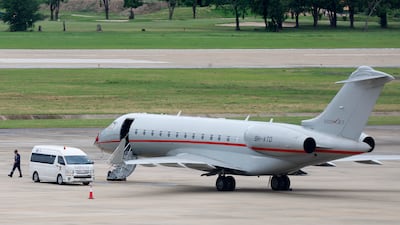
The aircraft carrying Mr Assange on a fuel stopover at Don Mueang International Airport in Bangkok. EPA -
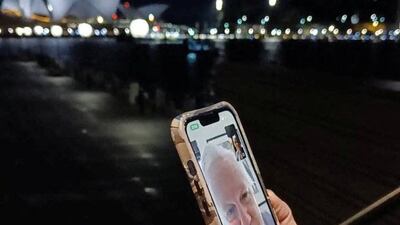
Mr Assange's image from Stansted Airport, seen in a video call with his wife Stella Assange in Sydney. Reuters


There is not a halfway with Assange. He’s black or he’s white. To some, like the US authorities, Assange was a danger, a major menace, someone who was happy to distribute state secrets without any thought as to the damage, human and political, they might cause. But if he was that bad, why did the US reach an agreement?
To others, he is a seeker of truth, same as any other brave, investigative journalist. But then, why did he not seek his day in a US court, when he could have hogged the limelight and presented his case?
His lawyers maintained that was because he would not get a fair trial and his mental state was too fragile to withstand transfer to a US jail.
He was also in the fortunate position of being able to resist. Chelsea Manning, his co-conspirator, did not have that luxury. Manning, a US army intelligence analyst, was court-martialled for supplying material to Assange and got 35 years, serving seven before then US president Barack Obama commuted her sentence in 2017.
Assange, it seems, was only prepared to take martyrdom so far. He’d already been promised that he would not face charges that carried the death penalty, that he would not be automatically put in solitary confinement, and that he would receive mental health care. Still, it was not enough – his lawyers claimed that there was nothing to prevent him from harming himself once he was consigned to US custody.
Meanwhile, the relentless publicity campaign to free him never let up. It did appear odd, the iconic figure to many on the left, heroic scourge of the state, on the one hand and nit-picking exploiter of every legal loophole, on the other.
To be fair, none of us know what we would have done in such circumstances. But once it became obvious that the Joe Biden administration was not going to follow Mr Obama and let up, Assange dug in.

There is fury in many quarters, especially among US military veterans of Iraq and Afghanistan, that the leaks may have put thousands of soldiers and informants’ lives at risk. Assange, they argue, did not merit leniency.
Equally, there are those defenders of press freedom who say that it would be a very depressing day indeed if he was jailed in the US for publishing government secrets. They welcome his release.
He was, they say, only doing the job that countless journalists do every day. But was he? The role of the journalist is to aggregate and to filter. Assange did only half of that, collecting vast amounts of information, yes, but then dumping it upon the world. WikiLeaks’ Afghan War Logs were published with little attempt to vet and disguise names of Afghan civilians who informed for the US military. They could well have been exposed and in danger.
The Justice Department went further, alleging that Assange stepped outside the normal remit of a reporter, by trying to break a Defence Department code and exhorting associates to hack computers and obtain phone records. To them, he was a solicitor of crime.
Such is the polarising effect of Assange that press campaigners will hear none of this. To them he was a journalist.
In which case, the Justice Department extracting a guilty plea must set a worrying precedent. The stage is set for prosecutions of US media companies for employing journalists to conduct investigations into any matter covered by national security. This, against the possible backdrop of an incoming Donald Trump presidency that, one imagines, would love to commit journalists to jail.
Likewise, Assange admits he broke the law, without the law ever being tested. The Justice Department maintained that the sole act of publishing government secrets violated the Espionage Act. Assange admitted as much, setting a new, low standard.
Whether he could be counted as a journalist or not, Assange has done journalism no favours.

