


The annual Tehran International Book Fair is now a shadow of its former self. Gone are the days when it was the leading cultural event of Iran, attracting millions of book lovers from around the country. But it can still occasionally muster a crowd.
Such an opportunity arose last Friday, when former Iranian foreign minister Mohammad Javad Zarif arrived at the venue to present his latest book, The Depth of Patience.
Dozens of visitors, including young men and women, lined up to get an autographed copy of Mr Zarif’s memoir about his time as the country’s top diplomat between 2013 and 2021. Some even brought along copies of Mr Ambassador, a 2013 memoir of Mr Zarif’s long stint in Iran’s representative office to the UN in New York.
Since its publication in March, The Depth of Patience has become an instant bestseller, having already entered its fourth print run.
Such enthusiasm for a politician is extremely rare in a country like Iran, where disillusionment with official politics is so widespread that only 7 per cent of the capital’s residents voted in the second round of parliamentary elections earlier this month. But Mr Zarif, a career diplomat who has never held elected office and repeatedly says that he has no political ambitions, has shown a talent for staying relevant.
His signature achievement at the foreign ministry was shepherding the 2015 nuclear deal, which Iran signed with the five permanent members of the UN Security Council (plus Germany and the EU) after months of intense negotiations. According to the agreement – called the JCPOA – Tehran was to scale back its nuclear programme in return for sanctions relief.
-

July 14, 2015: Iran and six major world powers reached a nuclear deal, capping more than a decade of on-off negotiations. AFP -
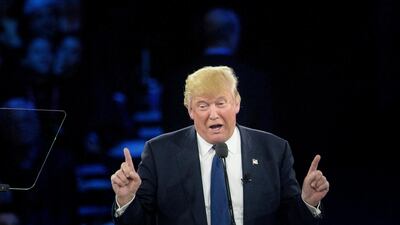
March 2016: Then presidential candidate Donald Trump says his number one priority is to dismantle the “disastrous deal” with Iran. He frequently refers to the agreement as the “worst deal ever” while campaigning. AFP -

April 2018: French President Emmanuel Macron and German Chancellor Angela Merkel visit the White House to try and persuade Trump to stick with the deal. Getty -

May 8, 2018: Donald Trump announces the United States plans to withdraw from the Iran nuclear deal. Mr Trump holds up the document he signed reinstating sanctions, in the Diplomatic Reception Room at the White House. AFP -

December 2018: Iran's Revolutionary Guard launch war games near the Strait of Hormuz, a day after its boats shadowed the US aircraft carrier John C Stennis through the strategic waterway. AP -
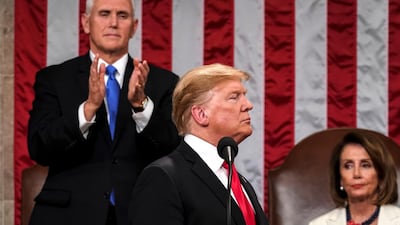
February 2019: President Trump uses his State of the Union address to single Iran out as the “world’s leading state sponsor of terror”. EPA -
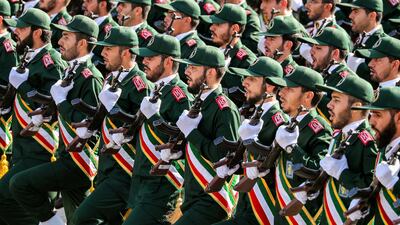
April 2019: The US designates the Islamic Revolutionary Guard Corps as a foreign terrorist organisation. AFP -

May 8, 2019: Iran announces a partial withdrawal from the deal. President Hassan Rouhani warns that after 60 days, the Islamic Republic would increase uranium enrichment level. EPA


Many Iranians heralded it as a precursor to a new period of opening up under then Iranian president Hassan Rouhani, who won re-election two years later. But the deal didn’t last much longer. In 2018, then president Donald Trump withdrew the US from the JCPOA, following which Mr Rouhani and Mr Zarif ended up being sidelined by Iran’s hardline supreme leader, Ayatollah Ali Khamenei.
Mr Zarif, however, has found ways to stay in the headlines ever since.
In April 2021, towards the end of his term as foreign minister, a three-hour audio interview got leaked in which he is heard criticising several of the regime’s policies, including fostering close ties to Russia, and the outsized influence of the Islamic Revolutionary Guard Corps within the power structure. Mr Zarif insisted that the interview was part of an internal oral history project, and that it was not aimed for publication. But the interviewer later claimed that the leak was intentional.
Shortly after stepping down, Mr Zarif took up a position in the University of Tehran and said he was staying out of public life. Yet he has never shied away from the spotlight and from time to time given media interviews.
In March, in another audio leak published by the London-based anti-regime outlet IranWire, he can be heard criticising the IRGC again, as well as both the hardline and reformist factions of the regime. Striking a familiar tone, he affirms that he has been repeatedly asked to run for president and implies that he would win if he were to run – while quickly adding that he has no desire to do so.
Mr Zarif’s new book is also full of such humble brags, including a well-known fact that the late US secretary of state Henry Kissinger once called him “a respectable adversary”. He portrays himself as a victim for having stood up for fellow Iranians, despite having been hemmed in on all sides – by the IRGC and the hardliners, but also by centrists such as former national security adviser Ali Shamkhani and Mr Rouhani himself.
The book is peppered with anecdotes that portray him in a patriotic light, too. He speaks of a 2019 meeting with Anne Linde, then Sweden’s minister of foreign trade, in which he protested Stockholm’s alleged refusal to export certain medicines to Iran due to US sanctions.
According to Mr Zarif, when Ms Linde told him that “Americans are our friends”, he interrupted her by saying “your friends are enemies of our children. I have nothing else to tell you”, before leaving the room.

The book’s most crucial chapter, perhaps, concerns Mr Zarif’s views on the Ukrainian airliner that was shot down by the IRGC over Tehran in January 2020, killing all 176 people on board. Iranian authorities admitted the IRGC’s responsibility some days later, but only after the state TV network repeatedly claimed that the plane crashed due to a technical failure. Offering an hour-by-hour account, Mr Zarif repeats his well-documented claim that he and Mr Rouhani were kept in the dark about the truth, just like the rest of Iran was.
Knowing full well the unhappiness of many Iranians with their government’s ties to Moscow, he also rehashes many of his well-known critiques of this relationship in the book.
There is no doubt that Mr Zarif has succeeded in creating a clear narrative about himself. Having spent years doing public diplomacy in the US, where he spent much of his adult life, Mr Zarif has become a master of the craft and seems to have continued honing it after his supposed retirement.
In his own telling, he is a patriotic Iranian who has sacrificed much for his country. He is also clear about his special relationship with Mr Khamenei that began, as he recounts in the book, in 1987 when the latter was president and visited the UN in New York with Mr Zarif acting as his interpreter.
It’s a relationship that has served Mr Zarif well, with Mr Khamenei having used him as a trusted envoy to the West and many Iranians having invested their hopes in him as the man who could rebuild Tehran’s ties to the US and Europe, and thus help drag their country out of international isolation.
In the twilight of his life, Mr Khamenei has pursued a staunchly anti-western policy and is, therefore, no longer in need of a figure like Mr Zarif. Nevertheless, can the forever smiling diplomat find a political future? Mr Zarif’s continued presence in the public eye keeps him relevant, and the fact that he has never engaged in partisan politics makes him desirable in the eyes of some.
In 2021, the regime’s reformist faction conducted an internal poll that made it clear that Mr Zarif was their preferred candidate for president. He refused to register to run, but does that mean he is simply not interested in power, or is he simply biding his time? Despite his repeated denials, Mr Zarif’s careful management of his public image suggests that political temptation is no stranger to him.
Perhaps he is simply testing the depths of his own patience.

