


It didn’t take long after Lee Hsien Loong announced that he would be stepping down as Singapore’s Prime Minister on May 18 for the tributes to start rolling in.
“Our region has had no wiser leader than PM Lee and Australia no better friend,” former Australian prime minister Malcolm Turnbull wrote on X. “He and his wife Ho Ching are humble leaders and first among equals – truly Singapore is their life’s work.” New Zealand Prime Minister Christopher Luxon called him “a remarkable leader for his country, the region and the world”.
The Rakyat Post in neighbouring Malaysia noted that Mr Lee had achieved the rank of brigadier general by the age of 32, and that “he could have been one of the greatest mathematicians if he hadn’t gone into politics” – having graduated top of his class in the subject at Cambridge University. And Michael Fullilove of the Lowy Institute think tank in Australia wrote: “I have found him to be a person of great strategic wisdom. When PM Lee speaks, the region listens.”
It’s a testament to his period in office that it has been a long time since anyone suggested that Mr Lee was “in his father’s shadow”, which was a commonplace description when he became premier in 2004. No one forgets who his father was – Lee Kuan Yew, the founding leader who through sheer brute determination drove Singapore “from third world to first”, as the second volume of his memoirs put it.
But the younger Mr Lee’s achievements, including the city-state bouncing back strongly from both the Great Recession and the pandemic, its regional leadership on the digital economy, emphasis on education, and some mild but significant social and political reforms, are all his own – as is his success in maintaining what he calls “our strong, trusted international reputation”.
-
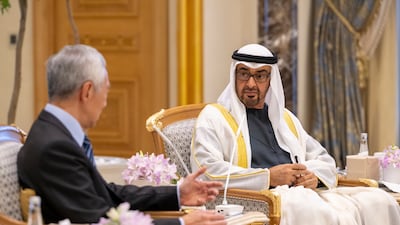
President Sheikh Mohamed with Singapore Prime Minister Lee Hsien Loong, at Qasr Al Watan. Mohamed Al Hammadi / UAE Presidential Court -
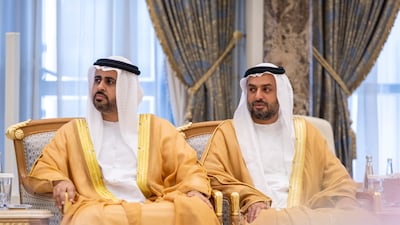
Sheikh Theyab bin Mohamed, Chairman of the Office of Development and Martyrs Families Affairs at the Presidential Court and Sheikh Mohamed bin Hamad, Private Affairs Adviser in the Presidential Court at Qasr Al Watan. Mohamed Al Hammadi / UAE Presidential Court -
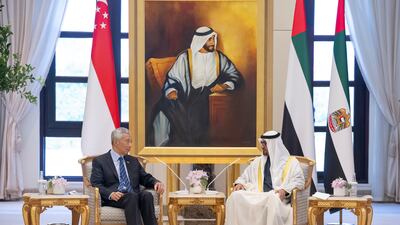
President Sheikh Mohamed and Mr Lee during an official reception. Hamad Al Kaabi / UAE Presidential Court -
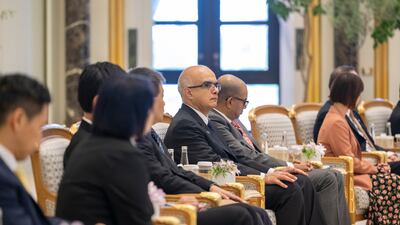
Kamal R Vaswani, Singapore Ambassador to the UAE, at Qasr Al Watan. Mohamed Al Hammadi / UAE Presidential Court -
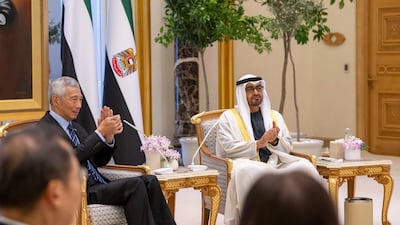
President Sheikh Mohamed and Mr Lee during a MOU exchange ceremony. Mohamed Al Hammadi / UAE Presidential Court -
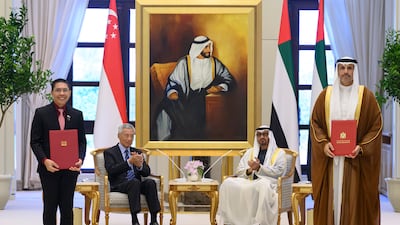
Khaldoon Al Mubarak, Abu Dhabi Executive Council Member Chairman of the Executive Affairs Authority and Managing Director Group CEO of Mubadala Investment Company exchanges an MOU with Mohamad Maliki bin Osman, Minister in the Prime Minister’s Office and Second Minister for Education and Foreign Affairs of Singapore. Abdulla Al Neyadi / UAE Presidential Court -
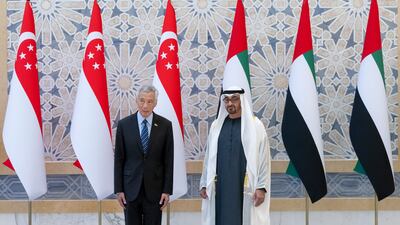
President Sheikh Mohamed receives Mr Lee at Qasr Al Watan. Hamad Al Kaabi / UAE Presidential Court -
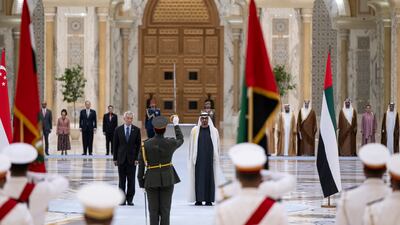
President Sheikh Mohamed and Mr Lee stand for the national anthems of the UAE and Singapore. Abdulla Al Neyadi / UAE Presidential Court -
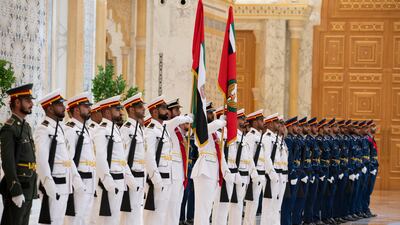
The UAE Honour Guard at Qasr Al Watan. Abdulla Al Neyadi / UAE Presidential Court -
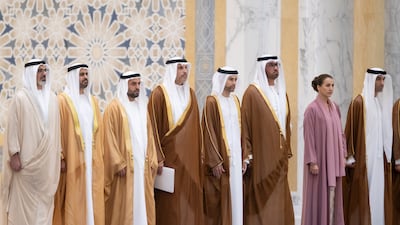
Sheikh Khaled bin Mohamed, Crown Prince of Abu Dhabi and Chairman of Abu Dhabi Executive Council; Sheikh Theyab bin Mohamed, Chairman of the Office of Development and Martyrs Families Affairs at the Presidential Court; Sheikh Mohamed bin Hamad bin Tahnoon, Private Affairs Adviser in the Presidential Court, Khaldoon Al Mubarak, Abu Dhabi Executive Council member, Chairman of the Executive Affairs Authority and Managing Director and Group Chief Executive of Mubadala Investment Company, Mohamed Al Hussaini, Minister of State for Financial Affairs; Dr Sultan Al Jaber, Minister of Industry and Advanced Technology, Group Chief executive of Adnoc and Chairman of Masdar; Mariam Al Mheiri, Minister of Climate Change and Environment, and Dr Thani Al Zeyoudi, Minister of State for Foreign Trade, stand for the national anthem during the reception at Qasr Al Watan. Hamad Al Kaabi / UAE Presidential Court -
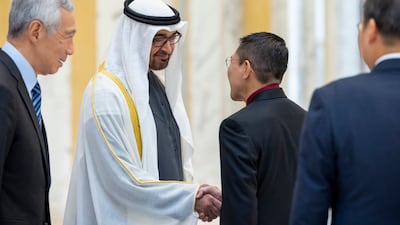
President Sheikh Mohamed greets a dignitary accompanying Mr Lee during an official reception at Qasr Al Watan. Ryan Carter / UAE Presidential Court -
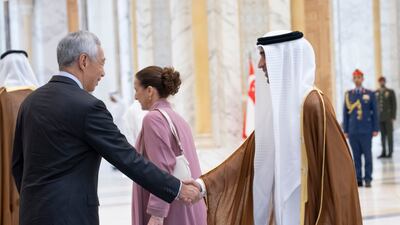
Dr Thani Al Zeyoudi, Minister of State for Foreign Trade, greets Mr Lee during the official reception at Qasr Al Watan. Hamad Al Kaabi / UAE Presidential Court -
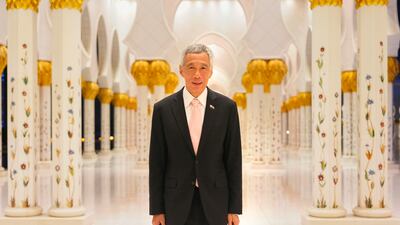
Lee Hsien Loong, Prime Minister of Singapore, visited the Sheikh Zayed Grand Mosque, accompanied by Dr Thani Al Zeyoudi, Minister of State for Foreign Trade, as part of his official visit to the UAE. Wam -
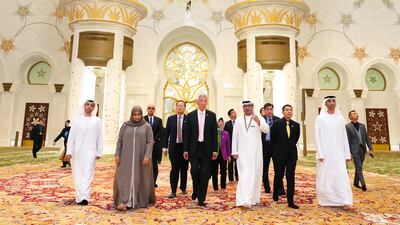
Lee Hsien Loong, Prime Minister of Singapore, visited the Sheikh Zayed Grand Mosque, accompanied by Dr Thani Al Zeyoudi, Minister of State for Foreign Trade, as part of his official visit to the UAE. Wam -
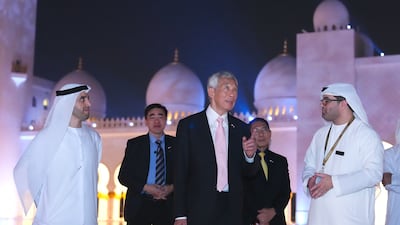
Lee Hsien Loong, Prime Minister of Singapore, visited the Sheikh Zayed Grand Mosque, accompanied by Dr Thani Al Zeyoudi, Minister of State for Foreign Trade, as part of his official visit to the UAE. Wam


Three figures that support that: according to Bloomberg, total asset management in Singapore increased more than eight-fold to $3.6 trillion in Mr Lee’s two decades at the helm; the non-resident population grew by 135 per cent, as growth demanded more workers than the country could supply; and 77 per cent of the population think Singapore is heading in the right direction, according to a poll this year.
One question that arises is whether Singapore is ready for a post-Lee politics.
Mr Lee senior was prime minister from 1959-1990, Mr Lee junior from 2004-2024. In between was Goh Chok Tong, like both Lees a member of the governing People’s Action Party, which has never lost power. But during Mr Goh’s time, Lee Kuan Yew remained in the cabinet as “senior minister” while his son had become deputy prime minister. Thus the joke that the country had been run by “the father, the son, and the holy Goh”.
Lawrence Wong, the finance minister and incoming premier, has just announced that Mr Lee junior will also remain in the cabinet as senior minister. So it’s not quite the end yet. But it’s moving in that direction (so long as Mr Lee’s son doesn’t enter politics, as it was once speculated that he would).
It ought to be no problem for the Lee family to depart from the political scene. Singapore is a democracy, after all. But as Jeevan Vasagar noted in his 2021 book Lion City, “few countries in the world are so intimately bound up with the fortunes of a single family. In a city which has gone through constant and sometimes turbulent change, the Lee family has been a constant presence in public life”.
As Singapore’s leaders well know, the history of city-states is not encouraging; they tend to be swallowed by larger neighbours. The reassurance provided by the presence of the country’s most famous family may be missed.
One role for which Mr Lee will be missed internationally is as one of the last, great tireless advocates for globalisation.
It’s a term that has become unfashionable, and Mr Lee has conceded that the concept is under pressure. But as he put it in a 2021 interview: “The imperative for countries to co-operate, for businesses to operate across many geographies, to tap resources, to bring skills and talents and experiences together, and then serve markets all around the world, I do not think that is going to disappear.”
Mr Lee’s belief in co-operation applies not only to the realm of commerce but also security. He has always stressed the need for “institutions which will bring in countries” on all sides.

In a lengthy discussion at the Council for Foreign Relations two years ago, it was notable that Mr Lee welcomed every single multilateral organisation or agreement that came up, from the Asia-Pacific Economic Co-operation forum, to the East Asia Summit, the US Indo-Pacific Economic Framework, the Three Joint Communiques between the US and China that set the basis for diplomatic relations and acknowledged the Chinese position on Taiwan, the principles of the UN charter, the Trans-Pacific Partnership (which later became the Comprehensive and Progressive Agreement for Trans-Pacific Partnership), the Association of South-East Asian Nations and more.
What was also welcome was his pointing out that international mechanisms have to adjust to reflect a changing world. In the case of China, he said the country needed “some space to influence the global system. For examples, shares in the IMF or influence in the World Bank”.
“You don’t want to change the whole system of international order or international law. This is a framework which everybody fits into. But now you’ve got a big player, and they do want to participate. And you have to enable them to participate,” he added.
The alternative, he argued, was that a different set of institutions would be developed, in this case the Belt and Road Initiative and the Asian Infrastructure Investment Bank. The question he demands that we ask and answer is simple: “What is the mechanism of the win-win co-operation?”
In today’s geopolitical landscape, Mr Lee’s pleas may feel quaint or unrealistic. The whole concept of international law or an international order has never been under such pressure. But maybe we should listen to him more. For his pleas are for a world that co-operates and adapts, not one that breaks asunder and splinters into hostile blocs.
The world that Mr Lee wants is one that we would miss, if the chance to build it evaporates – just as the region and beyond may miss Prime Minister Lee once he has gone.

