


Over the years, I have spent much time in the US and had some memorable encounters with illustrious Americans.
I met Robert Downey Jr in a Santa Monica music studio, and interviewed him on the roof, at his insistence. The former Saturday Night Live star and Democratic senator Al Franken was so captivated by my questions that he kept falling asleep during our conversation. The conservative pundit Ann Coulter got so infuriated by me over lunch in New York that I thought she was about to skewer me with her fork. The late Al Jarreau sang to me.
And to this day, I have kept to myself something USAID administrator Samantha Power said to me about the Middle East – words that would have had Republicans calling for her dismissal when she served as the Obama administration’s ambassador to the UN.
They and others all had one thing in common: I took them seriously, and in return I felt they were being straight with me. Alas, the word of the US government cannot be relied on with such certainty today, which is why not everyone is completely convinced by American officials’ insistence that it was ISIS alone that was responsible for the terrorist attack in Russia last Friday.
Take some of the statements made by US President Joe Biden and Secretary of State Antony Blinken over the past few months, for instance.
-

A memorial next to the Crocus City Hall, on the western edge of Moscow, Russia. AP Photo -

Russian law enforcement officers at the site of a deadly gun attack on the Crocus City Hall. AFP -
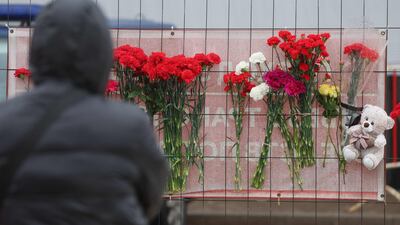
A makeshift memorial in front of Crocus City Hall, a day after the gun attack. AFP -
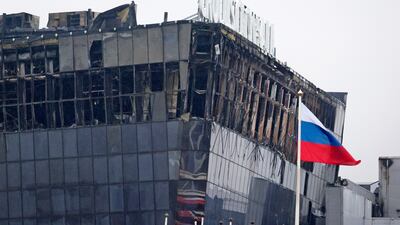
The damaged Crocus City Hall after the attack, which was claimed by ISIS. AP Photo -

People attend a vigil in honour of the Moscow concert gun attack victims in the centre of Simferopol, Crimea. AFP -

Laying flowers in memory of the Moscow victims, in Simferopol. AFP -
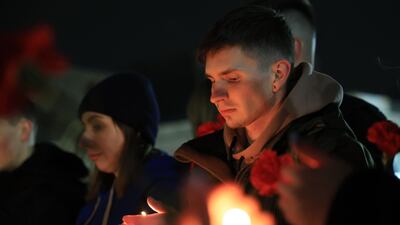
The vigil in Simferopol, Crimea. AFP -
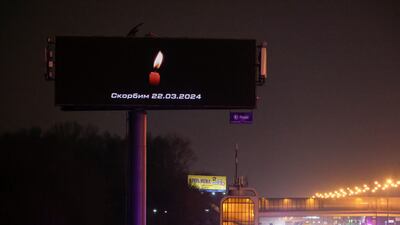
A digital board with a date and a slogan that reads 'We mourn' opposite Crocus City Hall. Reuters -

Emergency services personnel and law enforcement officers outside the hall after gunmen opened fire at concertgoers. AFP -

A fire spread through the building after the attack. AFP -

A firefighting helicopter douses flames at Crocus City Hall. AP -

Fire rises above the Crocus City Hall following the shooting. EPA -

Officers stand guard near the burning Crocus City Hall. Reuters -
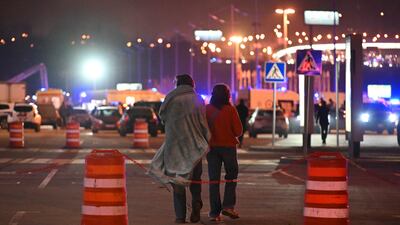
Russia tightened security at airports, transport hubs and across the capital - a vast urban area of more than 21 million people. AP -
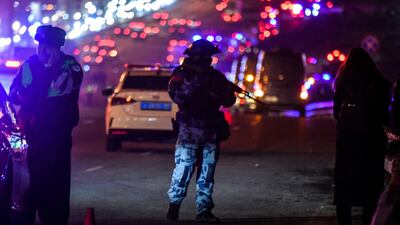
All large-scale public events were cancelled across the country. AFP -

A medic stands near ambulances parked outside the burning concert venue. AP -
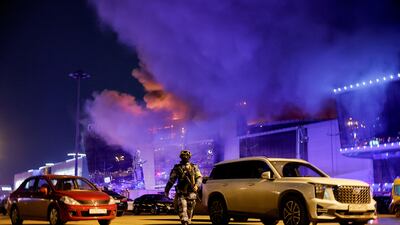
Plumes of black smoke rise above Crocus City Hall after the attack. Reuters -
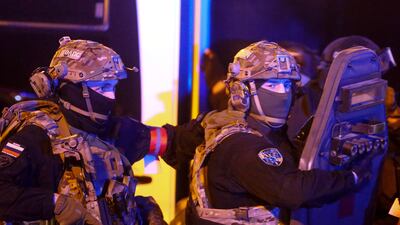
Members of Russian special operations forces gather at the building after the shooting. Reuters -

Smoke rises above the venue following the shooting. Some witnesses reported explosions. Reuters -
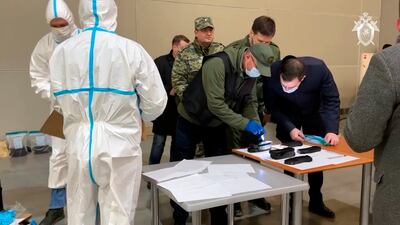
Investigators and intelligence services officials at the scene after the attack. AP -

An assault rifle lies on the ground as investigators work at the scene. AP -
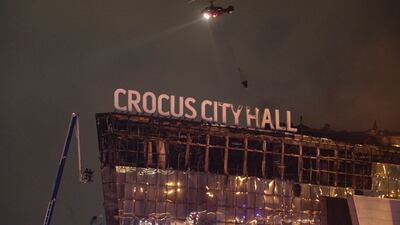
Russian firefighters at the venue. EPA


Now Mr Biden and Mr Blinken are both honourable men, I am sure. But it is hard to square what Mr Blinken said about Israel last November with the facts on the ground. By then, about 15,000 people had been killed in Gaza and most of the population was homeless, yet he said: “Israel understands the imperative of protecting civilians, the imperative of the humanitarian assistance.” Today, the death toll has doubled, with famine imminent, and yet food trucks are blocked from entering the territory.
In January, Mr Blinken declared: “We want this war to end as soon as possible.” Again, I am sure Mr Blinken is an honourable man, but some may be forgiven for doubting that he truly meant what he said.
After all, in 1982 then-US president Ronald Reagan was able to call then-Israeli prime minister Menachem Begin about the Israeli bombing of Beirut and say: “I want it to stop and stop now.” Couldn’t Mr Blinken’s boss have done the same to Israeli Prime Minister Benjamin Netanyahu if they really wanted the war to end “as soon as possible”? Or, as the EU’s foreign policy chief, Josep Borrell, pointed out in February: “If you believe that too many people are being killed, maybe you should provide less arms in order to prevent so many people being killed.”
Why did Mr Biden say last November, “I never really thought that I would see and have confirmed pictures of terrorists beheading children”, only for his officials to deny that same day that he had done any such thing?
To take another issue: the blowing up of several sections of the Nord Stream gas pipelines in the Baltic Sea in September 2022.
A few months previously, Mr Biden had stated that if Russia invaded Ukraine, “then there will no longer be Nord Stream 2. We will bring an end to it”. In the immediate aftermath, in a posting he then deleted, Polish Foreign Minister Radek Sikorski wrote: “Thank you USA!” And a few days after the explosions, Mr Blinken described them as “a tremendous opportunity to once and for all remove the dependence on Russian energy and thus to take away from Vladimir Putin the weaponisation of energy as a means of advancing his imperial designs”.

Mr Blinken denounced as “absurd” the suggestion that the US or its partners were in any way responsible for the incident, but he said, “we will get to the bottom of what happened” and share the information “as soon as we have it”. It’s now 18 months on, and yet supposedly no one knows who was responsible. Is it even vaguely credible that the CIA or US State Department have no inkling about who committed this undoubtedly illegal act?
Going further back, we all remember the misleading statements – to put it politely – by US officials about WMDs and Saddam Hussein’s supposed connections with Al Qaeda that led to the catastrophic war in Iraq.
The history of CIA cover-ups, including allegations of lying to the US Congress, is well known. It hasn’t quite got to the point that then-UK chancellor Gordon Brown had with then-prime minister Tony Blair in 2004, when Mr Brown supposedly told him: “There is nothing that you could say to me now that I could ever believe.” But it would be fair to conclude that you’d have to be exceptionally credulous to assume that something was true just because a US official said that it was.
Who would I trust? I believe the word of my colleagues at this newspaper, I believe my old friends at Al Jazeera English, I believe clear-sighted analysts such as Kishore Mahbubani, Shashi Tharoor and Christiane Amanpour, I believe in the statements of UN officials, and I believe peace-seekers such as the Israeli activist Ami Dar, who’s been truly inspiring on X throughout all this time.
There is a prominent American I would also believe: former president Jimmy Carter, whom I also had the honour of once interviewing. Mr Biden and Mr Blinken may indeed be honourable men, but their credibility does not match that of the great patriarch of the Democratic Party.
It is America’s and the world’s loss that we cannot be one hundred per cent certain that what they tell us is true.

