

Amid the prevailing pessimism surrounding Israel’s brutal war in Gaza and the potential expansion of the conflict into Lebanon, there may be a glimmer of cautious optimism.
Based on my understanding, officials in the US and Europe believe that Israel is willing to engage in a diplomatic solution with Lebanon. It is predicated on the idea that Israel would separate the issue of instability on its northern border from the Gaza war. This is driven in large part by public demands for a resolution to the displacement of 140,000 Israelis from the north and uncertainty about Hezbollah’s advanced missile arsenal on the other side of the border.
Further, negotiations for a ceasefire in Gaza have not been disrupted by the recent killing of more than a hundred Palestinians by Israeli forces at Al Nabulsi roundabout, south-west of Gaza City. Hamas has only threatened to halt the negotiations if such incidents are repeated, while maintaining its commitment to deliver its final draft on the ceasefire.
Meanwhile, American diplomats are engaging with their Arab counterparts to ensure security guarantees and a roadmap towards a gradual transition to Palestinian control over Gaza, provided that discussions about the future and form of a Palestinian state would gradually follow.
On Lebanon, I am given to understand that the coming week could witness a visit by the US envoy Amos Hochstein, perhaps as soon as a temporary ceasefire in Gaza appears assured. Mr Hochstein brings with him a roadmap to implement UN Security Council Resolution 1701 – intended to resolve the 2006 Lebanon War – and a mechanism leading to the institutionalisation of the Blue Line that separates Lebanon from Israel.

Mr Hochstein apparently hopes to reach a formula to re-stabilise southern Lebanon and northern Israel, backed by US guarantees. This would involve Hezbollah withdrawing to the north of Litani River within a range of seven to 10 kilometres. Lebanon’s armed forces will then take over the administration of that area.
In return, Israel would pledge to halt violations of Lebanese sovereignty that include conducting sorties in its air space.
We should, of course, not get ahead of ourselves. For we are talking here not about peace, but rather stability. There is currently little prospect for a peace treaty or normalisation, but there is a careful consideration of the cost of a potential major war between Hezbollah and Israel.
While Hezbollah isn’t enthusiastic about withdrawing to the north of Litani River, it may need to reposition itself if Mr Hochstein’s efforts secure the required assurances from Israel (and from Iran). These are face-saving formulas.
The Biden administration is making every effort to address Israel’s reticence. It is seeking to garner support from all of the Middle East’s stakeholders to ensure that President Joe Biden’s re-election campaign is not marred by the worsening or spreading of conflict. The discussions, therefore, are aimed at securing temporary arrangements – which entail stability – rather than arriving at a comprehensive settlement.
Likewise on the Palestinian front, talks aren’t aimed at getting a final resolution but about securing preliminary arrangements.
Discussions with the relevant stakeholders are focused on three stages: cessation of hostilities in tandem with Israel building a separation barrier; a transfer of control in Gaza to the Palestinian Authority and the formation of a technocratic government; and the convening of an international conference for discussions on a Palestinian state.
-

King Abdullah II of Jordan, left, on board a military aircraft during an operation to drop humanitarian aid over the southern Gaza Strip. AFP -
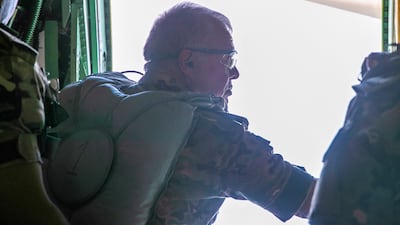
The Jordanian monarch took part as planes flew low to drop the parcels containing food, medicine and fuel. Reuters -
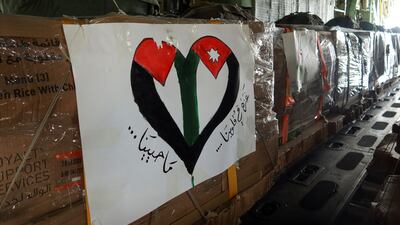
Aid parcels to be airdropped along the Gaza coast are loaded onto a plane, in co-operation with Egypt, Qatar, France and the UAE, in Zarqa, Jordan. Reuters -
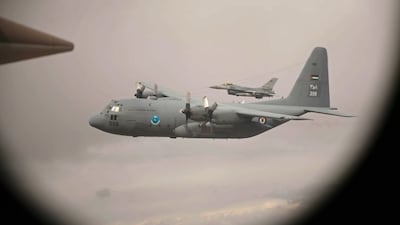
Three Jordanian planes, and one each from Egypt and France, took off from a base in Zarqa, east of Amman, for the relief operation. AFP -
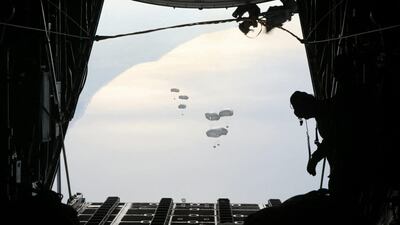
A Jordanian military aircraft dropping relief goods over the southern Gaza Strip. AFP -
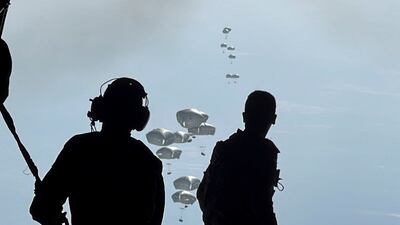
The planes dropped the crates of aid after flying to Gaza from the Mediterranean, and after obtaining Israeli clearance, source said. Reuters -

The French involvement showed 'the important role of the kingdom in unifying international efforts' on aid for Gaza, Jordanian army spokesman Brig Gen Mustafa Al Hiyari said. Reuters


Initially, there was hope that the October 7 attacks – as devastating as they were – could pave the way for a “grand bargain”, transitioning the Middle East towards peace. However, enthusiasm has since waned due to Israel’s apparent intransigence and the clear rejection by the Israeli public opinion and government of the “two-state solution”. And despite the Biden administration’s diplomatic outreach in the region, anticipating the fate of the Israel-Gaza war and that of Israel’s low-intensity conflict with Hezbollah remains challenging.
This is why there is no longer any discussion about a possible grand bargain, or a permanent settlement, or an opportunity for a qualitative leap in the Arab-Israeli conflict. Rather, the post-October 7 language in western capitals today leans heavily on phrases such as “containment”, and “initiating a process” that does not necessarily lead to the establishment of the Palestinian state within the 1967 borders and with its capital in East Jerusalem.
The situation today echoes old sentiments and hopes for an “eventual” resolution to the Arab-Israeli conflict.
The broader conflict had evolved in recent years, as it had become almost limited to a Palestine-Israel dispute, with the Iranian regime claiming to be the custodians of the Palestinian cause. But Iranian one-upmanship today is not military in nature but rather conciliatory after Tehran prioritised its bilateral relations with the Biden administration. Tehran even shirked responsibility for Hamas’s “calculated adventures” on October 7 and the subsequent, and devastating, Israeli retaliation.
In a sense, the new-old dynamic involves a return to the language of “process” – a term entrenched for decades in the expression “peace process” in the Middle East.

