


It is easy to look at the way British MPs behaved over calls for a Gaza ceasefire last week and weep.
Faced with the urgent question of how to end the Israel-Gaza war and all its spill-over consequences, there was universal agreement that the fighting must stop. There the unity stopped.
Opposition group the Scottish National Party threw down a challenge to the bigger parties with a motion calling for an immediate ceasefire. What happened next was a meltdown of epic proportions in the 650-member UK Parliament.
The events are still unfolding. But these are not in relation to Gaza where the suffering goes on, nor in relation to diplomatic efforts to bring the Israeli military campaign, launched in the wake of the October 7 Hamas assault, to a halt. What is happening in London is a demonstration that Parliament is dangerously detached from the public.
I take seriously the point that individual MPs feel threatened by hostility from parts of the community. The global point to take, though, is that Parliament is at a juncture where it has failed to represent public opinion.
It is no longer acting as a tribune of the people. Its place in the nation, as the forum where issues of the day are given an airing, has disappeared into a black hole. The working out of common understandings on the most divisive issues should be its foremost task. Now the House of Commons has reached the juncture of not being able to give the opposing sides a full hearing so that the will of the chamber can be expressed.
-
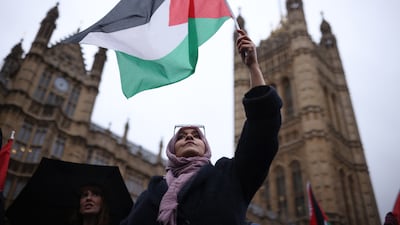
A protester waves a Palestinian flag during a rally outside the UK Parliament in London calling for a ceasefire, as MPs consider a motion on Gaza on February 21. Getty Images -
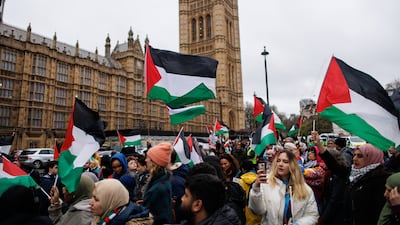
Pro-Palestinian protesters queue for the House of Commons public gallery as British MPs debate a motion in Parliament on calling a ceasefire in Gaza. EPA -
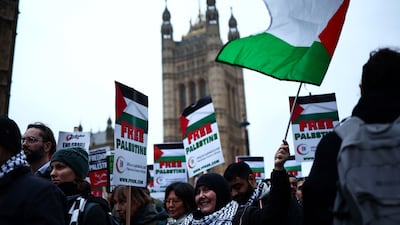
Demonstrators wave Palestinian flags in Parliament Square, London. AFP -
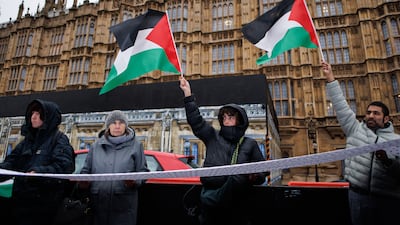
Protesters queue for the House of Commons public gallery. EPA -
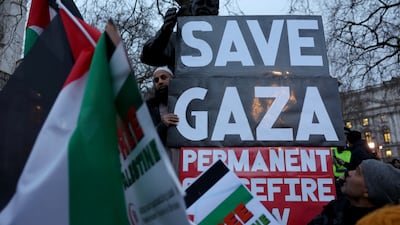
The protest outside the House of Commons. Reuters -
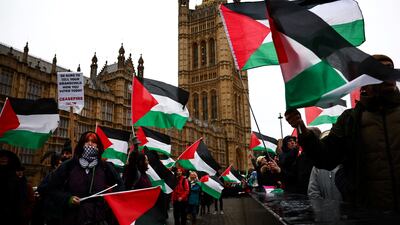
The protest in Parliament Square. AFP -
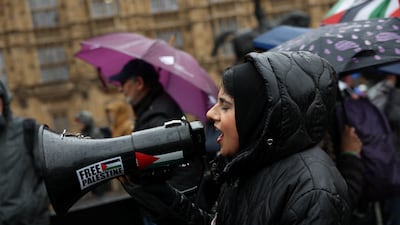
Campaigners queue to lobby MPs in Parliament before the Gaza ceasefire vote. Reuters -
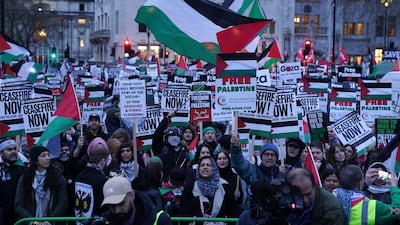
People gather for the Palestine Solidarity Campaign outside the Houses of Parliament. PA -
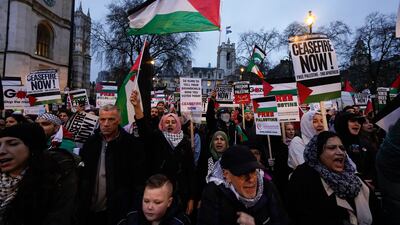
People take part in a Palestine Solidarity Campaign rally outside the Houses of Parliament, London. PA -
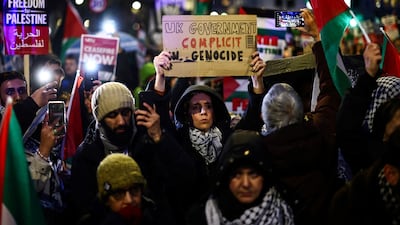
Demonstrators wave Palestinian flags and hold placards in Parliament Square. AFP -
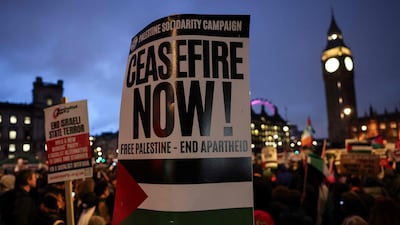
The protest in Parliament Square as the House of Commons voted on a call for an immediate ceasefire in Gaza. AFP


It is something unprecedented – a failing that cannot be allowed to pass. To those outside the country scratching their heads that Speaker Lindsay Hoyle is under pressure to resign over Gaza, the explanation lies in this collapse of authority for the mother of parliaments.
At the outset, it is true that almost all MPs and leaders desperately want the war to end.
The government has said that it is pursuing a humanitarian pause to get aid to the trapped population. It also wants the hostages returned and insists that Hamas cannot be left in control. The opposition Labour party is also committed to a policy of an immediate humanitarian ceasefire, predicated on the return of the hostages.
Labour MPs are worried about the effect of the policy on their support base. Not just Muslim voters but many others are outraged. A crowd of demonstrators was outside Parliament on Wednesday to peacefully make this point.
Inside the building, the pressure on Labour went into overdrive. Brutal politics then kicked into gear. Shabana Mahmood, the shadow justice secretary and the only Muslim in Labour’s top leadership, warned that there would be frontbench resignations if MPs were not able to vote for a ceasefire that night.
Labour leader Keir Starmer’s office set its sights on its own wording that would give more qualification than the Scottish National Party’s version. But it was the SNP’s opposition day. Suddenly the third party found itself relegated to the end of the debate. Uproar ensued. This turned into chaos when the government announced that it would abandon its own motion, too, because Mr Hoyle had allowed Labour to leapfrog the rule book.
Mr Hoyle has apologised. The look that he was working at Mr Starmer’s behest was not a good one. About 70 MPs – more than 10 per cent of the body – are now backing a no-confidence vote against the Speaker and his removal.
His former colleague Lord Walney has produced a report warning that MPs are in danger as a result of the tensions surrounding UK politics. He has described experiences of “aggressive intimidation” that he says should not be allowed as a measure of protection for the politicians. He wants the government to produce new guidance to police forces to break up the protests, not just outside Parliament, but at other gatherings too.

“And I think we ought to be looking at those sites that are crucial to the functioning of democracy on a national or local level, like MPs’ offices, like local council chambers, like Parliament itself,” he said. “[I want] an easier and a faster process that, where those areas are being encircled by the kind of angry aggressive protests that have that implied sense of threat, as we are seeing, to give the police the ability to disperse them more quickly, which is clearly not happening at the moment.”
Yet the bigger picture is not getting much of a look in. Tell Mama, an organisation that measures anti-Muslim hate, recorded 2,010 cases of abuse between October 7, 2023 and February 7 this year – a more than tripling of incidents. Two thirds of those targeted were Muslim women. Almost half of all hate crimes were directed at Muslims.
The timing of the Westminster farrago for Mr Starmer could not be worse because a new challenge to his position as opposition leader is just over the horizon next week.
Former MP George Galloway, who has made serial comebacks on the back of his long history of campaigning on Palestinian issues, is reportedly a frontrunner for the vacant seat of Rochdale. The bombastic, hat-wearing street fighter will have to overcome Azhar Ali, the Labour’s official candidate but for whom the party recently withdrew its support after his controversial remarks about Israel.
He remains on the ballot but if his zombie campaign fails, Mr Starmer will have to endure yet another maiden speech by Mr Galloway playing to the galleries of protest.

