


Turning 21 was celebrated as coming of age when Col Tim Collins was growing up in Northern Ireland. Fittingly, it is 21 years since the Iraq war veteran made his name in Kuwait, addressing his troops on the eve of the launch of the second war against Saddam Hussein.
Col Collins was recognised on screen when Kenneth Branagh, a fellow Belfast boy, played him in 10 Days to War, a TV examination of the conflict. In fact, the Branagh version of Col Collins’s peroration is the only one that exists: no TV news camera was on hand in the desert for his stirring words.
Since then, he has spent much of his career on mediation and brokering peace as well as more straightforward security work. He has used his upbringing in a troubled land and his soldier’s experience to try to help others find a way to peace.
Last week saw a coming of age of a different sort for the now 64-year-old Col Collins. He is standing for a party that in his childhood ran Northern Ireland until the uprising of its Catholic minority. That fostered the terrorist campaign and British army deployment that was only addressed in 1998 with the Good Friday Agreement.
Col Collins’s announcement comes as Northern Ireland is poised to see yet another twist in its tortured efforts to ensure that its Protestant unionists – which includes Col Collins – share power with the Catholics.
On the day he stepped back into public life, he made some pointed remarks about the region not “clinging to the past”. “We have got to remember we have young people,” he said. “We need better health services, we need better education, we need to spend the money where it is required, we need to move on.”
Fair enough, but Col Collins could not tear down the political fabric of Northern Ireland if he wanted to.
The term “frozen conflict” centres on long-running disputes, especially in the former Soviet Union and the Middle East. Northern Ireland’s is a deeply frozen reconciliation process and every effort to resolve it is actually highlighting its obvious flaws.
The Good Friday Agreement was designed to give a fresh start to the politics of Northern Ireland while creating brave new dimensions. It had an ideal of “parity of esteem” for both communities’ aspirations to be treated as fully legitimate. In time, this would unite the divided communities. And yet to this day, parallel worlds exist in antagonism.
Col Collins is standing for a seat regarded as Northern Ireland’s prosperous golden coast just outside Belfast. His candidacy was announced at a yachting marina in the town of Bangor.
When I visited the Bangor Marina at the weekend, there was little of note but for a grey-haired man trying to teach an elderly dog some new tricks. It is a place of coastal prosperity and uniformity. Even so, Col Collins would be well advised to use his background to inject some urgency into Northern Ireland politics if he wins.
A revolving door of collapsed Northern Ireland governments has dominated the past seven years. Even if Col Collins’s rivals in the largest unionist party, the DUP, agree at a crucial meeting on Monday night to stand up, a new executive bickering is likely to remain the dominant driver of local politics.
Cultural divisions thrive because there are hardships. Hospital services, for instance, are on the skids.
The British government is offering an infusion of more than £3 billion ($3.8 billion) of extra public spending for the new administration to turn the corner. But there is a paradox that the Westminster authorities are negotiating this with only one side.
-

Former British prime minister Tony Blair and former Taoiseach Bertie Ahern sign the Good Friday agreement on April 10, 1998. This year marks 25 years since the signing of the historic agreement. PA -
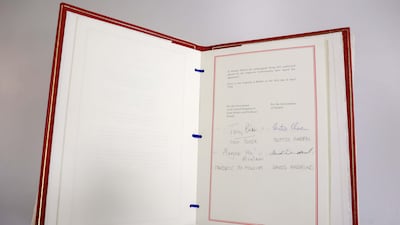
The original Good Friday agreement. PA -
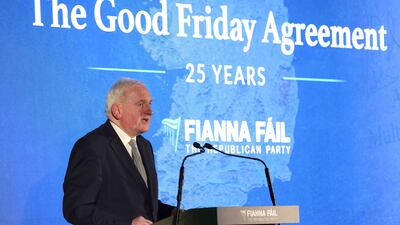
Mr Ahern speaking at University College Dublin at an event organised by the Fianna Fail party to commemorate the 25th anniversary of the Good Friday Agreement in Dublin. PA -
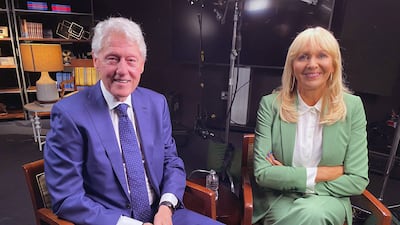
RTE television presenter Miriam O'Callaghan with former US president Bill Clinton, who appeared on Prime Time in April to mark 25 years of the agreement. PA -
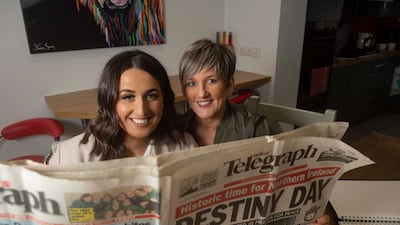
Erin McArdle, left, who was born on April 10, 1998, and her mother Caroline, hold The Telegraph which was published on the same day, at her home in Ballymena in Northern Ireland. EPA -
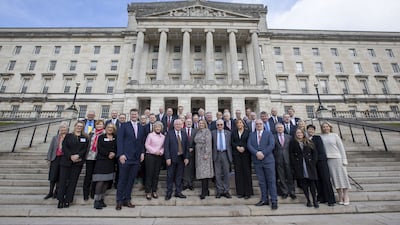
Attendees of the 63rd Plenary of the British-Irish Parliamentary Assembly pose together in March on the steps of Parliament Buildings in Stormont in Belfast, to mark the 25th anniversary of the agreement. PA -
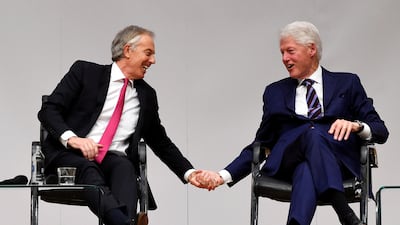
Mr Blair and Mr Clinton hold hands an event to celebrate the 20th anniversary of the Good Friday Agreement in Belfast, Northern Ireland, on April 10, 2018. Reuters -
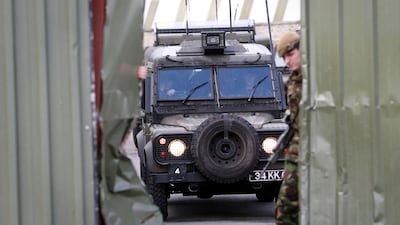
British army soldiers from 2nd Battalion, The Prince of Wales Royal Regiment, leave Bessbrook British army base for the last time in South Armagh in Northern Ireland, on June 25, 2007. AP -

Mr Blair, former US Senator George Mitchell and Mr Ahern, at Downing Street, London, to announce a review of the Northern Ireland peace process in July 1999. PA -
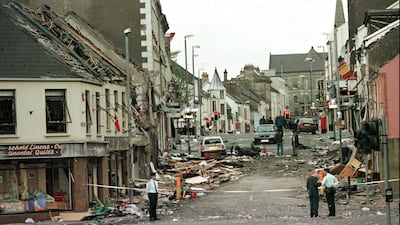
Royal Ulster Constabulary Police officers stand on Market Street after a car bombing in the centre of Omagh in Northern Ireland, in August 1998. AP -
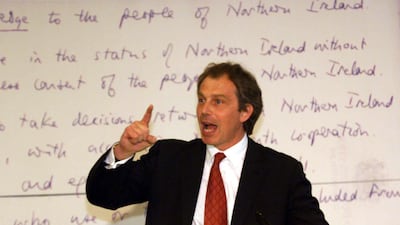
Mr Blair argues his case for the Yes vote in the peace referendum at the University of Ulster in Northern Ireland in May 1998. PA -
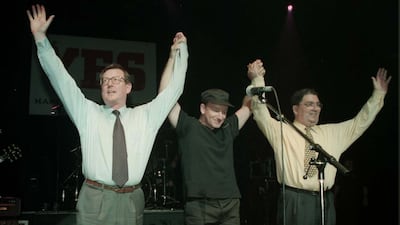
Ulster Unionist leader David Trimble, U2 singer Bono, and SDLP leader John Hume on stage for the 'YES' concert at the Waterfront Hall in Belfast in May 1998. PA -
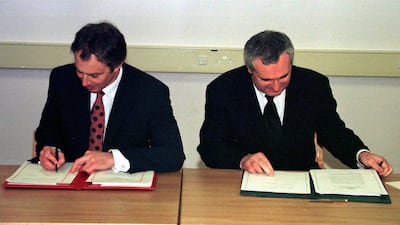
Mr Blair and Mr Ahern sign the Good Friday Agreement on April 10, 1998. PA -

Mr Blair, former US senator George Mitchell, and Mr Ahern pose after signing the agreement. AP -
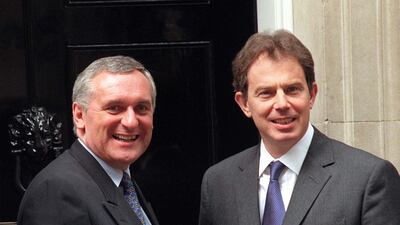
Mr Blair greets Mr Ahern at Downing Street, London, in July 1997. PA -
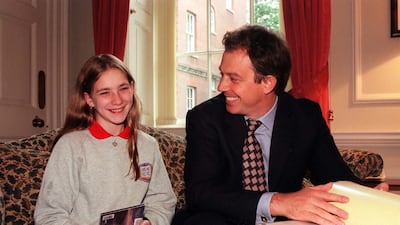
Mr Blair and a Belfast schoolgirl, Margaret Gibney, inside 10 Downing Street in June 1997. Ms Gibney had become popular around the world after she asked Mr Blair to bring peace to Northern Ireland. PA -
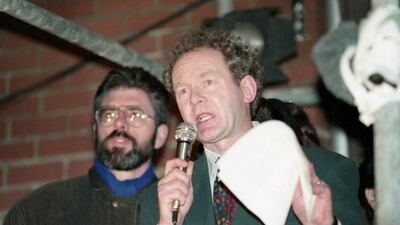
The Sinn Fein's deputy leader, Martin McGuinness, and leader Gerry Adams at a rally in Belfast in December 1994. AP -
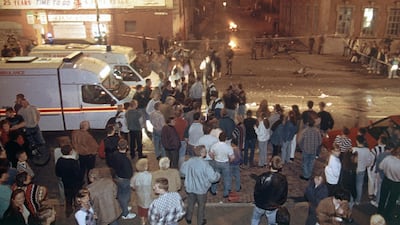
People gather at the scene of a car bomb explosion outside the Sinn Fein headquarters in West Belfast in Northern Ireland in September 1994. AP -
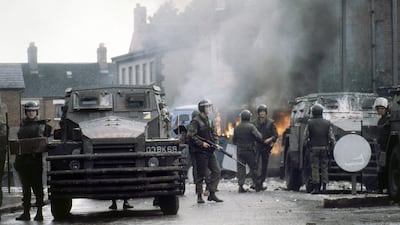
British troops with armoured vehicles surround a blazing barricade near the Andersonstown Police Station in Belfast in 1979. AP -
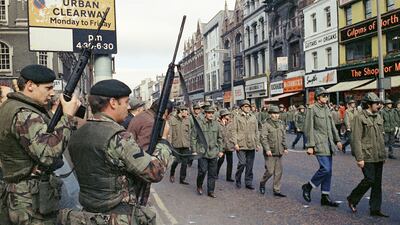
British troops look on as members of the Ulster Defence Association march through Belfast in 1972. AP


Its talks are with the DUP and its leader Jeffrey Donaldson. The deal, if it happens, will confirm Michelle O’Neill, the leader of the Republican party Sinn Fein, as the first minister of Northern Ireland and Mr Donaldson as the deputy first minister. Under the “parity of esteem” principle, however, both will have equal power.
The acid test is how to widen the telescope to drive changes across Northern Ireland society.
There is much to do. In the Belfast newspapers this weekend, there is a hometown movie that won a Sundance Film Festival award. Normally this would be treated as seismic, but not so in two of the three morning papers. The movie is titled Kneecap and the contents are decidedly Republican.
One local report took the names of the three protagonists in the movie, who are all Gaelic, and translated them for its audience in their own hometown. The report said one of the protagonists, JJ O Dochartaigh, is “usually Anglicised as O’Doherty”.
There is a name for this: it is blatant othering. In the context, it is hate-mongering.
The last O’Neill to lead Northern Ireland, before Michelle O’Neill’s presumptive elevation, was a Protestant former captain in the British Army. On the edge of the abyss in 1968, Capt O’Neill said the place was at a crossroads. He warned that an entity based on “one section rather than upon the interests of all could have no long-term future”.
As for Col Collins, he has a small chance of redemption after the hollow legacy of his 2003 words. His challenge now, really as it was in Kuwait, is a “better place for us having been there – our business now is north”.

