


On Tuesday, the opposition alliance called “INDIA” will meet in Delhi to discuss its strategy for the general election in May 2024.
As leaders of the 28-party coalition put their heads together to find the best way to defeat the ruling Bharatiya Janata Party (BJP), there is a sense that the writing is already on the wall. The BJP appears likely to win a third straight general election, under the leadership of Prime Minister Narendra Modi, and govern the country for another five years.
Several of India’s pollsters are predicting that the BJP-led National Democratic Alliance will win more than 300 of the 543 seats in the lower house of Parliament. According to one, the BJP alone will end up with 323 seats and INDIA with just 163 seats.
The point is that INDIA’s poll strategy is as clear as mud, while people know exactly what to expect from the governing party.
During the last two general elections, in 2014 and 2019, the BJP’s campaign fundamentally rested on three pillars: Hindutva (or political Hinduism); hypernationalism; and welfarism targeted at the country’s poorest citizens. This combination has worked wonders for the party and, for now, there is no reason for it to reinvent the wheel for 2024.

The BJP has structural advantages, too: its organisational strength is unparalleled; it has a huge war chest; and it has in Mr Modi an excellent messenger to articulate its agenda. But while these strengths make a world of difference for any campaign, they are secondary to the agenda itself.
What is it that INDIA can offer to the voters as a credible alternative to Hindutva and hypernationalism? The BJP has built a narrative of an emerging “New India” that is culturally Hindu and is on its way to becoming a “Vishwaguru”, or a teacher to the world, particularly at a time of great global instability.
Whatever the truth about the state of India’s economy and the challenges it faces on its northern border with China, the BJP’s narrative-building talents evoke a sense of national pride and an optimism that India’s rise to become a superpower is only a matter of time. And that one man is making this happen: Mr Modi.
Weighed against this, what is INDIA’s vision for India? For now, it has nothing concrete to offer.
The primary challenge for the alliance is that its constituents have differing ideologies. Within the coalition there are Gandhians, Ambedkarites, western classical liberals, socialists, communists and even a Hindu right-wing party and a Muslim party. What then is the glue that binds them? It appears to be little more than a singular aim of unseating Mr Modi and his BJP from power.
The alliance has, therefore, largely engaged in a negative campaign targeting the BJP and Mr Modi personally, raising issues such as institutional corruption, cronyism, societal polarisation and the decline of the country’s democratic institutions. While some of these issues need to be highlighted, the negativity around its campaigns – without providing solutions – have put off many voters.
Attacking the BJP may appeal to the respective parties’ bases, but it’s unlikely to wash with many traditional BJP voters who might nonetheless be looking for an alternative, or the millions of swing voters who are seeking change but don’t find “anti-BJPism” a compelling enough reason.
With one of Mr Modi's most consistent calls being to end dynastic politics, today he simply points to more than half the parties in INDIA and calls them out for having effectively become family firms with no agenda beyond preserving their own power.
-
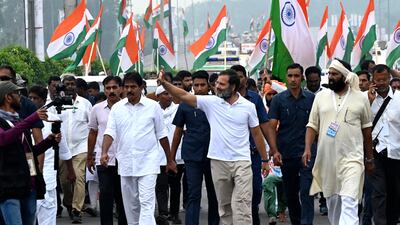
Rahul Gandhi, centre, a leader in India's Congress party, takes part in the Bharat Jodo Yatra, or Unite India March, on the outskirts of Hyderabad on November 1 last year. The march is a five-month, 3,570km trek through 12 states. AFP -

Rahul Gandhi marches on the outskirts of Hyderabad in 2022. AFP -

Rahul Gandhi, centre, during the march. AFP -

Rahul Gandhi throws flower petals towards press photographers during a march in New Delhi on December 24 last year. AP -

Rahul Gandhi and his supporters march in New Delhi. Reuters -

People wait for the Unite India March, led by senior Congress party figure Rahul Gandhi, in New Delhi on December 24. Reuters -
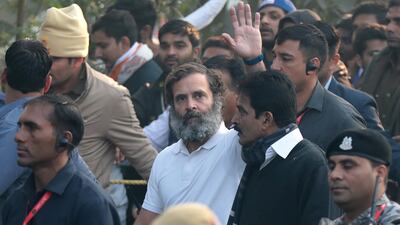
Rahul Gandhi began the Unite India March, aimed at regaining political relevance, in Kanyakumari in the Tamil Nadu state on 7 September last year. EPA -

Opposition Congress leaders and supporters march in New Delhi on December 24. AP -

Rahul Gandhi addresses the crowd at the Red Fort during the Unite India March in Delhi. Reuters


It’s not that the alliance doesn’t have interesting ideas.
Some of its constituents have called for decentralised governance, citing the Constitution that describes India as a “union of states” first and then a nation. In 2019, the Indian National Congress promised to devolve power to local governments, which, given the size of the country, is still a welcome suggestion five years later. Also in 2019, Congress floated the idea of a universal basic income, which is being tested at local levels around the world.
But because these were half-heartedly presented as half-baked ideas in past elections, people didn't buy into them. The least INDIA can do is to flesh them out and create attractive narratives around them for 2024.
As discussed in a previous column, one of INDIA’s agendas has been to call for a nationwide caste census to reconstitute government welfare programmes. But only one state whose government is run by parties within the INDIA alliance – Bihar – has released the results of its state-wide caste survey.
Congress, on the other hand, has delayed releasing the results of a caste survey its government in Karnataka state conducted years ago. It worries that the results could pose problems for its own vote base, with many among them belonging to castes that might end up losing out if the welfare pie gets redrawn.
However, such pussyfooting will only prompt voters to ask whether INDIA’s call for a nationwide caste census is merely an election ploy – and justifiably so.
Another sign of mixed messaging has been Congress’s peddling of “soft Hindutva” during recent election campaigns in Madhya Pradesh and Chhattisgarh.
One of the reasons the BJP ended up defeating Congress in these elections is that, given a choice between a party that offers hard, unbridled Hindutva (the BJP) and one that makes token Hindutva gestures (Congress), voters will prefer the real thing to the cheap imitation.
So what options does INDIA have?
Perhaps, by bringing together some of the aforementioned ideas and others that are no doubt being discussed, the alliance can build an overarching narrative around rediscovering “Old India”. It is an India that Mahatma Gandhi and his generation of freedom fighters had imagined, where secularism, egalitarianism and decentralisation were meant to thrive.
If INDIA is to present itself as a genuine alternative to the BJP and challenge its imagination of a New India that is more assertive and unabashedly Hindu, then in the absence of other ideas a re-imagination of the values espoused by Gandhi may be the way forward.
Whatever they do, one thing is clear: without an ideological scaffolding, come 2024 India’s opposition parties are going to find out what the bitter end of the swearing-in ceremony feels like – once again.

