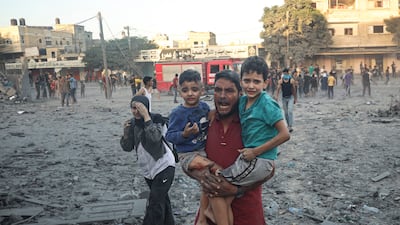
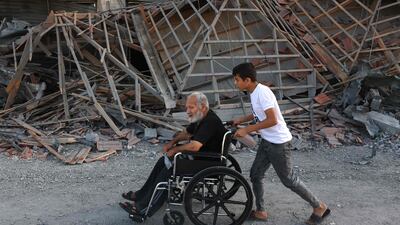
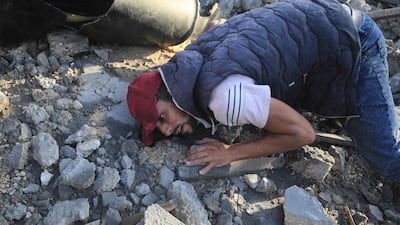
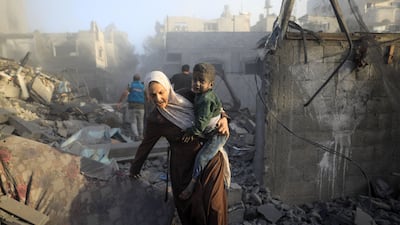
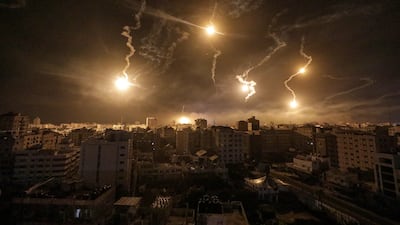
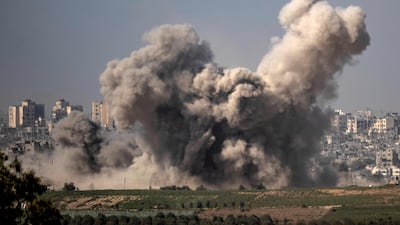
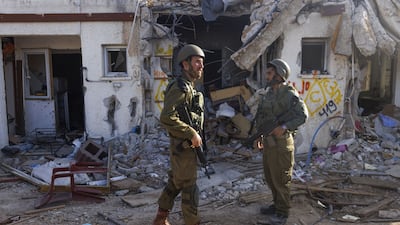
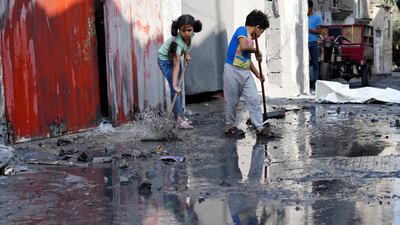
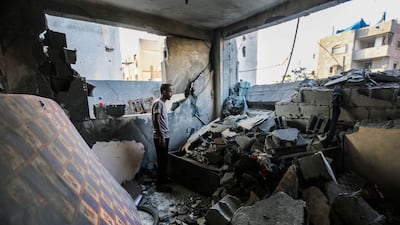
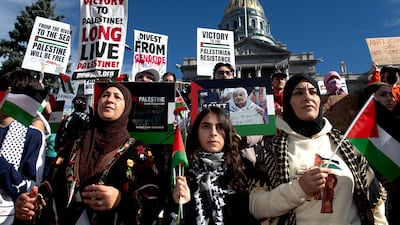
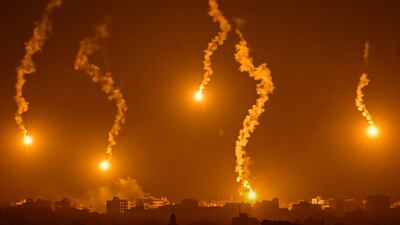
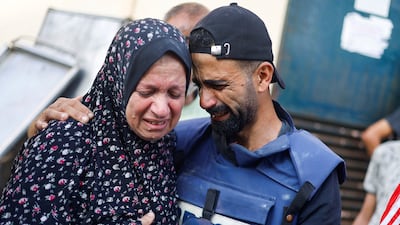
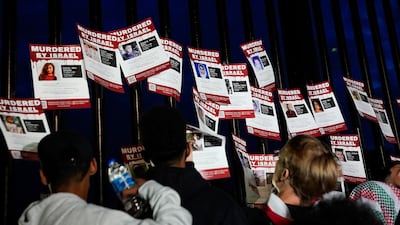
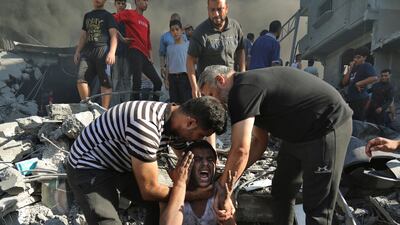
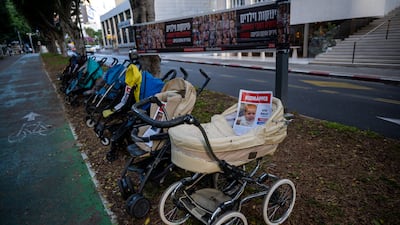
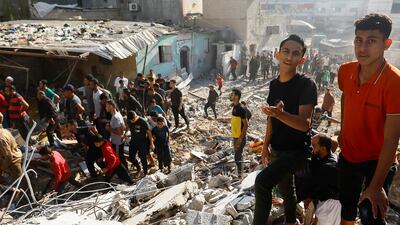
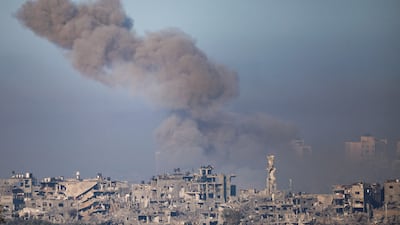
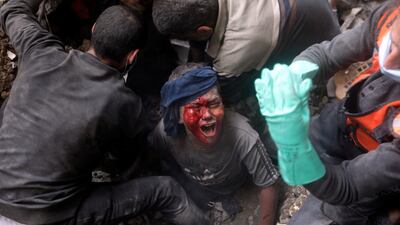
One month into the horrifying Israel-Gaza war and there are ample indications that it may be just starting. Another familiar scenario, however, suggests that it could end much sooner than many anticipate. Much depends on the US, the only power that Israel is currently inclined to listen to, but whose influence following the Hamas-led killing spree on October 7 is untested.
This latest Grand Guignol horror-show between Israelis and Palestinians has a familiar look: a provocation by a Palestinian or Lebanese militia, followed by demands for their total elimination and the "restoration of deterrence" by Israel, growing international condemnation and some visible American discomfort with Israeli war crimes and Arab suffering that ultimately brings fighting to an end.
This time, however, Israel was at least initially serious in vowing that Hamas as a viable organisation must be destroyed. Such practically unachievable war aims write the other side's victory speech for them. Israel has apparently walked into a gigantic trap, but one that will unfold gradually and over time.
It is not that Hamas has unexpected weapons and tactics for killing or capturing Israeli reservists, although they may well. Rather, Hamas is clearly hoping Israel will allow itself to be drawn into a long-term ground presence in Gaza, so that Hamas can eventually organise a potent guerrilla insurgency against occupation forces. This will probably begin slowly, as hidden pockets of Hamas operatives either regroup in Gaza or return to it from neighbouring areas, or the insurgency has to be built almost from scratch.
Either way, if Israel is bogged down in a ground presence that it cannot fob off on anyone else – and who else would want to inherit a devastated and decimated Gaza Strip, along with the inevitable insurgency that would be visited on whoever appears to be acting on behalf of the occupation – such an insurgency is virtually inevitable.
Insurgencies build momentum over time, and Hamas plans to argue that, as it picks off Israeli soldiers individually or in small groups on a weekly basis, it alone is battling occupation forces over control of Palestinian land. They will draw the contrast with the Palestinian Authority and its security co-operation with Israel in the occupied West Bank, and the Palestine Liberation Organisation sitting, alone, at the negotiating table, waiting for non-existent talks.
Hamas was founded by the Muslim Brotherhood during the First Intifada in 1987 to eventually take over the Palestinian national movement from the secularists in Fatah, the PLO and the PA. In one of its most reckless and self-destructive policies, the Israeli right consistently bolstered and protected Hamas, while also periodically and literally cutting it down to size and keeping it contained by Gaza wars cynically described as "mowing the grass". The parallel policy was to ensure that the PA remained in power in the West Bank, but terribly weak both politically and institutionally, and making absolutely no progress towards liberation or statehood.
In March 2019 Israeli Prime Minister Benjamin Netanyahu patiently explained to a meeting of Likud party Knesset members that, “Anyone who wants to thwart the establishment of a Palestinian state has to support bolstering Hamas and transferring money to Hamas.” In case anyone didn't fully understand, he continued, "This is part of our strategy – to isolate the Palestinians in Gaza from the Palestinians in the West Bank.” But obviously it was this "clever" policy of divide-and-rule that predictably culminated in the October 7 attacks. If Israelis are serious about their security, they will hold the authors of this policy to serious account.
Israel is on a quixotic mission to "destroy Hamas," which cannot be done, and to "restore deterrence," which also cannot be meaningfully accomplished except by ending, or at least moving towards ending, the occupation that began in 1967. Without substantive hope for eventual liberation, future October 7s are virtually guaranteed. But, instead, Mr Netanyahu and his Jewish supremacist cabinet colleagues – many of whom are presently trying to outdo each other in genocidal threats against the Palestinian people in Gaza and beyond – are moving inexorably towards large-scale annexation and, probably, mass expulsions.
Until the past few days, the Biden administration's main goal was to stop major fighting from spreading, particularly to include Hezbollah. But over the past month of mayhem this hasn't happened, and it probably won't unless there is a dramatic new development, especially fighting at holy places in occupied East Jerusalem, and above all, the Al Aqsa Mosque compound.
One of the few things all four key actors in this equation – the US, Iran, Hezbollah and Israel – strongly agreed about since October 7 is the imperative of preventing the war from spreading. That's primarily why it hasn't and probably won't.
In recent days, though, Washington has turned its attention to the need for a halt to fighting – marketed as a "humanitarian pause" to aid civilians – and implying that Israel needs to be careful not to go too far. This reminds everyone, especially Israel, that Washington has a limit to how much Arab suffering it can tolerate in its own interests, despite its practical and rhetorical embrace of Israel and refusal thus far to openly call for a ceasefire or say anything that would appear to draw a redline for Mr Netanyahu.
As usual, the ball is in Israel's court now. If it wants to pursue the folly of trying to practically destroy Hamas, it will be forced to initiate a prolonged ground presence in Gaza's urban streets. Israeli fantasies notwithstanding, no one else – not UN peacekeepers, an Arab expeditionary or police force, the PA security services, local Gaza residents, or anyone at all – is going to swoop in and rescue Israel from the disaster it has created over more than 60 years of occupation (since 2007 from the outside, by controlling the coastline, airspace, electromagnetic spectrum, and all but one crossing) not just for the Palestinians, but for itself, in Gaza.
The Israelis may eventually realise that the wisest course is to batter Hamas quickly and relatively cleanly, with as few civilian casualties as possible, and get out immediately, even if remnants of Hamas crawl out of the rubble and declare a resoundingly and obviously pyrrhic victory. All other plausible scenarios provide Hamas some version of what it was hoping to achieve before dawn on October 7. Such a victory would be all too real.
Live updates: Follow the latest on Israel-Gaza
MATCH INFO
Uefa Champions League final:
Who: Real Madrid v Liverpool
Where: NSC Olimpiyskiy Stadium, Kiev, Ukraine
When: Saturday, May 26, 10.45pm (UAE)
TV: Match on BeIN Sports
Infiniti QX80 specs
Engine: twin-turbocharged 3.5-liter V6
Power: 450hp
Torque: 700Nm
Price: From Dh450,000, Autograph model from Dh510,000
Available: Now
Will the pound fall to parity with the dollar?
The idea of pound parity now seems less far-fetched as the risk grows that Britain may split away from the European Union without a deal.
Rupert Harrison, a fund manager at BlackRock, sees the risk of it falling to trade level with the dollar on a no-deal Brexit. The view echoes Morgan Stanley’s recent forecast that the currency can plunge toward $1 (Dh3.67) on such an outcome. That isn’t the majority view yet – a Bloomberg survey this month estimated the pound will slide to $1.10 should the UK exit the bloc without an agreement.
New Prime Minister Boris Johnson has repeatedly said that Britain will leave the EU on the October 31 deadline with or without an agreement, fuelling concern the nation is headed for a disorderly departure and fanning pessimism toward the pound. Sterling has fallen more than 7 per cent in the past three months, the worst performance among major developed-market currencies.
“The pound is at a much lower level now but I still think a no-deal exit would lead to significant volatility and we could be testing parity on a really bad outcome,” said Mr Harrison, who manages more than $10 billion in assets at BlackRock. “We will see this game of chicken continue through August and that’s likely negative for sterling,” he said about the deadlocked Brexit talks.
The pound fell 0.8 per cent to $1.2033 on Friday, its weakest closing level since the 1980s, after a report on the second quarter showed the UK economy shrank for the first time in six years. The data means it is likely the Bank of England will cut interest rates, according to Mizuho Bank.
The BOE said in November that the currency could fall even below $1 in an analysis on possible worst-case Brexit scenarios. Options-based calculations showed around a 6.4 per cent chance of pound-dollar parity in the next one year, markedly higher than 0.2 per cent in early March when prospects of a no-deal outcome were seemingly off the table.
Bloomberg
The%20specs
%3Cp%3E%3Cstrong%3EEngine%3A%20%3C%2Fstrong%3E77kWh%202%20motors%0D%3Cbr%3E%3Cstrong%3EPower%3A%20%3C%2Fstrong%3E178bhp%0D%3Cbr%3E%3Cstrong%3ETorque%3A%20%3C%2Fstrong%3E410Nm%0D%3Cbr%3E%3Cstrong%3ERange%3A%20%3C%2Fstrong%3E402km%0D%3Cbr%3E%3Cstrong%3EPrice%3A%20%3C%2Fstrong%3EDh%2C150%2C000%20(estimate)%0D%3Cbr%3E%3Cstrong%3EOn%20sale%3A%20%3C%2Fstrong%3ETBC%3C%2Fp%3E%0A
Analysis
Members of Syria's Alawite minority community face threat in their heartland after one of the deadliest days in country’s recent history. Read more
Skewed figures
In the village of Mevagissey in southwest England the housing stock has doubled in the last century while the number of residents is half the historic high. The village's Neighbourhood Development Plan states that 26% of homes are holiday retreats. Prices are high, averaging around £300,000, £50,000 more than the Cornish average of £250,000. The local average wage is £15,458.
Mercer, the investment consulting arm of US services company Marsh & McLennan, expects its wealth division to at least double its assets under management (AUM) in the Middle East as wealth in the region continues to grow despite economic headwinds, a company official said.
Mercer Wealth, which globally has $160 billion in AUM, plans to boost its AUM in the region to $2-$3bn in the next 2-3 years from the present $1bn, said Yasir AbuShaban, a Dubai-based principal with Mercer Wealth.
“Within the next two to three years, we are looking at reaching $2 to $3 billion as a conservative estimate and we do see an opportunity to do so,” said Mr AbuShaban.
Mercer does not directly make investments, but allocates clients’ money they have discretion to, to professional asset managers. They also provide advice to clients.
“We have buying power. We can negotiate on their (client’s) behalf with asset managers to provide them lower fees than they otherwise would have to get on their own,” he added.
Mercer Wealth’s clients include sovereign wealth funds, family offices, and insurance companies among others.
From its office in Dubai, Mercer also looks after Africa, India and Turkey, where they also see opportunity for growth.
Wealth creation in Middle East and Africa (MEA) grew 8.5 per cent to $8.1 trillion last year from $7.5tn in 2015, higher than last year’s global average of 6 per cent and the second-highest growth in a region after Asia-Pacific which grew 9.9 per cent, according to consultancy Boston Consulting Group (BCG). In the region, where wealth grew just 1.9 per cent in 2015 compared with 2014, a pickup in oil prices has helped in wealth generation.
BCG is forecasting MEA wealth will rise to $12tn by 2021, growing at an annual average of 8 per cent.
Drivers of wealth generation in the region will be split evenly between new wealth creation and growth of performance of existing assets, according to BCG.
Another general trend in the region is clients’ looking for a comprehensive approach to investing, according to Mr AbuShaban.
“Institutional investors or some of the families are seeing a slowdown in the available capital they have to invest and in that sense they are looking at optimizing the way they manage their portfolios and making sure they are not investing haphazardly and different parts of their investment are working together,” said Mr AbuShaban.
Some clients also have a higher appetite for risk, given the low interest-rate environment that does not provide enough yield for some institutional investors. These clients are keen to invest in illiquid assets, such as private equity and infrastructure.
“What we have seen is a desire for higher returns in what has been a low-return environment specifically in various fixed income or bonds,” he said.
“In this environment, we have seen a de facto increase in the risk that clients are taking in things like illiquid investments, private equity investments, infrastructure and private debt, those kind of investments were higher illiquidity results in incrementally higher returns.”
The Abu Dhabi Investment Authority, one of the largest sovereign wealth funds, said in its 2016 report that has gradually increased its exposure in direct private equity and private credit transactions, mainly in Asian markets and especially in China and India. The authority’s private equity department focused on structured equities owing to “their defensive characteristics.”
The most expensive investment mistake you will ever make
When is the best time to start saving in a pension? The answer is simple – at the earliest possible moment. The first pound, euro, dollar or dirham you invest is the most valuable, as it has so much longer to grow in value. If you start in your twenties, it could be invested for 40 years or more, which means you have decades for compound interest to work its magic.
“You get growth upon growth upon growth, followed by more growth. The earlier you start the process, the more it will all roll up,” says Chris Davies, chartered financial planner at The Fry Group in Dubai.
This table shows how much you would have in your pension at age 65, depending on when you start and how much you pay in (it assumes your investments grow 7 per cent a year after charges and you have no other savings).
|
Age
|
$250 a month
|
$500 a month
|
$1,000 a month
|
|
25
|
$640,829
|
$1,281,657
|
$2,563,315
|
|
35
|
$303,219
|
$606,439
|
$1,212,877
|
|
45
|
$131,596
|
$263,191
|
$526,382
|
|
55
|
$44,351
|
$88,702
|
$177,403
|
The biog
Fatima Al Darmaki is an Emirati widow with three children
She has received 46 certificates of appreciation and excellence throughout her career
She won the 'ideal mother' category at the Minister of Interior Awards for Excellence
Her favourite food is Harees, a slow-cooked porridge-like dish made from boiled wheat berries mixed with chicken
Tank warfare
Lt Gen Erik Petersen, deputy chief of programs, US Army, has argued it took a “three decade holiday” on modernising tanks.
“There clearly remains a significant armoured heavy ground manoeuvre threat in this world and maintaining a world class armoured force is absolutely vital,” the general said in London last week.
“We are developing next generation capabilities to compete with and deter adversaries to prevent opportunism or miscalculation, and, if necessary, defeat any foe decisively.”
Batti Gul Meter Chalu
Producers: KRTI Productions, T-Series
Director: Sree Narayan Singh
Cast: Shahid Kapoor, Shraddha Kapoor, Divyenndu Sharma, Yami Gautam
Rating: 2/5
MATCH INFO
England 241-3 (20 ovs)
Malan 130 no, Morgan 91
New Zealand 165 all out (16.5ovs)
Southee 39, Parkinson 4-47
England win by 76 runs
Series level at 2-2
The Dark Blue Winter Overcoat & Other Stories From the North
Edited and Introduced by Sjón and Ted Hodgkinson
Pushkin Press
The specs
Engine: 3.0-litre six-cylinder turbo
Power: 398hp from 5,250rpm
Torque: 580Nm at 1,900-4,800rpm
Transmission: Eight-speed auto
Fuel economy, combined: 6.5L/100km
On sale: December
Price: From Dh330,000 (estimate)
The specs: McLaren 600LT
Price, base: Dh914,000
Engine: 3.8-litre twin-turbo V8
Transmission: Seven-speed automatic
Power: 600hp @ 7,500rpm
Torque: 620Nm @ 5,500rpm
Fuel economy 12.2.L / 100km
Brief scoreline:
Manchester United 2
Rashford 28', Martial 72'
Watford 1
Doucoure 90'
EA Sports FC 26
Publisher: EA Sports
Consoles: PC, PlayStation 4/5, Xbox Series X/S
Rating: 3/5
How green is the expo nursery?
Some 400,000 shrubs and 13,000 trees in the on-site nursery
An additional 450,000 shrubs and 4,000 trees to be delivered in the months leading up to the expo
Ghaf, date palm, acacia arabica, acacia tortilis, vitex or sage, techoma and the salvadora are just some heat tolerant native plants in the nursery
Approximately 340 species of shrubs and trees selected for diverse landscape
The nursery team works exclusively with organic fertilisers and pesticides
All shrubs and trees supplied by Dubai Municipality
Most sourced from farms, nurseries across the country
Plants and trees are re-potted when they arrive at nursery to give them room to grow
Some mature trees are in open areas or planted within the expo site
Green waste is recycled as compost
Treated sewage effluent supplied by Dubai Municipality is used to meet the majority of the nursery’s irrigation needs
Construction workforce peaked at 40,000 workers
About 65,000 people have signed up to volunteer
Main themes of expo is ‘Connecting Minds, Creating the Future’ and three subthemes of opportunity, mobility and sustainability.
Expo 2020 Dubai to open in October 2020 and run for six months
Auron Mein Kahan Dum Tha
Starring: Ajay Devgn, Tabu, Shantanu Maheshwari, Jimmy Shergill, Saiee Manjrekar
Director: Neeraj Pandey
Rating: 2.5/5
Last-16 Europa League fixtures
Wednesday (Kick-offs UAE)
FC Copenhagen (0) v Istanbul Basaksehir (1) 8.55pm
Shakhtar Donetsk (2) v Wolfsburg (1) 8.55pm
Inter Milan v Getafe (one leg only) 11pm
Manchester United (5) v LASK (0) 11pm
Thursday
Bayer Leverkusen (3) v Rangers (1) 8.55pm
Sevilla v Roma (one leg only) 8.55pm
FC Basel (3) v Eintracht Frankfurt (0) 11pm
Wolves (1) Olympiakos (1) 11pm
The biog
Hobbies: Salsa dancing “It's in my blood” and listening to music in different languages
Favourite place to travel to: “Thailand, as it's gorgeous, food is delicious, their massages are to die for!”
Favourite food: “I'm a vegetarian, so I can't get enough of salad.”
Favourite film: “I love watching documentaries, and am fascinated by nature, animals, human anatomy. I love watching to learn!”
Best spot in the UAE: “I fell in love with Fujairah and anywhere outside the big cities, where I can get some peace and get a break from the busy lifestyle”
Meydan Racecourse racecard:
6.30pm: The Madjani Stakes Listed (PA) | Dh175,000 | 1,900m
7.05pm: Maiden for 2-year-old fillies (TB) | Dh165,000 | 1,400m
7.40pm: The Dubai Creek Mile Listed (TB) | Dh265,000 | 1,600m
8.15pm: Maiden for 2-year-old colts (TB) | Dh165,000 | 1,600m
8.50pm: The Entisar Listed (TB) | Dh265,000 | 2,000m
9.25pm: Handicap (TB) | Dh190,000 | 1,200m
10pm: Handicap (TB) | Dh190,000 | 1,600m.
'The Sky is Everywhere'
Director:Josephine Decker
Stars:Grace Kaufman, Pico Alexander, Jacques Colimon
Rating:2/5
RESULTS
5pm: Wathba Stallions Cup – Maiden (PA) Dh70,000 (Dirt) 1,400m
Winner: Yas Xmnsor, Sean Kirrane (jockey), Khalifa Al Neyadi (trainer)
5.30pm: Falaj Hazza – Handicap (PA) Dh70,000 (D) 1,600m
Winner: Arim W’Rsan, Dane O’Neill, Jaci Wickham
6pm: Al Basrah – Maiden (PA) Dh70,000 (D) 1,800m
Winner: Kalifano De Ghazal, Abdul Aziz Al Balushi, Helal Al Alawi
6.30pm: Oud Al Touba – Handicap (PA) Dh70,000 (D) 1,800m
Winner: Pharitz Oubai, Sean Kirrane, Ibrahim Al Hadhrami
7pm: Sieh bin Amaar – Conditions (PA) Dh80,000 (D) 1,800m
Winner: Oxord, Richard Mullen, Abdalla Al Hammadi
7.30pm: Jebel Hafeet – Conditions (PA) Dh85,000 (D) 2,000m
Winner: AF Ramz, Sean Kirrane, Khalifa Al Neyadi
8pm: Al Saad – Handicap (TB) Dh70,000 (D) 2,000m
Winner: Sea Skimmer, Gabriele Malune, Kareem Ramadan
HUNGARIAN GRAND PRIX RESULT
1. Sebastian Vettel, Ferrari 1:39:46.713
2. Kimi Raikkonen, Ferrari 00:00.908
3. Valtteri Bottas, Mercedes-GP 00:12.462
4. Lewis Hamilton, Mercedes-GP 00:12.885
5. Max Verstappen, Red Bull Racing 00:13.276
6. Fernando Alonso, McLaren 01:11.223
7. Carlos Sainz Jr, Toro Rosso 1 lap
8. Sergio Perez, Force India 1 lap
9. Esteban Ocon, Force India 1 lap
10. Stoffel Vandoorne, McLaren 1 lap
11. Daniil Kvyat, Toro Rosso 1 lap
12. Jolyon Palmer, Renault 1 lap
13. Kevin Magnussen, Haas 1 lap
14. Lance Stroll, Williams 1 lap
15. Pascal Wehrlein, Sauber 2 laps
16. Marcus Ericsson, Sauber 2 laps
17r. Nico Huelkenberg, Renault 3 laps
r. Paul Di Resta, Williams 10 laps
r. Romain Grosjean, Haas 50 laps
r. Daniel Ricciardo, Red Bull Racing 70 laps
No Shame
Lily Allen
(Parlophone)
The biog
Hobby: "It is not really a hobby but I am very curious person. I love reading and spend hours on research."
Favourite author: Malcom Gladwell
Favourite travel destination: "Antigua in the Caribbean because I have emotional attachment to it. It is where I got married."
Company%20profile
%3Cp%3EName%3A%20Tabby%3Cbr%3EFounded%3A%20August%202019%3B%20platform%20went%20live%20in%20February%202020%3Cbr%3EFounder%2FCEO%3A%20Hosam%20Arab%2C%20co-founder%3A%20Daniil%20Barkalov%3Cbr%3EBased%3A%20Dubai%2C%20UAE%3Cbr%3ESector%3A%20Payments%3Cbr%3ESize%3A%2040-50%20employees%3Cbr%3EStage%3A%20Series%20A%3Cbr%3EInvestors%3A%20Arbor%20Ventures%2C%20Mubadala%20Capital%2C%20Wamda%20Capital%2C%20STV%2C%20Raed%20Ventures%2C%20Global%20Founders%20Capital%2C%20JIMCO%2C%20Global%20Ventures%2C%20Venture%20Souq%2C%20Outliers%20VC%2C%20MSA%20Capital%2C%20HOF%20and%20AB%20Accelerator.%3Cbr%3E%3C%2Fp%3E%0A
Defending champions
World Series: South Africa
Women’s World Series: Australia
Gulf Men’s League: Dubai Exiles
Gulf Men’s Social: Mediclinic Barrelhouse Warriors
Gulf Vets: Jebel Ali Dragons Veterans
Gulf Women: Dubai Sports City Eagles
Gulf Under 19: British School Al Khubairat
Gulf Under 19 Girls: Dubai Exiles
UAE National Schools: Al Safa School
International Invitational: Speranza 22
International Vets: Joining Jack
Tips on buying property during a pandemic
Islay Robinson, group chief executive of mortgage broker Enness Global, offers his advice on buying property in today's market.
While many have been quick to call a market collapse, this simply isn’t what we’re seeing on the ground. Many pockets of the global property market, including London and the UAE, continue to be compelling locations to invest in real estate.
While an air of uncertainty remains, the outlook is far better than anyone could have predicted. However, it is still important to consider the wider threat posed by Covid-19 when buying bricks and mortar.
Anything with outside space, gardens and private entrances is a must and these property features will see your investment keep its value should the pandemic drag on. In contrast, flats and particularly high-rise developments are falling in popularity and investors should avoid them at all costs.
Attractive investment property can be hard to find amid strong demand and heightened buyer activity. When you do find one, be prepared to move hard and fast to secure it. If you have your finances in order, this shouldn’t be an issue.
Lenders continue to lend and rates remain at an all-time low, so utilise this. There is no point in tying up cash when you can keep this liquidity to maximise other opportunities.
Keep your head and, as always when investing, take the long-term view. External factors such as coronavirus or Brexit will present challenges in the short-term, but the long-term outlook remains strong.
Finally, keep an eye on your currency. Whenever currency fluctuations favour foreign buyers, you can bet that demand will increase, as they act to secure what is essentially a discounted property.
Roger Federer's record at Wimbledon
1999 - 1st round
2000 - 1st round
2001 - Quarter-finalist
2002 - 1st round
2003 - Winner
2004 - Winner
2005 - Winner
2006 - Winner
2007 - Winner
2008 - Finalist
2009 - Winner
2010 - Quarter-finalist
2011 - Quarter-finalist
2012 - Winner
2013 - 2nd round
2014 - Finalist
2015 - Finalist
2016 - Semi-finalist
Scoreline:
Manchester City 1
Jesus 4'
Brighton 0
Astroworld
Travis Scott
Grand Hustle/Epic/Cactus Jack
The specs: Rolls-Royce Cullinan
Price, base: Dh1 million (estimate)
Engine: 6.75-litre twin-turbo V12
Transmission: Eight-speed automatic
Power: 563hp @ 5,000rpm
Torque: 850Nm @ 1,600rpm
Fuel economy, combined: 15L / 100km
More from our neighbourhood series:
The%C2%A0specs%20
%3Cp%3E%3Cstrong%3EEngine%3A%20%3C%2Fstrong%3E4.4-litre%2C%20twin-turbo%20V8%0D%3Cbr%3E%3Cstrong%3ETransmission%3A%20%3C%2Fstrong%3Eeight-speed%20auto%0D%3Cbr%3E%3Cstrong%3EPower%3A%20%3C%2Fstrong%3E617hp%0D%3Cbr%3E%3Cstrong%3ETorque%3A%20%3C%2Fstrong%3E750Nm%0D%3Cbr%3E%3Cstrong%3EPrice%3A%20%3C%2Fstrong%3Efrom%20Dh630%2C000%0D%3Cbr%3E%3Cstrong%3EOn%20sale%3A%20%3C%2Fstrong%3Enow%3C%2Fp%3E%0A
MATCH INFO
Norwich City 0 Southampton 3 (Ings 49', Armstrong 54', Redmond 79')
Fight card
1. Featherweight 66kg: Ben Lucas (AUS) v Ibrahim Kendil (EGY)
2. Lightweight 70kg: Mohammed Kareem Aljnan (SYR) v Alphonse Besala (CMR)
3. Welterweight 77kg:Marcos Costa (BRA) v Abdelhakim Wahid (MAR)
4. Lightweight 70kg: Omar Ramadan (EGY) v Abdimitalipov Atabek (KGZ)
5. Featherweight 66kg: Ahmed Al Darmaki (UAE) v Kagimu Kigga (UGA)
6. Catchweight 85kg: Ibrahim El Sawi (EGY) v Iuri Fraga (BRA)
7. Featherweight 66kg: Yousef Al Husani (UAE) v Mohamed Allam (EGY)
8. Catchweight 73kg: Mostafa Radi (PAL) v Ahmed Abdelraouf of Egypt (EGY)
9. Featherweight 66kg: Jaures Dea (CMR) v Andre Pinheiro (BRA)
10. Catchweight 90kg: Tarek Suleiman (SYR) v Juscelino Ferreira (BRA)