


The Biden administration has a unique opportunity to help bring about a paradigm shift in the Middle East conflict, in concert with its partners in the region.
The first thing it must do – and it appears to be doing it – is dissuade Israel from slipping into a regional war with Hezbollah, and possibly even Iran.
While Israel does not want to fight this war alone, there might be some within the country who view it as an opportunity to eliminate the threats emanating from Hezbollah’s missiles on its northern border with Lebanon and the Iran nuclear programme.
Second, Washington must continue to send firm messages to Tehran to deter it from committing the folly of provocation or blackmail. As expected, the Biden administration has chosen Syria as the arena for conducting military operations through which to convey its warnings to the Iranian regime.
Third, continued political investment in the Palestinian Authority, led by Mahmoud Abbas, is necessary.
Fourth, some Arab countries seem ready – even in the aftermath of the Hamas attack on October 7 – to challenge Israel to make peace and normalise relations with them. This requires the Biden administration to provide the necessary political support to enable these countries to implement their peace strategy.
It requires Washington to show the courage to address Palestinian rights in the American arena in a practical, resolute, fair and firm language, in the face of the short-sighted rush to adopt the Israeli narrative that eliminating Hamas would solve the Palestinian issue.
This is the time for courage to persuade Israel to present a plan at the level of the Arab Peace Initiative. Saudi Arabia may be ready to revive this initiative, even in a new format if necessary.
The US – more than China, Russia and the EU – can seize the opportunity for a fundamental change in the Middle East.
-
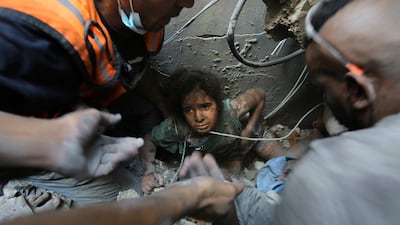
A girl is rescued from the rubble of a building destroyed by Israeli air strikes in Jabalia refugee camp, in the northern Gaza Strip. AP Photo -

An Apache helicopter fires flares, seen from Sderot in southern Israel, close to the border with Gaza. Reuters -

Palestinians plug their phones into portable charging stations on a street in Khan Younis, Gaza. Bloomberg -
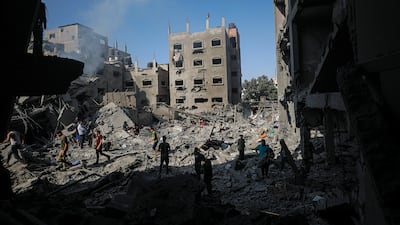
Residents search survivors among the rubble following Israeli strikes on Jabalia, northern Gaza. EPA -
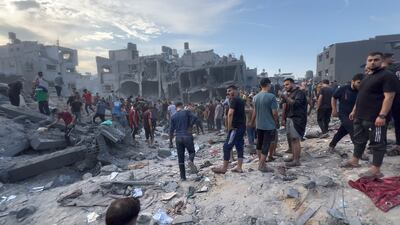
Palestinians search for survivors and bodies following Israeli airstrikes at the Jabalia, the largest refugee camp in Gaza. AP -
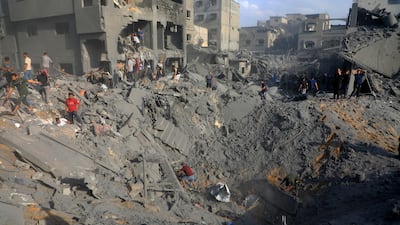
Palestinians look for survivors among the rubble of destroyed buildings following Israeli strikes on Jabalia refugee camp in northern Gaza. AP -
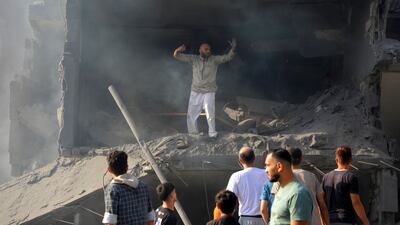
Palestinians look for survivors among the rubble of destroyed buildings following Israeli strikes on Jabalia refugee camp in northern Gaza. AP -

A fire burns in western Gaza after an Israeli air strike. Reuters -

Missiles are fired from Israel towards the Gaza Strip. Getty Images -
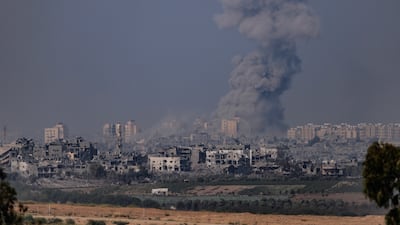
Smoke rises from an explosion in Gaza. Getty Images -
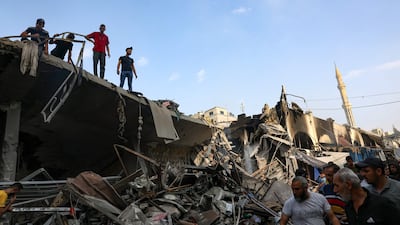
A group of men survey the destruction following air strikes on Al Shatee camp in Gaza city, as Israeli forces entered the northern area of the Gaza Strip. AFP -
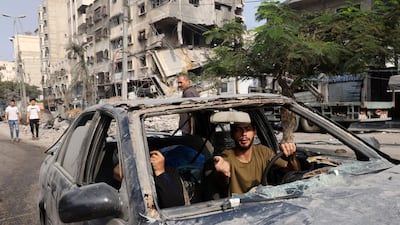
A man drives a damaged car following air strikes on Gaza city. AFP -
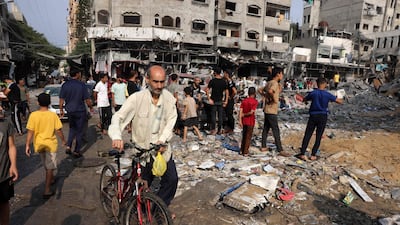
A man pushes a bicycle past the remains of buildings destroyed in Israeli strikes on Al Shatee camp in Gaza city. AFP -

A woman and children walk past a house destroyed in Israeli strikes on Al Shatee camp in Gaza city. AFP -
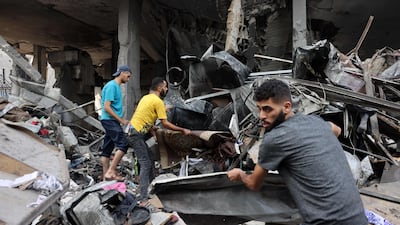
People dig through the rubble of a destroyed building following Israeli strikes on Al Shatee camp in Gaza city. AFP -

A man drives a damaged car past a building destroyed in Israeli strikes on Al Shatee camp in Gaza city. AFP -
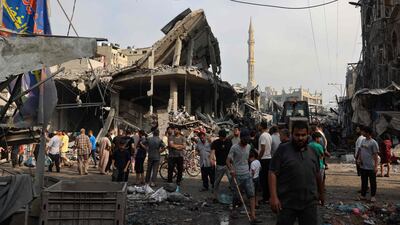
People gather amid the destruction following Israeli strikes on Al Shatee camp in Gaza city. AFP -
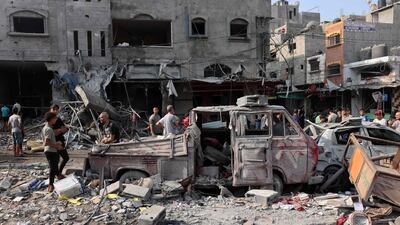
Wrecked vehicles and rubble on the streets following Israeli strikes on Al Shatee camp in Gaza city. AFP -
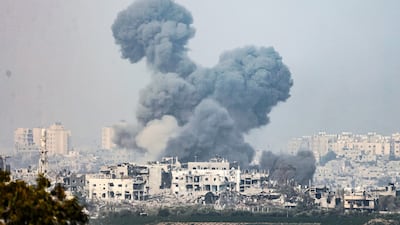
Smoke rises from the northern Gaza Strip as Israeli air and ground forces amplified their military activities against Hamas. EPA -

An Israeli Apache attack helicopter flies close to the border with the Gaza Strip, near Israel's southern city of Ashkelon. AFP -
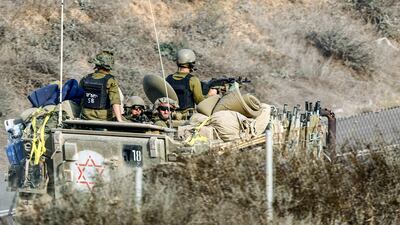
Israeli soldiers in an armoured personnel carrier on patrol near Israel's border with Gaza. EPA -
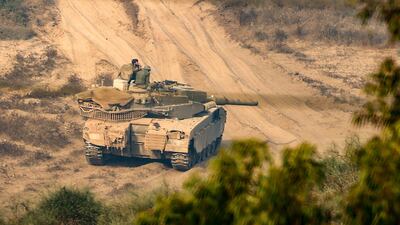
The crew of an Israeli tank prepare for ground operations near the border with Gaza. EPA -
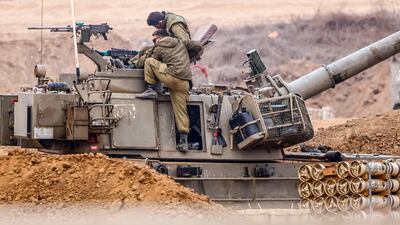
Israeli soldiers prepare for ground manoeuvres at an undisclosed location in Israel near the border with Gaza. EPA -
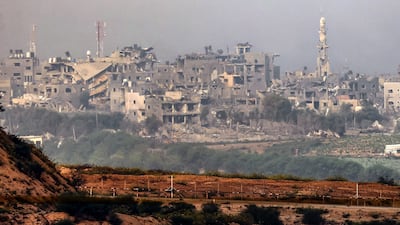
The ruins of northern Gaza seen from Sderot in southern Israel. EPA -
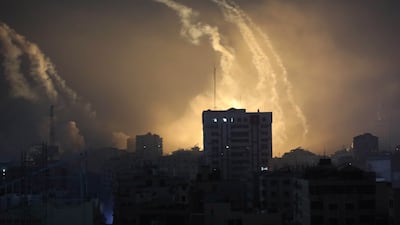
Smoke and explosions caused by Israeli bombardment over northern Gaza. AP Photo -

An explosion on the Israel-Gaza border. Reuters -
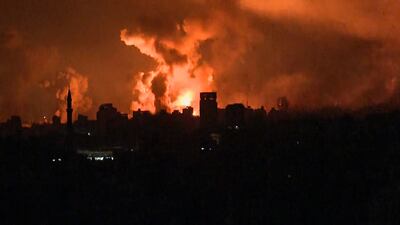
A video grab shows fireballs and smoke rising above Gaza city following an Israeli attack. AFP -

An explosion in Gaza seen from Sderot in southern Israel. Reuters -

A video grab shows rockets fired from Gaza city. AFP -
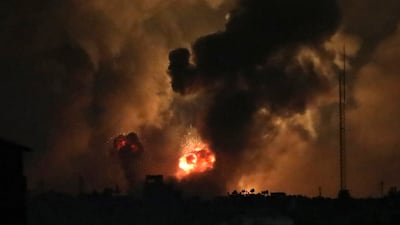
Israeli air strikes in the northern Gaza Strip. AP Photo -
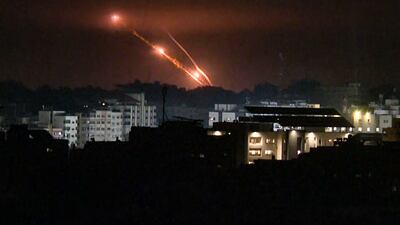
A video grab shows a salvo of rockets fired from Gaza city. AFP -
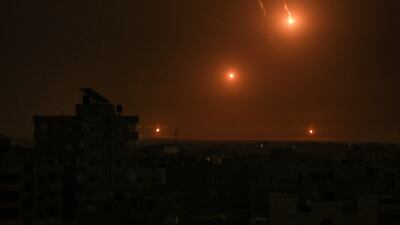
A flare trail fired by the Israeli army east of Khan Younis on the southern Gaza Strip. AFP -

Smoke from the bombing of the Gaza Strip over the Israeli border city of Ashkelon. AFP -

Flares over Gaza as seen from Sderot in southern Israel. Reuters


America can leverage China’s invitation to an international conference to let Beijing know that it welcomes its willingness to participate in bridging the gap between influential countries in the Middle East, along the lines of its sponsorship of the consequential agreement between Saudi Arabia and Iran.
China will likely not be prepared to sponsor a peace conference in the Middle East because it recognises the limits of its influence in the region, and because this is not among its foremost priorities. Nevertheless, the Biden administration should reassure Beijing that its reconciliation efforts are welcome.
Meanwhile, it is worth analysing what Hamas is up to.
The group’s goal remains to highlight the “heroism” of its movement in Palestine (with support from Iran’s Islamic Revolutionary Guard Corps); to expose – in its view – the “political cowardice” of the Palestinian Authority and Fatah; and to capitalise on the global sympathy for Gaza’s plight, even if it means exploiting this catastrophe.
During a Hamas delegation’s visit to Moscow earlier this week, it requested the Russian leadership to dissuade Israel from expanding its ground invasion of Gaza. I am given to understand that the delegation said, if Israel doesn’t go all-out with its invasion and speaks of a future Palestinian state, either directly or through the US, Hamas would demonstrate readiness to take steps towards a cessation of hostilities.
I am also given to understand that the delegation told the Russians that Hamas does not need extensive intervention by Hezbollah at this time.
Iran seeks the preservation of Hamas as an organisation and as a movement – and it supposedly wants Russia to prevent its crushing at the hands of Israel. For its part, Moscow wants to work towards finding a new situation that allows for a less radical Hamas ready for moderate solutions.
Certain key Arab countries continue to provide a back channel between the US and Iran to contain tensions and prevent escalation. Saudi Arabia, meanwhile, is holding on to its agreement with Iran, which provides the latter with one of the most important means of ending its international isolation, even though it has not achieved any regional breakthroughs, including in Yemen.
The current atmosphere suggests a joint Iranian-Russian desire to highlight their strategic relationship, as was evident during visits by diplomats to each other’s countries.
Russia is seeking a balance between supporting Iranian interests in the region and opposing Tehran’s involvement in a broader war. It doesn’t want to lose its influence over Iran, Hezbollah and Hamas. Therefore, it is working to strengthen its “historical” relations with these groups while officially claiming to seek only to “end the conflict”.

In fact, Moscow has openly supported Hamas because it sees in it an opportunity to regain a role against the West.
The common ground between the Russian and American positions includes their opposition to Israel’s large-scale ground invasion, their resistance to the opening of the Lebanese-Israeli front and opposition to Iran’s involvement in a broader war.
This is significant.
However, Moscow’s role remains limited compared to that of Washington. While it looks for a role by offering transitional solutions, America alone has the bandwidth to offer long-term solutions that can reshape the region’s geopolitics.
The Arab states have a crucial role in this restructuring process.
Saudi Arabia, in particular, can play a pivotal role in coming up with an eventual resolution, because it currently has leverage to influence Israel, prompting it to adjust its policies and embrace the internationally endorsed two-state solution. If Israel desires to normalise relations with Saudi Arabia, it must read between the lines and stop evading its responsibilities towards the Palestinians.
The world must also understand that showing empathy for the people of Gaza, and Palestine as a whole – while very important – should not warrant the punishment of Israel by some western universities and intellectual institutions, as is currently happening.
This is not only a short-sighted position that disregards clear Arab positions against Hamas committing massacres against civilians, but it also contributes to a dangerous escalation that blinds many to the necessity of encouraging leaders to make bold decisions in order to prevent sliding into uncontrollable wars.
Supporters on both sides of the Palestine-Israel divide should demonstrate wisdom and avoid engaging in emotional and political extremism. For this is a very delicate moment in Middle Eastern history, and therefore requires the courage to demand wise leadership and the formulation of equitable policies.

