


The longest ongoing occupation in history, that involves Israelis and Arabs, particularly the Palestinians, is replete with flare-ups and violent confrontation. The overwhelming majority of these, including civilian losses, have been at the expense of the Palestinians. While I accept no moral equivalency between the occupier and those who have been occupied over seven decades of continuous Israeli oppression, the question was never whether there would be another outbreak of violence but rather when, where and by whom.
On October 7, Hamas undertook an unprecedented and sophisticated military operation targeting more than 20 military and security targets, and some civilian targets inside Israel itself. This resulted in more than 1,300 casualties and Hamas incarcerating more than 130 Israeli military and security personnel as well as some civilians.
Israel responded quickly with air attacks on Gaza resulting in more than 2,500 Palestinian deaths and the displacement of more than a million inhabitants. Israel also imposed a total blockade on Gaza, preventing the entry of food, water, medicine and fuel, as well as cutting off electricity. It also called on Gazans to cross the Egyptian border into Sinai and then to southern Gaza in anticipation of a major ground onslaught that it warned would exceed anything it had previously done. As this article goes to print, the number of Palestinian casualties will have significantly increased.
Since October 7, analysts have been debating the motivation behind this new development and how Hamas acquired the capacity to execute such a sophisticated operation, leading to the quick assumption of Iranian involvement. Another paramount question has been how could Israeli intelligence fail to uncover or assess the magnitude and seriousness of this substantial Palestinian operation?
-
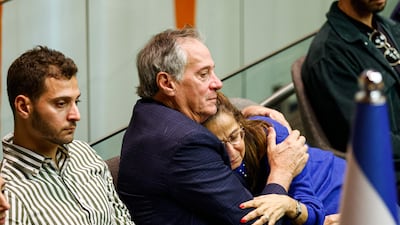
At UN headquarters in New York City, Rachel Zeitchik, right, and Jay Zeitchik attend an event for families of Israelis kidnapped by Hamas. AFP -
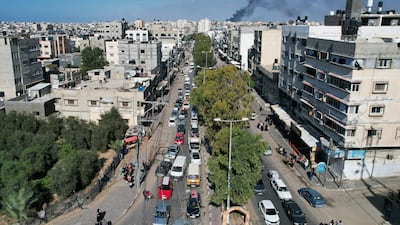
Palestinians flee from northern Gaza towards the south after the Israeli army demanded the population of more than a million people leave before a ground invasion. AP -
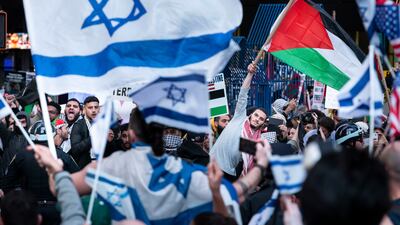
Demonstrators at a rally in support of Palestine face a counter-demonstration in support of Israel near Times Square in New York. EPA -
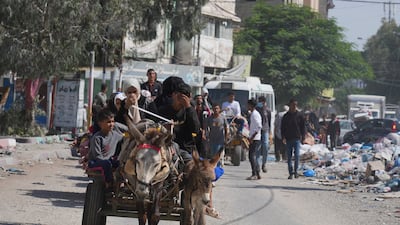
Palestinians flee from northern Gaza to the south after the Israeli army issued an evacuation warning. AP -
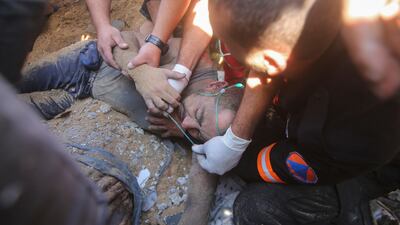
An injured man is rescued from the rubble of a building following an Israeli airstrike in Rafah, Gaza Strip. AP -
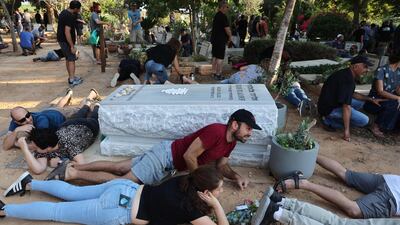
Mourners take cover as sirens sound during the funeral of Tom Godo, killed during the attack by Hamas militants on the Kibbutz Kisuffim last week, in Kibbutz Naan near Tel Aviv. AFP -
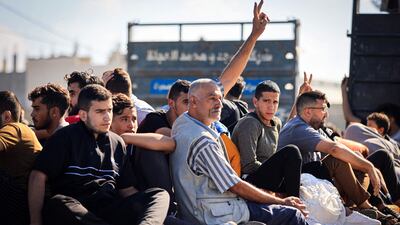
A Palestinian man flashes the victory sign as he and others leave northern Gaza before an expected Israeli ground offensive. AFP -
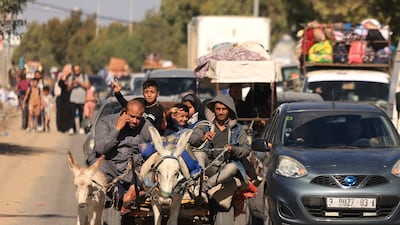
Palestinians head south with their belongings after being ordered by Israel to leave northern Gaza on Friday. AFP -

Israel ordered more than a million Palestinians to head south within 24 hours. Reuters -

The UN criticised the directive, saying forcing such a large number of people to flee en masse would be catastrophic. Reuters -

Gazans have to travel about 15km if they live in the northernmost part of the strip to reach the area south of the Wadi Gaza. Reuters -

The UN said that more than 423,000 people have already fled their homes in the territory, with a sizeable number making the more than 10km journey on foot. Reuters -
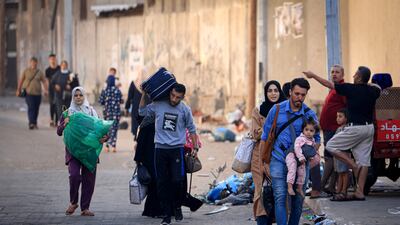
Palestinians with their belongings flee to safer areas in Gaza City. AFP -

An Armoured Personnel Carrier drives near Israel's border with the Gaza Strip. Reuters -
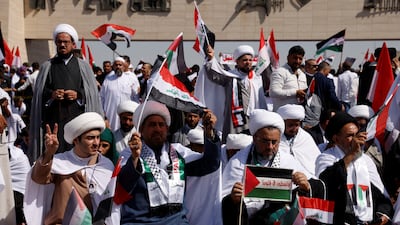
Supporters of Iraqi Shi'ite cleric Moqtada al-Sadr gather for mass Friday prayer during a protest in solidarity with Palestinians in Gaza, in Baghdad, Iraq. Reuters -
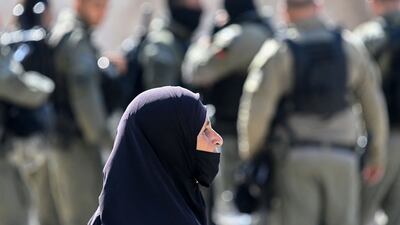
A Palestinian woman waits to cross into Jerusalem's Old City through Damascus Gate next to Israeli soldiers. AFP -
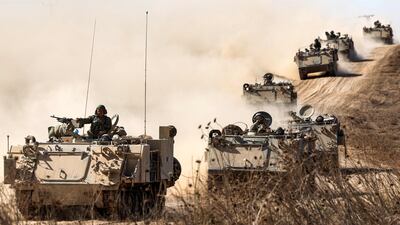
Israeli army infantry fighting vehicles deploy along the border with the Gaza Strip in southern Israel. AFP -
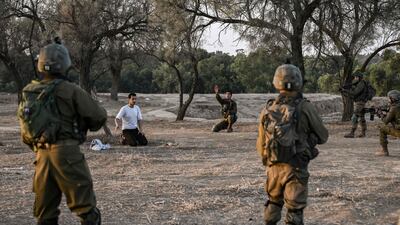
Israeli soldiers detain a man while on patrol near Kibbutz Beeri, near the Gaza Strip. AFP -
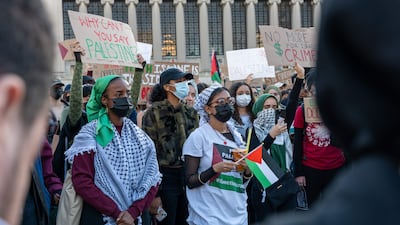
Students hold in a rally in support of Palestine at Columbia University in New York. Getty Images -

Family and friends mourn Valentin Ghnassia, 23, who was killed in a battle with Palestinian militants at Kibbutz Beeri near the Israeli border with the Gaza Strip. Getty Images -
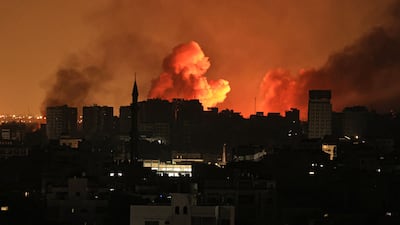
A ball of fire erupts in Gaza city after an Israeli air strike. AFP -
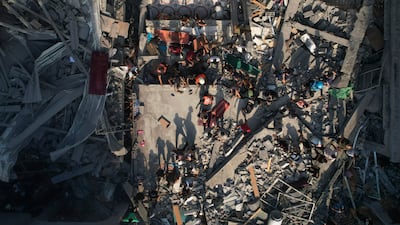
Palestinians inspect the rubble of buildings hit by an Israeli air strike at Al Shati refugee camp. AP -
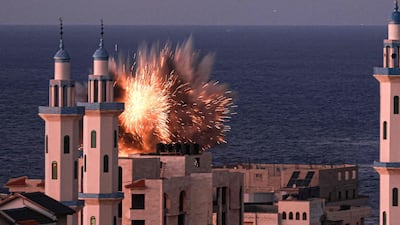
A fireball erupts from an Israeli air strike in Gaza city. AFP -

People waiting for news of victims outside the morgue at Al-Shifa hospital in Gaza City. AFP -
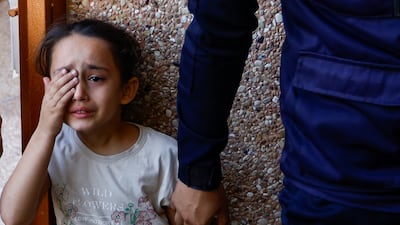
A girl mourns the death of members of the Samour family, who were killed in Israeli strikes on their house in Khan Younis in the southern Gaza Strip. Reuters -

Israelis arrive to sign up at a weapons distribution point for people allowed to carry arms, at the Ayyelet HaShahar Kibbutz in northern Israel, near the Lebanese border. AFP -
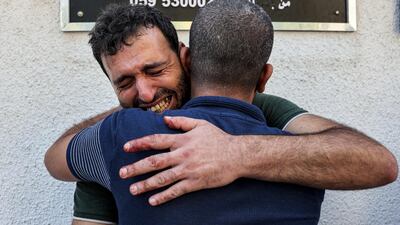
Mourners outside the morgue at Al-Shifa hospital in Gaza City as battles between Israel and the Hamas movement continue for a sixth consecutive day. AFP -
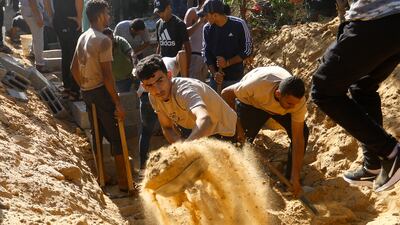
Men dig graves to bury members of the Samour family, who were killed in Israeli strikes on their house in Khan Younis. Reuters -
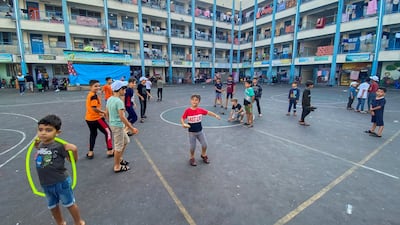
Palestinian children who fled their homes during Israeli strikes, play at a United Nations-run school in Gaza City. Reuters -
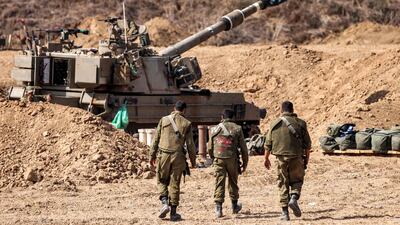
Israeli soldiers near a self-propelled howitzer near the border with Gaza in southern Israel. AFP -

Israel's Foreign Minister Eli Cohen, left, welcomes US Secretary of State Antony Blinken upon arrival at Israel's Ben Gurion Airport. AFP -

Palestinian children in a makeshift shelter at Al-Shifa hospital in Gaza City. Reuters -
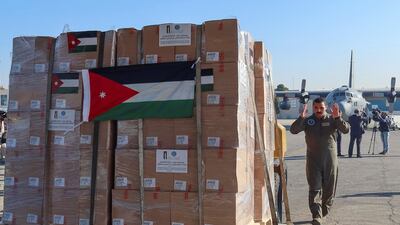
Boxes of humanitarian aid and supplies from Jordan Hashemite Charity Organisation destined for Gaza, in Amman, Jordan. Reuters -
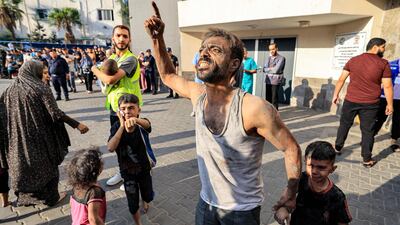
Palestinians outside Al-Shifa hospital in Gaza City on the sixth day of fighting between Israel and Hamas. AFP -
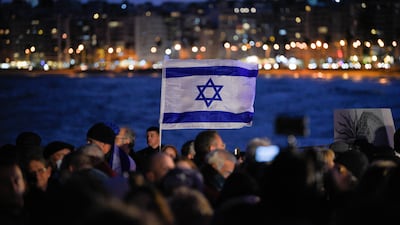
A pro-Israel vigil in Montevideo, Uruguay. EPA


These discussions will continue and now extend to how will the Hamas action and the Israeli reaction to it change the political paradigm in the Middle East. Questions are also being raised about the future role of Hamas and other non-state parties given that formally established institutions, such as the Palestinian Authority, have been unable to convince Israel to commit to a two-state solution. In fact, there has been an even more aggressive trend to establish parallel security systems and further embolden armed Israeli settlers and their appetite for more Palestinian territory.
Many questions can be answered only after the guns have fallen silent and wise minds draw rational, evidence-based conclusions, although US National Security Adviser Jake Sullivan has already said there is no evidence of direct Iranian involvement. Nevertheless, I believe some important preliminary conclusions merit quick reference.
First and foremost: prolonged occupation fuels anger and resistance. Both of these endure even during periods of false dormancy. Associated with that, the complete absence of a peace process exacerbates a sense of frustration, especially when the occupying power does not respect its obligations under international humanitarian law.
Equally true is that as asymmetries grow between adversarial parties, there is always a rise in civilian targets and casualties as we saw among Palestinians in the West Bank this year and now on the Israeli side as a result of the October 7 operations.
Another important lesson to be drawn is that a sense of supremacy and invincibility is often a recipe for complacency and dangerous mistakes. Despite Israel’s highly sophisticated and technologically advanced intelligence capacity, it completely misread Hamas’s capacity and intentions. This was very similar to its underestimation of Egypt’s intentions before the 1973 October War, when the Egyptian army crossed the Suez Canal and overran the Bar Lev Line, once presumed to be impenetrable.
It is unquestionable that with an extremist Israeli government, the divisions among the Palestinians and the recent outbreak of another ongoing bloody conflict, the overall political environment does not augur well for constructive peacemaking through diplomacy. That being said, these dire and dangerous circumstances actually compel us to immediately embark on multidisciplinary, goal-oriented and targeted diplomacy – and in full force. To not make efforts towards ending the violence would be morally incomprehensible.
Consequently, the first track should be a diplomatic one to establish a ceasefire. This track should be jointly led by the US, given its relations with Israel, and by Egypt, given its proximity to Gaza and the ongoing contacts between its security services and Hamas. This is imperative because collective punishment is a clear and flagrant violation of international humanitarian law.
A second urgent track should be a diplomatic humanitarian one, with the primary objective of securing health and other basic services for the inhabitants of Gaza. Most of these international services will be provided through logistic operations into Palestine from El Arish area of north-eastern Sinai. Therefore, Egypt should play a fundamental role here in conjunction with the UN, international humanitarian institutions and potential donors, be they the EU or other Arab countries. In its second phase, this track would also play a role in the inevitable reconstruction of Gaza.
The third track should be a diplomatic crisis management one with the objective of developing mechanisms to establish security and stability arrangements around the perimeter of Gaza without expanding Israel’s military footprint. This track is not meant to resolve the core Palestinian-Israeli conflict, or for that matter the adversarial relationship between Hamas and Israel, but rather to develop measures and procedures that allow for a disengagement of Israel from Gaza. The diplomatic crisis management track should also take on the task – directly or indirectly – of working towards an exchange of those incarcerated.
Fourthly, a diplomatic conflict resolution track should be established, even in these difficult circumstances.
One step in this direction would be for the Palestinians, supported by other Arabs, to submit a resolution to the UN Security Council reaffirming that Arab-Israeli peace should be established on resolutions 242 and 338, which are frequently referred to as the two-state solution. This could also be coupled with a reaffirmation of the 2002 Arab League resolution, which stipulated that all member states would be open to normal relations with Israel if its occupation ended. The message here would be a readiness for an even wider, more inclusive regional peace as the conflict is resolved.
These would be useful markers to reaffirm internationally as a platform for future diplomatic efforts to bring peace to the Middle East.

