Raghida Dergham is the founder and executive chairwoman of the Beirut Institute, and a columnist for The National
September 10, 2023
While a significant breakthrough was made at the G20 summit in New Delhi, the week gone by has proved to be a challenging one for both Russia and Turkey.
On Monday, Russian President Vladimir Putin hosted Turkish President Recep Tayyip Erdogan in Sochi for talks to refloat the cancelled grain deal involving Ukraine. But the leaders failed to reach an agreement that would have allowed the resumption of Ukrainian grain shipments and eased food prices around the world.
The impact of this setback on the war in Ukraine and the frozen conflict in Syria is yet uncertain.
The rhythm of alliances today follows the tempo of the war in Eastern Europe, which appears to have dislodged Russia from the ranks of the major powers that also include the US and China.
Washington has redoubled efforts to push Moscow to the margins, the latest example of which has been its announcement of a $600 million aid package for Ukraine to boost its counteroffensive.
It is, meanwhile, actively engaged in diplomatic efforts with key Asian countries, including Japan, South Korea and Vietnam, as part of its attempts to counter China’s influence in the continent. On Sunday, US President Joe Biden arrived in Hanoi to meet Vietnam’s paramount leader, Nguyen Phu Trong, in his bid to boost ties with the South-East Asian country.
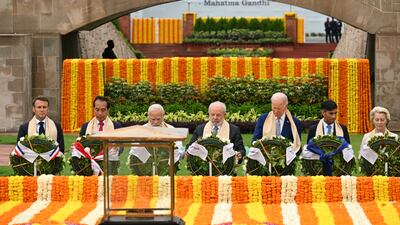
From left, French President Emmanuel Macron, Indonesian President Joko Widodo, Indian Prime Minister Narendra Modi, Brazilian President Luiz Inacio Lula da Silva, US President Joe Biden, British Prime Minister Rishi Sunak and European Commission President Ursula von der Leyen visit Raj Ghat memorial. Reuters
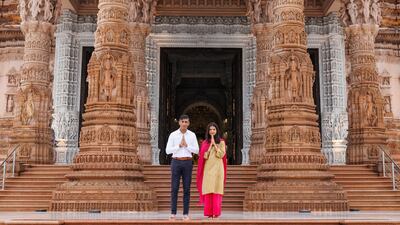
British Prime Minister Rishi Sunak and his wife Akshata Murty visit the Akshardham Hindu Temple in New Delhi. Getty Images
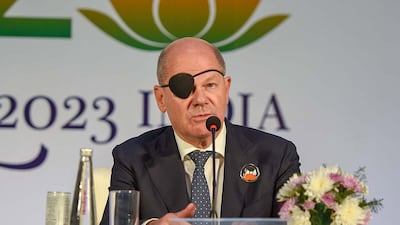
German Chancellor Olaf Scholz addresses a press conference during the G20 Summit in New Delhi. EPA
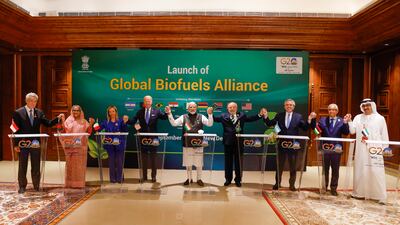
From left, Singaporean Prime Minister Lee Hsien Loong, Bangladeshi Prime Minister Sheikh Hasina, Italian Prime Minister Giorgia Meloni, US President Joe Biden, Indian Prime Minister Narendra Modi, Brazilian President Luiz Inacio Lula da Silva, Argentinian President Alberto Fernandez, Mauritius Prime Minister Pravind Kumar Jugnauth and UAE Minister of Foreign Affairs Sheikh Abdullah bin Zayed attend the launch of the Global Biofuels Alliance at the G20 summit in New Delhi. AP
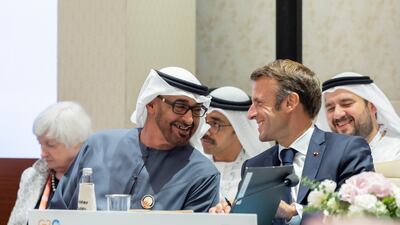
UAE President Sheikh Mohamed and French President Emmanuel Macron attend the India-Middle East-Europe Economic Corridor on the sidelines of the G20 Summit in New Delhi. Photo: UAE Presidential Court
From left, Indian Prime Minister Narendra Modi, Indian President Droupadi Murmu and UAE Minister of Foreign Affairs Sheikh Abdullah bin Zayed at the G20 summit in New Delhi. AFP
India's Prime Minister Narendra Modi addresses the G20 Leaders' Summit at the Bharat Mandapam in New Delhi. AFP
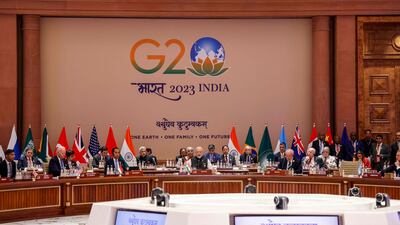
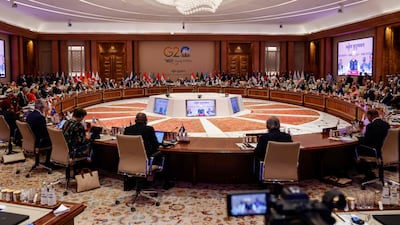
The 18th G20 Summit between 19 countries and the European Union, and now the African Union, is the first to be held in India and South Asia. AFP
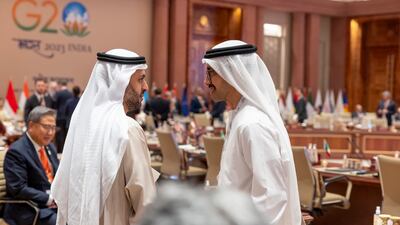
Sheikh Mohamed bin Hamad, Private Affairs Advisor in the Presidential Court, left, and Sheikh Abdullah bin Zayed, UAE Minister of Foreign Affairs, attend the first session of the G20 Summit. UAE Presidential Court
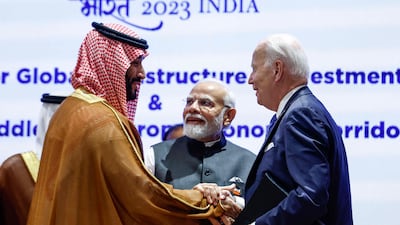
Saudi Arabia's Crown Prince and Prime Minister Mohammed bin Salman, India's Prime Minister Narendra Modi and US President Joe Biden attend a session as part of the G20 Leaders' Summit at the Bharat Mandapam in New Delhi. AFP
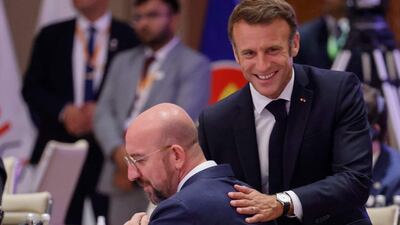
France's President Emmanuel Macron greets European Council President Charles Michel before the start of the second working session. AFP
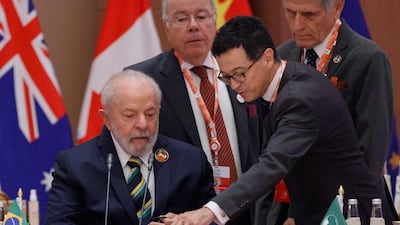
Brazil's President Luiz Inacio Lula da Silva speaks with his advisors before the start of the second working session. AFP
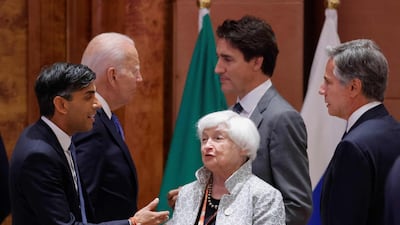
Britain's Prime Minister Rishi Sunak, US Treasury Secretary Janet Yellen, US President Joe Biden, Canada's Prime Minister Justin Trudeau and US Secretary of State Antony Blinken speak before the start of the second working session. AFP
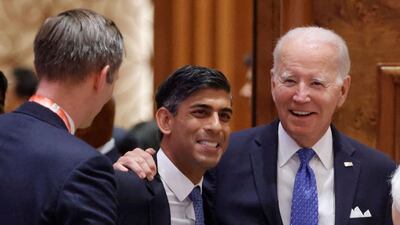
US President Joe Biden greets Britain's Prime Minister Rishi Sunak. AFP
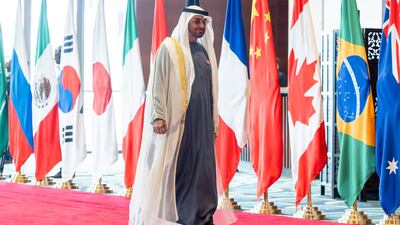
Sheikh Mohamed arrives at the IECC Convention Centre. Photo: UAE Presidential Court
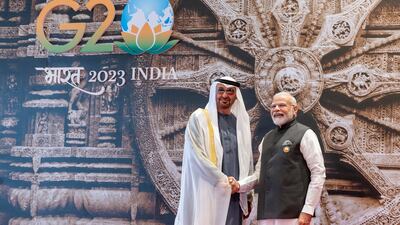
Sheikh Mohamed is greeted by India's Prime Minister Narendra Modi. UAE Presidential Court
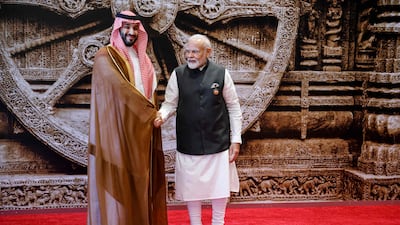
India's Prime Minister Narendra Modi welcomes Saudi Arabia's Crown Prince and Prime Minister Mohammed bin Salman to the G20 summit. AFP
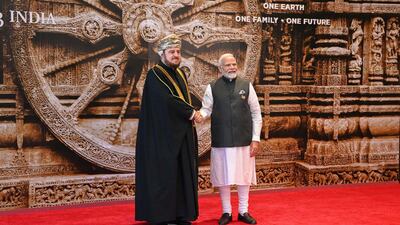
India's Prime Minister Narendra Modi welcomes Oman's Deputy Prime Minister Sayyid Asaad bin Tariq. Oman News Agency
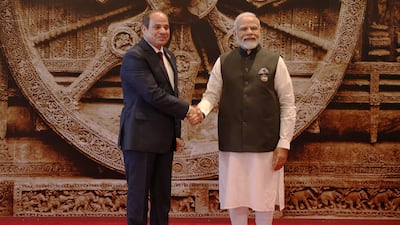
India's Prime Minister Narendra Modi with Egyptian President Abdel Fattah El Sisi at the G20 summit. Getty
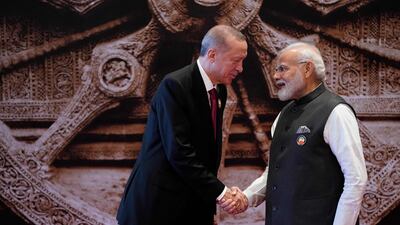
India's Prime Minister Narendra Modi greets Turkey's President Recep Tayyip Erdogan. AFP
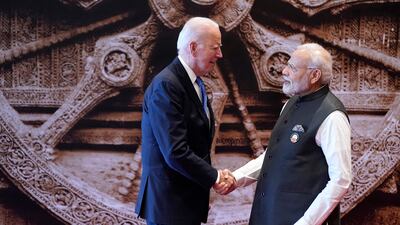
India's Prime Minister Narendra Modi welcomes US President Joe Biden to the G20 summit. AFP
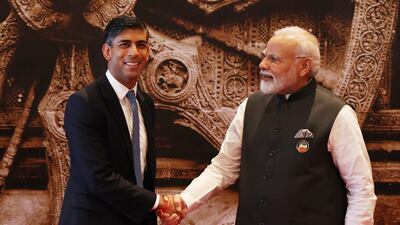
India's Prime Minister Narendra Modi with UK Prime Minister Rishi Sunak. Getty
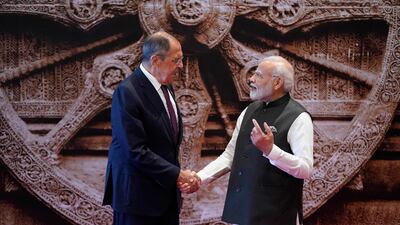
India's Prime Minister Narendra Modi greets Russian Foreign Minister Sergey Lavrov on the opening day of the G20 summit. AFP
India's Prime Minister Narendra Modi and Canada's Prime Minister Justin Trudeau. AFP
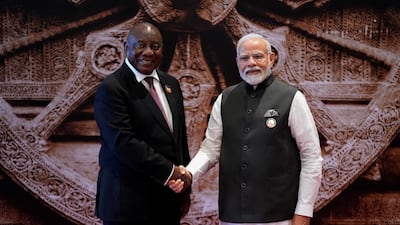
Indian Prime Minister Narendra Modi welcomes South Africa President Cyril Ramaphosa to the G20 summit, three weeks after the leaders were together at the Brics summit in Johannesburg. Reuters
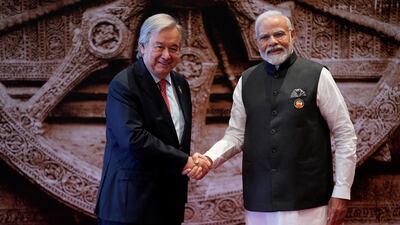
Indian Prime Minister Narendra Modi greets UN Secretary General Antonio Guterres. Reuters
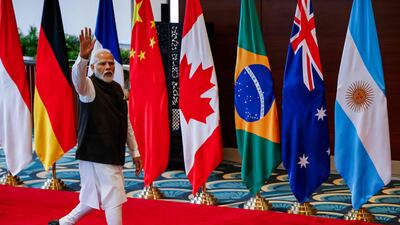
India's Prime Minister Narendra Modi arrives to host the G20 Leaders' Summit in New Delhi. AFP
Important and pioneering achievements are what New Delhi sought to reveal at the summit
As in the case of the recently concluded Brics summit in Johannesburg, South Africa, Mr Putin was forced to skip the G20 summit in India. And with another world leader, Chinese President Xi Jinping, also choosing to stay away from New Delhi, Mr Biden took centre stage at the summit, helping to secure a landmark deal on Saturday.
A multibillion-dollar India-Middle East-Europe Economic Corridor was announced, which includes the UAE, Saudi Arabia, India, Jordan, Israel and the EU, and is expected to enhance connectivity and integration between participating countries. In the coming weeks and months, details regarding the creation of a railway network linking India to the maritime routes in the Middle East, as well as connecting the Arab Gulf countries and the Levant, will be ironed out.
Mr Biden specifically thanked President Sheikh Mohamed for his key role in securing the deal. “I do want to say thank you, thank you, thank you,” he said at an event to unveil the initiative. “I don’t think we’d be here without you.”
Such important and pioneering breakthroughs are what New Delhi sought to reveal at the summit, where disputes were expected to intensify due to differing positions between the West and the Brics countries leaning more towards “non-alignment” between the US and China, as well as between Nato member states and Russia.
Turkey has attempted to play a distinctive role within Nato, of which it is a member, and in which it sees itself as enjoying a unique position as both a Middle Eastern and a European country.
Mr Erdogan succeeded in recent times in solidifying Ankara’s importance in Nato and acted as a mediator between Russia and Ukraine and secured the grain deal last year, until Russia decided to not renew it unless western countries provided financial guarantees.
Unfortunately, neither side could secure the old deal, or a new one, on Monday.
There have been misgivings between the two countries in recent months. There was, for instance, disappointment in Moscow in April when Ankara struck an agreement with Kyiv to supply Bayraktar TB2 armed drones to it. Turkey’s realignment within the Nato alliance has also not sit well with the Kremlin.
In Sochi, agreements over other issues were, therefore, hard to secure. These included oil pipeline projects, initially intended to somewhat replace the German Nord Stream 2, the Russian-financed nuclear reactor project in Turkey, and the conflict in Syria.
Moscow has been disconcerted by Ankara’s support for Ukraine, with the Turkish government continuing to not recognise the Russian annexation of Crimea. The Kremlin has also sought Ankara’s normalisation of ties, and engagement, with the Assad regime, with a view to resolve the Syrian refugee crisis and other issues.
There are several reasons for the restlessness being felt in Russian diplomacy today, especially amid a series of disappointing summits for Russia, which risks exacerbating its international isolation. The next stop for the leadership in Moscow is the UN General Assembly later this month, where it intends to test the loyalties of many of its old friends, and not just Turkey.
As for Ankara, it faces challenges on the domestic front. The collapse in the Turkish lira’s value is worrying, as is the crisis of the approximately four million Syrian refugees still living in the country. That the talks in Sochi did not yield the desired results will add to the list of troubles that the leadership in Turkey has to grapple with.
Syria will be a significant arena reflecting the consequences of Sochi. How this will precisely pan out, only time will tell.

Results:
Men's wheelchair 800m T34: 1. Walid Ktila (TUN) 1.44.79; 2. Mohammed Al Hammadi (UAE) 1.45.88; 3. Isaac Towers (GBR) 1.46.46.
ICC Women's T20 World Cup Asia Qualifier 2025, Thailand
UAE fixtures May 9, v Malaysia May 10, v Qatar May 13, v Malaysia May 15, v Qatar May 18 and 19, semi-finals May 20, final
Quick pearls of wisdom
Focus on gratitude: And do so deeply, he says. “Think of one to three things a day that you’re grateful for. It needs to be specific, too, don’t just say ‘air.’ Really think about it. If you’re grateful for, say, what your parents have done for you, that will motivate you to do more for the world.”
Know how to fight: Shetty married his wife, Radhi, three years ago (he met her in a meditation class before he went off and became a monk). He says they’ve had to learn to respect each other’s “fighting styles” – he’s a talk it-out-immediately person, while she needs space to think. “When you’re having an argument, remember, it’s not you against each other. It’s both of you against the problem. When you win, they lose. If you’re on a team you have to win together.”
Mercer, the investment consulting arm of US services company Marsh & McLennan, expects its wealth division to at least double its assets under management (AUM) in the Middle East as wealth in the region continues to grow despite economic headwinds, a company official said.
Mercer Wealth, which globally has $160 billion in AUM, plans to boost its AUM in the region to $2-$3bn in the next 2-3 years from the present $1bn, said Yasir AbuShaban, a Dubai-based principal with Mercer Wealth.
“Within the next two to three years, we are looking at reaching $2 to $3 billion as a conservative estimate and we do see an opportunity to do so,” said Mr AbuShaban.
Mercer does not directly make investments, but allocates clients’ money they have discretion to, to professional asset managers. They also provide advice to clients.
“We have buying power. We can negotiate on their (client’s) behalf with asset managers to provide them lower fees than they otherwise would have to get on their own,” he added.
Mercer Wealth’s clients include sovereign wealth funds, family offices, and insurance companies among others.
From its office in Dubai, Mercer also looks after Africa, India and Turkey, where they also see opportunity for growth.
Wealth creation in Middle East and Africa (MEA) grew 8.5 per cent to $8.1 trillion last year from $7.5tn in 2015, higher than last year’s global average of 6 per cent and the second-highest growth in a region after Asia-Pacific which grew 9.9 per cent, according to consultancy Boston Consulting Group (BCG). In the region, where wealth grew just 1.9 per cent in 2015 compared with 2014, a pickup in oil prices has helped in wealth generation.
BCG is forecasting MEA wealth will rise to $12tn by 2021, growing at an annual average of 8 per cent.
Drivers of wealth generation in the region will be split evenly between new wealth creation and growth of performance of existing assets, according to BCG.
Another general trend in the region is clients’ looking for a comprehensive approach to investing, according to Mr AbuShaban.
“Institutional investors or some of the families are seeing a slowdown in the available capital they have to invest and in that sense they are looking at optimizing the way they manage their portfolios and making sure they are not investing haphazardly and different parts of their investment are working together,” said Mr AbuShaban.
Some clients also have a higher appetite for risk, given the low interest-rate environment that does not provide enough yield for some institutional investors. These clients are keen to invest in illiquid assets, such as private equity and infrastructure.
“What we have seen is a desire for higher returns in what has been a low-return environment specifically in various fixed income or bonds,” he said.
“In this environment, we have seen a de facto increase in the risk that clients are taking in things like illiquid investments, private equity investments, infrastructure and private debt, those kind of investments were higher illiquidity results in incrementally higher returns.”
The Abu Dhabi Investment Authority, one of the largest sovereign wealth funds, said in its 2016 report that has gradually increased its exposure in direct private equity and private credit transactions, mainly in Asian markets and especially in China and India. The authority’s private equity department focused on structured equities owing to “their defensive characteristics.”
In the village of Mevagissey in southwest England the housing stock has doubled in the last century while the number of residents is half the historic high. The village's Neighbourhood Development Plan states that 26% of homes are holiday retreats. Prices are high, averaging around £300,000, £50,000 more than the Cornish average of £250,000. The local average wage is £15,458.
October 26: Bahrain withdraws from a proposal to create a federation of nine with the seven Trucial States and Qatar.
December: Ahmed Al Suwaidi visits New York to discuss potential UN membership.
1971
March 1: Alex Douglas Hume, Conservative foreign secretary confirms that Britain will leave the Gulf and “strongly supports” the creation of a Union of Arab Emirates.
July 12: Historic meeting at which Sheikh Zayed and Sheikh Rashid make a binding agreement to create what will become the UAE.
July 18: It is announced that the UAE will be formed from six emirates, with a proposed constitution signed. RAK is not yet part of the agreement.
August 6: The fifth anniversary of Sheikh Zayed becoming Ruler of Abu Dhabi, with official celebrations deferred until later in the year.
August 15: Bahrain becomes independent.
September 3: Qatar becomes independent.
November 23-25: Meeting with Sheikh Zayed and Sheikh Rashid and senior British officials to fix December 2 as date of creation of the UAE.
November 29: At 5.30pm Iranian forces seize the Greater and Lesser Tunbs by force.
November 30: Despite a power sharing agreement, Tehran takes full control of Abu Musa.
November 31: UK officials visit all six participating Emirates to formally end the Trucial States treaties
December 2: 11am, Dubai. New Supreme Council formally elects Sheikh Zayed as President. Treaty of Friendship signed with the UK. 11.30am. Flag raising ceremony at Union House and Al Manhal Palace in Abu Dhabi witnessed by Sheikh Khalifa, then Crown Prince of Abu Dhabi.
December 6: Arab League formally admits the UAE. The first British Ambassador presents his credentials to Sheikh Zayed.
The Rub of Time: Bellow, Nabokov, Hitchens, Travolta, Trump and Other Pieces 1986-2016
Martin Amis,
Jonathan Cape
How the UAE gratuity payment is calculated now
Employees leaving an organisation are entitled to an end-of-service gratuity after completing at least one year of service.
The tenure is calculated on the number of days worked and does not include lengthy leave periods, such as a sabbatical. If you have worked for a company between one and five years, you are paid 21 days of pay based on your final basic salary. After five years, however, you are entitled to 30 days of pay. The total lump sum you receive is based on the duration of your employment.
1. For those who have worked between one and five years, on a basic salary of Dh10,000 (calculation based on 30 days):
a. Dh10,000 ÷ 30 = Dh333.33. Your daily wage is Dh333.33
b. Dh333.33 x 21 = Dh7,000. So 21 days salary equates to Dh7,000 in gratuity entitlement for each year of service. Multiply this figure for every year of service up to five years.
2. For those who have worked more than five years
c. 333.33 x 30 = Dh10,000. So 30 days’ salary is Dh10,000 in gratuity entitlement for each year of service.
Note: The maximum figure cannot exceed two years total salary figure.
Yahya Al Ghassani's bio
Date of birth: April 18, 1998
Playing position: Winger
Clubs: 2015-2017 – Al Ahli Dubai; March-June 2018 – Paris FC; August – Al Wahda
The burning issue
The internal combustion engine is facing a watershed moment – major manufacturer Volvo is to stop producing petroleum-powered vehicles by 2021 and countries in Europe, including the UK, have vowed to ban their sale before 2040. The National takes a look at the story of one of the most successful technologies of the last 100 years and how it has impacted life in the UAE.
In the UAE’s arid climate, small shrubs, bushes and flower beds usually require about six litres of water per square metre, daily. That increases to 12 litres per square metre a day for small trees, and 300 litres for palm trees.
Horticulturists suggest the best time for watering is before 8am or after 6pm, when water won't be dried up by the sun.
A global report published by the Water Resources Institute in August, ranked the UAE 10th out of 164 nations where water supplies are most stretched.
The Emirates is the world’s third largest per capita water consumer after the US and Canada.
Timeline
2012-2015
The company offers payments/bribes to win key contracts in the Middle East
May 2017
The UK SFO officially opens investigation into Petrofac’s use of agents, corruption, and potential bribery to secure contracts
September 2021
Petrofac pleads guilty to seven counts of failing to prevent bribery under the UK Bribery Act
October 2021
Court fines Petrofac £77 million for bribery. Former executive receives a two-year suspended sentence
December 2024
Petrofac enters into comprehensive restructuring to strengthen the financial position of the group
May 2025
The High Court of England and Wales approves the company’s restructuring plan
July 2025
The Court of Appeal issues a judgment challenging parts of the restructuring plan
August 2025
Petrofac issues a business update to execute the restructuring and confirms it will appeal the Court of Appeal decision
October 2025
Petrofac loses a major TenneT offshore wind contract worth €13 billion. Holding company files for administration in the UK. Petrofac delisted from the London Stock Exchange