

On the evening of Wednesday, August 23, India ventured where no nation has ever gone before. Its Chandrayaan-3 lunar mission accomplished a soft landing on the south pole of the Moon. The lander, Vikram, with a rover, Pragyan, inside it, touched down after making a tricky descent.
Only three countries – the US, China and the former Soviet Union – had previously pulled off Moon landings. But all of them landed on its equator. Until India did so last week, no country has accomplished the immensely more difficult feat of landing on the satellite’s pole.
Only days ago, the Russian spacecraft, Luna-25, attempted a similar landing and crashed into the surface of the Moon. Luna-25 cost $250 million. Chandrayaan-3, on the other hand, worked on a much lower budget of $75 million.
That budget is not merely a fraction of what the US or Russia have spent on specific space programmes. The budget is far less than that of Christopher Nolan’s 2014 sci-fi, space hit, Interstellar, which cost $165 million. One of this summer’s big film hits, Oppenheimer, had a budget of $100 million, while another, Mission: Impossible – Dead Reckoning Part One, cost $291 million to make.
A combination of using homegrown components and technologies instead of relying on expensive imports and a vast pool of dedicated and talented space engineers and scientists have kept the cost of the lunar mission markedly low.
This low-cost landing will achieve a number of things, both scientific and economic.
The rover will do a walkabout on the Moon’s surface. It will send back images that will help scientists study its geology. There is the prospect of finding water on the surface – frozen water that has been untouched by the Sun’s radiation in the cold polar regions. If this water can be extracted, it is good news for future manned lunar missions.
The water can be used for drinking and sanitation instead of carrying huge loads of it from the Earth. The more load one carries from the Earth, the more fuel one needs, leading to the escalation of the cost of the mission. Water can also be broken down into atoms of hydrogen and oxygen, both of which can be used as propellants to fire rockets.
In economic terms, India will now have to be taken seriously as a space power.
The landing will strengthen India’s hand in international space collaboration. Having mastered a feat that none of the traditional space giants could, the country’s stocks will soar in the space exploration market and the space economy. In the light of this low-cost mission, it will be no surprise to see others knocking on India’s door for the wherewithal and expertise in the field.
Another remarkable aspect of Chandrayaan-3 has been the wholesome participation and contribution of women. As many as 54 women scientists and engineers were part of the mission, although none helmed it. In a walk of life that has been traditionally dominated by men, it is heartening to see the presence of such a large number of women in such an epochal mission.
There will be another fallout from this remarkable achievement. The governing Bharatiya Janata Party is nothing if not a master at appropriating and cultivating a narrative. The narrative that it has, by dint of this landing, turned India into a global space superpower is sure to find many takers across the length and breadth of the country.
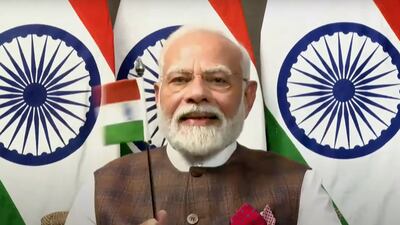
“This is a victory cry of a new India,” Prime Minister Narendra Modi said as he watched the landing, waving the Indian flag, while attending the Brics summit in South Africa. What remained implicit in Mr Modi’s quote, but will be teased out in the days and months ahead, is that the BJP is the custodian and creator of this “new India”.
As the general election – scheduled for 2024 – draws closer, a muscular, aggressive nationalism is likely to be closely allied to this unprecedented achievement.
-
The landing site of India's Chandrayaan-3 spacecraft on the Moon's south pole. Photo: ISRO -

A composition of the images from one of the lander's cameras taken during the descent. Photo: ISRO -

A rendering shows Chandrayaan-3 as it prepares to land on the south pole of the Moon on Thursday. AFP -
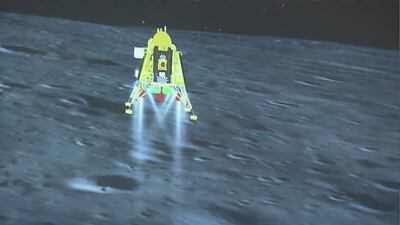
Chandrayaan-3 landed successfully, with Indian Prime Minister Narendra Modi calling it a 'historic day'. AFP -
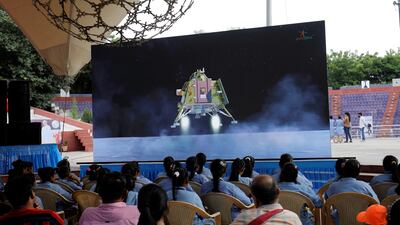
People watch a live stream of the Moon landing at an auditorium in Ahmedabad. Reuters -

Delight as the spacecraft makes a successful soft landing. Reuters -

Indian Space Research Organisation staff and journalists watch Mr Modi speak after the successful landing. AP -
The landing took place in uncharted territory that scientists believe could hold vital reserves of frozen water and precious elements. Photo: Isro -

Indian space agency staff in Bengaluru celebrate the successful landing of Chandrayaan-3 on the Moon. AP -

India made history by becoming the first nation to land on the south pole of the Moon. Photo: Isro -

Mr Modi watches as the lander touches down safely. Photo: Isro -

A live telecast of Chandrayaan-3 shows a digital projection of the Moon landing. AP -

A man in Ahmedabad cheers in anticipation of the successful landing. AP -

Students in Chennai form a circle around a rudimentary replica of the Chandrayaan-3 lander before its attempt to land on the Moon. EPA -

Students with painted faces gather in Chennai in support of the lunar mission. AFP -
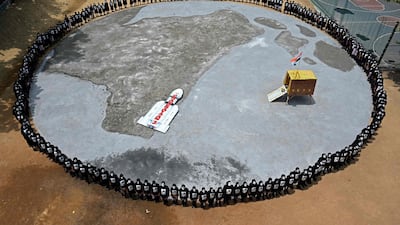
Students form a circle around a replica of the lander in Chennai. AFP -
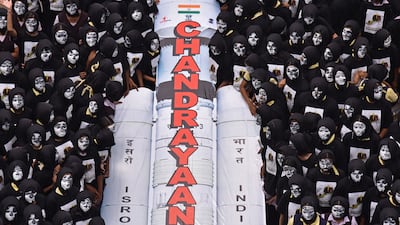
Students in Chennai gather around a model of Isro's Chandrayaan-3 rocket. EPA -

The students faces were painted to resemble the Moon. EPA


Millions of Indians watched the Moon landing – in schools, shops, at home, in hotels. As many as seven million watched the live YouTube stream. People prayed for a successful landing at temples, mosques and churches. The interest in the lunar mission was at a frenzied, high pitch.
The BJP has already positioned itself as the agent that is leading India to dine at the world’s top table. It projects itself as the architect of India’s eminence in the wider world. The presidency of the G20 has been used as shining evidence for that prominence.
The BJP will undoubtedly use the lunar landing as further confirmation of its hand in making India a superpower – even if such missions are not planned overnight but are in the works over decades. This staggering scientific breakthrough is likely to turn into an election campaign plank.
For the moment, though, one ought to cherish this world-historical event. The landing on the south pole of the Moon is a giant step for India. Just as much, it is a giant leap for humankind.

