


In an era marked by relentless technological innovation, industries around the globe are undergoing unprecedented transformations. We’re witnessing the convergence of artificial intelligence, robotics, blockchain and biotechnology, revolutionising the way we work, live and communicate. Yet, there’s one sphere where technology’s potential remains profoundly untapped – our fight against climate change. As we channel innovation to reshape industries, we have a golden opportunity to wield disruptive technology as a mighty force for global environmental restoration.
This is needed the world over, but critical to our region. According to the latest Intergovernmental Panel for Climate Change 6th Synthesis Report, the Mena region is approaching a tipping point. It is one of the world’s hardest-hit regions by climate change and is also one least equipped to cope with it. Mena is the world’s least climate-resilient and most water-stressed region. About 60 per cent of the population in the region lacks access to drinkable water and more than 70 per cent of the region’s gross domestic product is exposed to high or very high water stress. Looking ahead, climate change is expected to act as a multiplier for the pressures already manifested in the region since it triggers, accelerates and deepens existing crises such as food insecurity, conflict and inequality.
In this pivotal moment, as we witness the tech-driven revolution of industries, we must seize the opportunity to propel technology as a catalyst for a sustainable world. Indeed, entrepreneurship is booming in the region. Numbers tell a compelling story: venture and investment capital in the Mena region is on a remarkable ascent. Wamda Capital, a Mena-based VC, reports that startups in Mena raised $3.94 billion in 2022 across 795 deals, a rise of 24 per cent in investment value when compared to 2021 and a 22 per cent increase in the number of deals. Governments are strategically fostering entrepreneurship, with the UAE and Saudi Arabia leading the way through visionary initiatives. Investors are increasingly drawn to the allure of Mena’s tech sector, exemplified by SoftBank’s involvement in a $50 million funding round for a UAE-based fintech venture. It is now time to focus this creative energy and surge of investment on climate action.
-

An aerial shot of the Great Barrier Reef in Australia, showing parts of the reef that has been subjected to coral bleaching. -

A house located on land that has been deformed by permafrost thaw at a former airfield in Churapcha, Russia. Reuters -

Native vegetation has been cut down to give space for eucalyptus plantations in the Setubinha region in Brazil. AFP -

A large melt pool forms in the Ilulissat ice fjord below the Jakobshavn Glacier at the fringe of the Greenland ice sheet. AP -
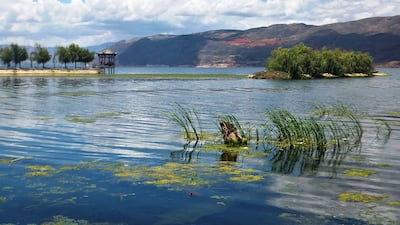
Lake Erhai in China has become eutrophic (where an entire body of water becomes enriched with nutrients and minerals) which caused algal growth that destroyed other life. Photo: Ronan O'Connell -
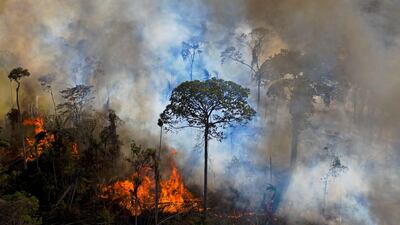
Deforestation in Para state, Brazil. AFP -
Moai statues in Easter Island, Chile, were damaged after a wildfire. Reuters


The opportunities are there for the taking as technology evolves at the speed of thought.
Consider the potential of AI. AI-driven algorithms can analyse complex climate data with unprecedented speed, enabling us to model and predict weather patterns, assess the impact of policy decisions and optimise energy consumption. The marriage of big data and AI has the potential to supercharge climate modelling, aiding in informed decision-making for sustainable urban planning, disaster management and resource allocation. Imagine AI-powered models predicting weather patterns with 95 per cent accuracy, as demonstrated by IBM’s Deep Thunder. Such accuracy could save up to 100,000 lives and $30 billion annually in disaster relief costs worldwide.
Blockchain, lauded for its transparency, can revolutionise carbon trading and emissions management. Today, about 64 per cent of carbon credits face validity issues. Blockchain’s incorruptible ledger can ensure the legitimacy of credits, reducing fraud and boosting confidence. If applied universally, this could enable annual global transactions worth $3.1 trillion by 2030.
Renewable energy is on the precipice of disruption, poised to redefine our energy landscape. Advanced solar panels with 40 per cent efficiency, such as those developed by Oxford PV, can revolutionise power generation. Coupled with battery innovations like Tesla’s MegaPack, which stores up to 3 MWh of energy, we can foresee cities powered by clean energy 24/7, reducing CO2 emissions by 1.5 billion tonnes annually.
There is also biotechnology the potential of which extends beyond medicine; it holds promise for carbon capture too. Synthetic biology’s marvels could engineer carbon-absorbing organisms. If successful, this could capture 1 gigatonne of CO2 every year by 2050, equivalent to taking 216 million cars off the road annually.

Additionally, remote sensing and satellite technology advancements enable us to monitor deforestation, track ocean health and assess urban sprawl in real time. This treasure trove of data can inform evidence-based policymaking, trigger timely interventions and foster international co-operation for a healthier planet. Similarly, satellite technology is rewriting conservation efforts. The ability to monitor deforestation rates, like Global Forest Watch’s real-time alerts, empowers governments and NGOs to take immediate action. This could prevent up to 70 per cent of anticipated deforestation in the Amazon alone.
In a decade, we could witness AI-driven climate modelling saving more than $300 billion, while blockchain ensures the validity of $3 trillion in carbon transactions. A solar-powered world with advanced panels and energy storage could prevent 1.5 billion tonnes of CO2 emissions annually. Biotechnology might spearhead a gigaton of carbon capture, and satellite surveillance could avert colossal deforestation.
Leveraging these technologies requires united efforts. Government backing, private-sector investment and research collaboration must converge. Imagine if just 10 per cent of tech investments were directed towards climate solutions. With global tech investments reaching $5.4 trillion in 2020, we’d have $540 billion aimed at innovative climate technologies. In our Mena region, we would unleash $394 million for climate-tech investments.
As we innovate to reshape industries and economies, let’s not overlook the greatest transformation project of them all – safeguarding our planet. The next industrial revolution must not only be a technological one; it must be a green one. By embracing the same spirit of innovation that has reshaped our world, we can forge a future where our technological prowess is a beacon of hope in the battle against climate change.

