


There has been a great deal of commentary about a possible US-engineered Saudi-Israel normalisation agreement: what it would actually do; whom it might benefit; and, most importantly, whether any such arrangement is even possible given current political realities in the US and Israel. A Saudi-Israel agreement would, no doubt, be consequential, but to introduce a touch of reality, it is important to look at some of the claims that have been made.
The first claim is that this will be end of the Arab-Israeli conflict. It most decidedly will not. Since the convening of the Madrid Peace Conference and culminating with unanimous Arab League endorsement of the Arab Peace Initiative in 2002, Arab countries have made it clear that the conflict is not existential. The central issue of concern has always been Palestinian rights.
Even in countries that have made peace with Israel, public opinion indicates that normalisation is desirable and that their support rests on the belief that engagement with Israel may give their governments more leverage to press for an end to violence and for Palestinian rights. Despite regional weariness with this conflict, Arab leaders and their publics still react with outrage when Israel commits new atrocities or violates Muslim rights in Jerusalem.
The next claim is that this will change the map of the Middle East. But the map of the Middle East is already changing. For all intents and purposes, the once powerful military-led countries in the Levantine and North Africa have lost their dominance in the Arab world, with leadership shifting southward to the Arab Gulf states.
Saudi Arabia and the UAE, for example, are playing transnational roles across the region as well as with global powers. Not allowing their policies to be solely directed by the US, both Gulf powers are deepening economic ties with China, remaining neutral on the war in Ukraine, and reopening diplomatic ties with Iran. In pursuit of their ambitious economic development and societal goals, they are seeking regional stability and calm. This is how they are working to change the map of the Middle East.

Israel and the US apparently want to turn back the clock from this changing Middle East with the goal of offsetting China’s growing role by swinging the Gulf countries back into an exclusive US orbit and creating a united front to challenge Iran.
There are those who say that Saudi-Israeli normalisation amounts to a disaster for the Palestinians. In fact, it would have no consequential impact on the plight of the Palestinians. Arab states have limited leverage over Israeli behaviour. Agreements Israel made in the lead-up to the Madrid Conference made no difference, neither did the Oslo Accords or the Arab Peace Initiative. Israel continues to gobble up Palestinian land, build new settlements and brutally violate Palestinian rights. The only address that matters in changing Israeli behaviour is in Washington. If the US really wanted to make Arab-Israeli peace a reality, it would use its diplomatic and political capital to do so.
If Saudi Arabia holds out for terms that include a real end to the oppressive occupation and if the US is intent on pushing this process forward, the entire effort might have a positive impact on the Palestinian future. If, however, the normalisation process moves forward without anything positive for Palestinians, it wouldn’t be a disaster – it would be same old, same old.
Then there are claims that normalisation spells the end of the two-state solution. That will not be the case, because that ship has already sailed. There is no conceivable government that can be formed in Israel, now or in the foreseeable future, that would allow for anything close to the minimum requirements of an independent, sovereign, viable Palestinian state.
At this point, the calls for a Palestinian “state” come from those who refuse to recognise the realities created by Israel’s huge settlement and Jewish-only infrastructure that have made real Palestinian independence and sovereignty impossible.
With Palestinian Arabs comprising slightly more than half of the population between the Jordan River and the Mediterranean Sea, with Palestinians increasingly integrated into the Israeli economy, and with Israeli settlements, infrastructure, “security zones” and checkpoints in place, we are in for a long and hard slog forward towards creating a unitary democratic state with equal rights for all.
-

Mass protests continue across Israel against the government's justice system reform plan. EPA -

Anti-government protesters march towards the Israeli Knesset in Jerusalem. EPA -

Protesters blocked roads across Israel, hours after parliament adopted a key clause of the government's judicial overhaul package, which opponents say threatens democracy. AFP -

A demonstrator in a dinosaur suit marches at Ben Gurion Airport near Lod. AFP -

Israelis wave flags during a protest against plans by Prime Minister Benjamin Netanyahu's government to overhaul the judicial system. AP -

Israelis have taken to the streets en masse to protest against the government’s plans to weaken the power of judges. Bloomberg -

Mass protests continue across the country against the government's justice system reform plan. EPA -

Mounted police in Tel Aviv, Israel, control protesters demonstrating against plans to overhaul the judicial system. AP -

Police and protesters clash on the 'Day of Disruption' opposing the judicial overhaul, in Tel Aviv. Reuters -

Israeli demonstrators wave flags as they block Highway 443 between Jerusalem and Tel Aviv, near Modiin. AFP -
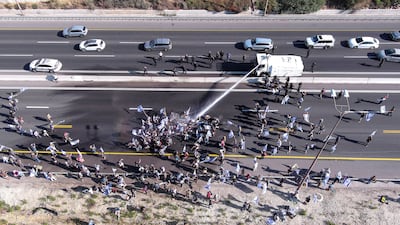
Israeli police use a water cannon against demonstrators at the Ein Hemed junction towards Jerusalem. Reuters -

Protesters set off a flare near Jerusalem as they oppose a bill to curb the Israeli Supreme Court's power to void government decisions. Reuters -

A confrontation in Tel Aviv, Israel, during protests against the move by Prime Minister Benjamin Netanyahu's coalition. Reuters -
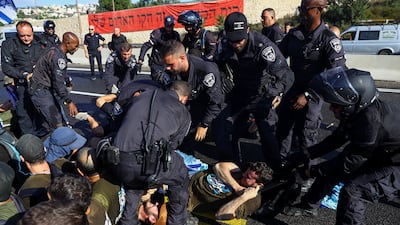
Members of the Israeli security forces remove demonstrators blocking a highway to Jerusalem. Reuters -
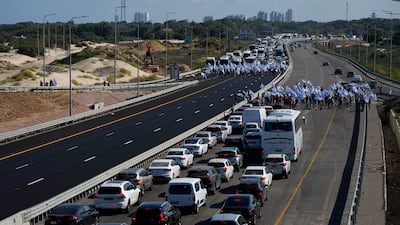
Israeli protesters block the Tel Aviv to Haifa highway near Beit Yanai, Israel. AP -
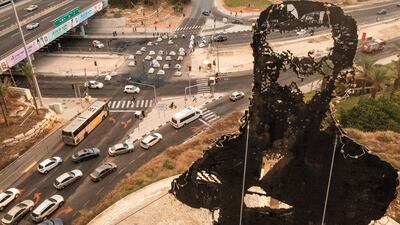
Demonstrators block a road with tents at the entrance to Herzliya, north of Tel Aviv, Israel. Reuters -

Israeli anti-government protesters block the entrance to Jerusalem, where some demonstrators entered the Knesset building. EPA


And finally, there is talk that normalisation will give US President Joe Biden a much-needed victory before the 2024 elections.
While it is doubtful that anything close to the kind of normalisation being touted in the US and Israeli media can occur, an agreement of any sort will not add five votes to the Biden column in 2024.
Democrats and Republicans are deeply polarised, and independent swing voters won’t be moved by foreign policy issues – except perhaps for Ukraine. Jewish voters will overwhelmingly support the Democratic nominee because of the domestic policies embraced by the GOP. And while Jewish voters may be concerned with the future of Israel, because of their growing unease with the orientation of the current Israeli government, they will not be impressed with any White House celebration that puts Prime Minister Benjamin Netanyahu centre stage.
All of this begs the question as to whether or not any form of Saudi-Israel normalisation can even happen given current Israeli and American politics.
This topic deserves a more complete discussion, but it should suffice to say that as much as Israel may want an agreement, no government or opposition figures in Israel would be willing to entertain even the most modest concessions regarding Palestinian rights.
Moreover, Republicans would be loath to provide Mr Biden with support for any form of agreement that would enhance his election year standing.
Bottom line: it’s time to end the hyperventilating over the prospects of a normalisation agreement. The better approach is for the US to embrace the new realities of a changing Middle East in which Israel is an outlier and for the US to accept its responsibility as the enabler of the Israeli occupation.

