Raghida Dergham is the founder and executive chairwoman of the Beirut Institute, and a columnist for The National
June 25, 2023
Indian Prime Minister Narendra Modi’s successful visit to Washington is a good example of the Biden administration’s readiness to nudge partners, rather than coerce them, to take positions desired by Washington.
It is noteworthy that the US has accepted India’s strategic neutrality on the Russia-Ukraine conflict, in the hope that this might evolve in the future. It has also refrained from criticising New Delhi over some of the country’s domestic challenges.
The Biden administration appeared satisfied with India’s stance towards China, without seeking to further inflame it. India boasts vast economic and technological capabilities that position it as a formidable competitor to its neighbour. India’s flexible policies have the potential to establish it as a global economic powerhouse, possibly surpassing even China in the future.
Mr Modi’s visit marks a pivotal moment in US-India relations, expanding them beyond simply countering the challenge posed by the rise of China.
It was evident that the common priority for US President Joe Biden and Mr Modi was strengthening their countries’ economic, security and military relations to support their overall strategic relationship – without any pressure to change positions on which the two sides diverge.
Their joint statement on Ukraine, for instance, underscored respect for the country’s territorial integrity, which is noteworthy given that New Delhi had previously sought to avoid taking a stance on the conflict.
Modi’s visit marks a pivotal moment in US-India relations, expanding them beyond the focus on simply countering the challenge posed by the rise of China
Washington abstained from criticising India’s extensive economic, energy and trade relations with Russia, with exports from Russia to India reportedly topping $40 billion in the last fiscal year. The Biden administration’s primary objective is for the US to eventually surpass Russia in securing military contracts that hold significant financial and security importance within the strategic relationship.
The former Trump administration had adopted a more rigid approach by trying to pressurise India to distance itself from Russia. But the Biden administration has chosen a step-by-step approach coupled with a larger American engagement with India, while maintaining a strong commitment to pursuing arms deals.
The Modi government is comfortable with this approach. It sees benefits in India’s continued participation in groupings supposedly aimed at countering China – especially the Quad, which also includes Australia, Japan and the US. Yet this is as far as New Delhi is willing to go, given that it seeks to avoid getting entangled in an outright conflict with China.
This is noteworthy in the context of the current trajectory of US-China relations.
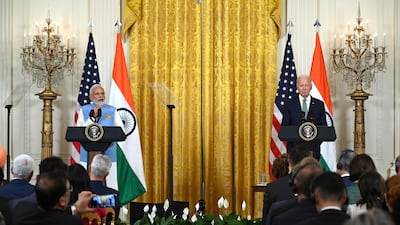
Mr Biden recently described Chinese President Xi Jinping as a “dictator”, which appeared to be a gaffe he made at an election campaign rally. But during the joint press conference with Mr Modi, the US president refused to back down, perhaps out of concern that this might reaffirm the widespread impression that he is prone to gaffes.
Mr Biden attempted to downplay the episode by expressing his expectation of a future meeting with the Chinese president. He added that such opinions would have few implications on the US-China relationship.
Beijing thinks otherwise. It officially protested in a letter submitted by Xie Feng, China’s ambassador to the US, demanding a retraction of those statements, or else face consequences.
China, however, does not seek to escalate matters with the US. It is highly probable that diplomats from both countries will find a way out of this awkward situation, especially as it follows US Secretary of State Antony Blinken’s recent visit to Beijing. Mr Blinken’s trip was marked by a conciliatory tone and a concerted effort to strengthen channels of communication.
Mr Biden’s time in office has been marked by a series of slip-ups and gaffes, causing ripples of controversy.
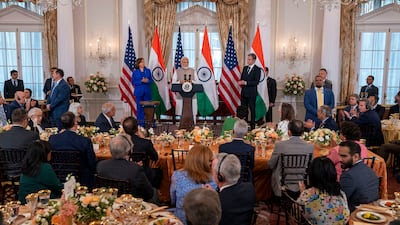
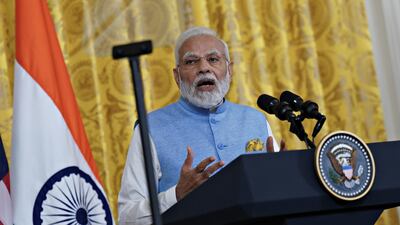
Indian Prime Minister Narendra Modi speaks at a lunch held in his honor hosted by US Vice President Kamala Harris and Secretary of State Antony Blinken at the State Department. Reuters
In a toast, Ms. Harris spoke of her Indian-born late mother, Shyamala Gopalan, who came to the United States at age 19 and became a leading breast cancer researcher. AP Photo
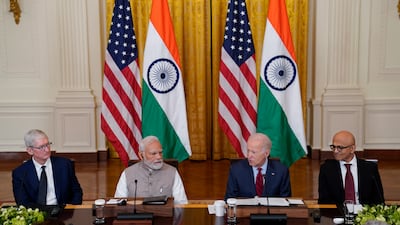
US President Joe Biden speaks during a meeting with Mr. Modi and American and Indian business leaders in the East Room of the White House. From left, Tim Cook, CEO of Apple, Mr. Modi, Mr. Biden, and Satya Nadella, CEO of Microsoft. AP Photo
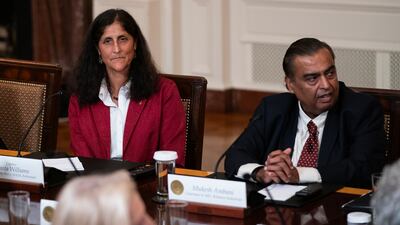
Sunita Williams, NASA astronaut, left, listens as Mukesh Ambani, Chairman and Managing Director of Reliance Industries, right, speaks during the meeting. AP Photo
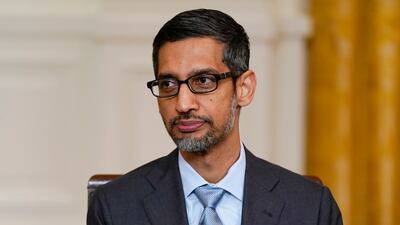
Sundar Pichai, CEO of Google, is also present. AP Photo
President Joe Biden talks with India's Prime Minister Narendra Modi at a state dinner at the White House in Washington. AP
Doug Emhoff, US second gentleman, third left, attends the official state dinner. AFP
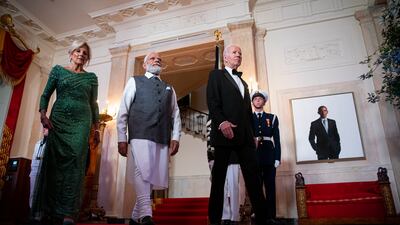
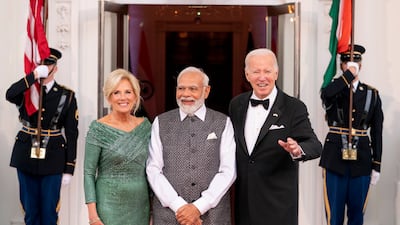
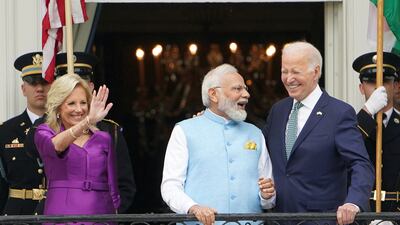
Mr Biden, Mr Modi and first lady Jill Biden at the Grand Staircase of the White House. EPA
The Bidens and Mr Modi arrive for a state dinner. AP
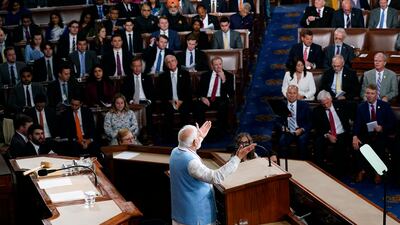
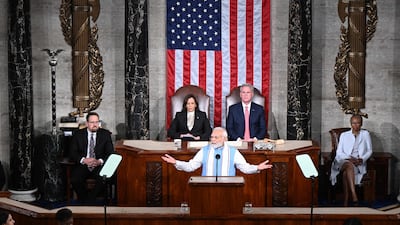
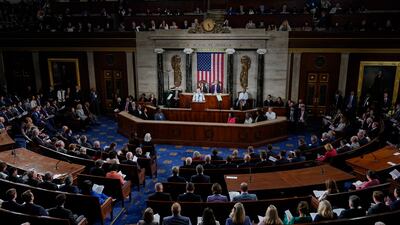
Mr Modi addresses a joint session of the US Congress. AP
Mr Modi speaks to the Congress. AFP
Mr Modi speaks to a joint session of the US Congress. AP
Mr Biden and Mr Modi speak during a joint press conferences in the East Room of the White House in Washington. AFP
Mr Modi and Mr Biden are expected to announce a series of defence and commercial deals designed to improve military and economic ties. Bloomberg
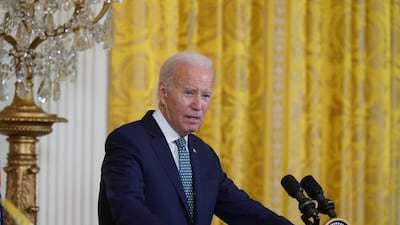
Mr Biden speaks at the news conference at the White House. Bloomberg
Mr Biden and Mr Modi speak in the Oval Office of the White House. EPA
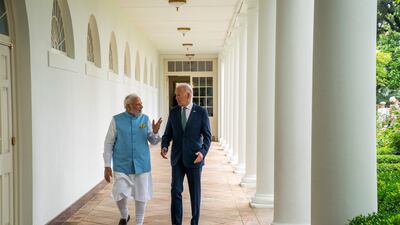
Mr Biden walks with Mr Modi at the White House during the Indian Prime Minister's official visit to Washington. Reuters
Mr Modi is welcomed to the White House. EPA
Mr Biden, first lady Jill Biden and Mr Modi attend an official state arrival ceremony at the White House. Reuters
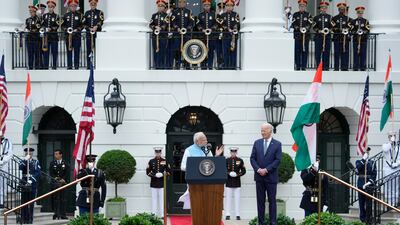
Mr Modi speaks from the South Lawn. He is in the US on a four-day state visit. AP
Mr Modi and Mr Biden watch a performance by the US Army Old Guard Fife and Drum Corps. AP
Mr Modi has said ties between the countries are 'one of the defining relationships of the 21st century'. AP
Mr Biden greets Mr Modi in Washington. AP
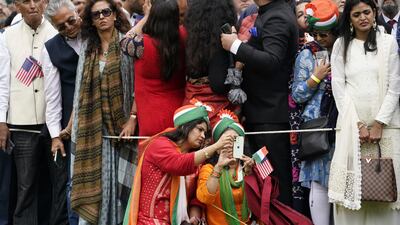
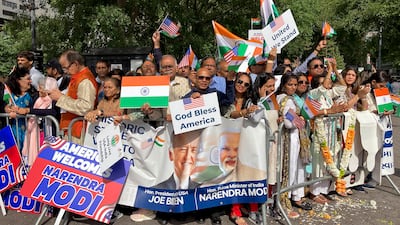
Indian Americans gather for the visit. AP
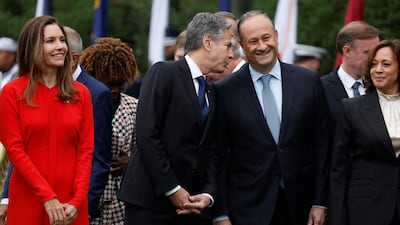
US Vice President Kamala Harris, right, and US Secretary of State Antony Blinken, second left, were among the senior officials at the event. Reuters
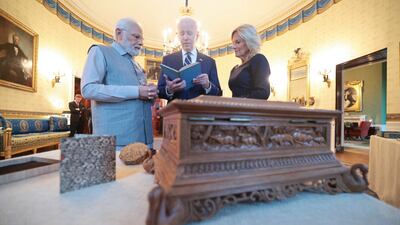
Mr Biden and Mr Modi exchange gifts at the White House. Reuters
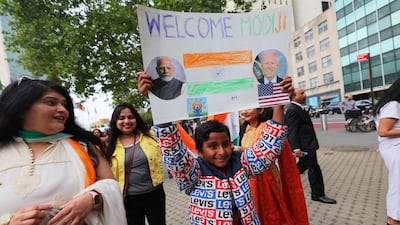
A child raises a homemade poster in front of the UN headquarters in New York to welcome Mr Modi. AFP
People gather near UN headquarters to welcome Mr Modi. AP
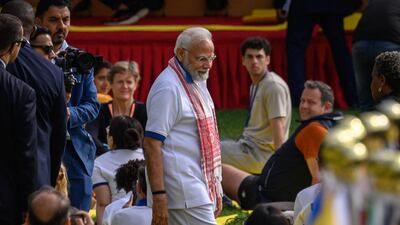
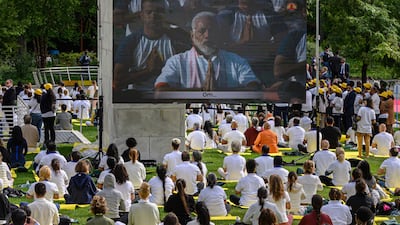
Mr Modi attends a yoga event on the International Day of Yoga, hosted at the UN. AFP
Mr Modi, seen on screen, leads a yoga session. AFP
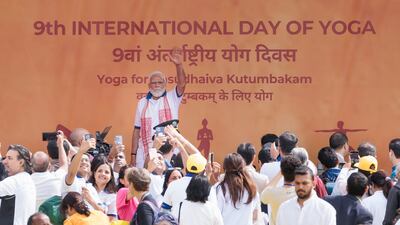
Mr Modi waves to the crowd after participating in a yoga class. EPA
Mr Modi gestures to participants as he arrives at the ninth International Day of Yoga event. Reuters
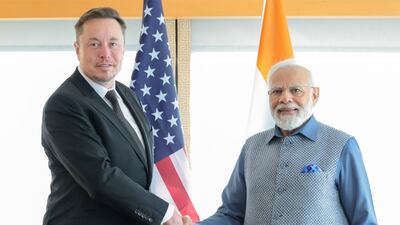
Mr Modi shakes hand with Tesla chief executive Elon Musk during their meeting in New York. Reuters
Mr Modi greets supporters as he arrives in New York. AP
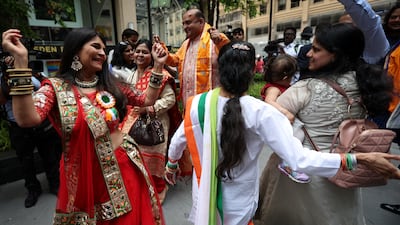
Supporters dance ahead of the arrival of Mr Modi in New York. Reuters
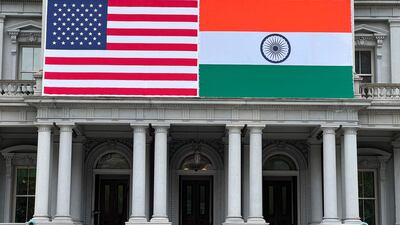
The flags of India and the US adorn the Eisenhower Executive Office Building in Washington. AP
Last year, he called Russian President Vladimir Putin a “butcher” and asserted that he “cannot remain in power”, prompting swift qualification from White House aides that his remarks did not indicate a policy of regime change. However, even as Mr Biden candidly voices his opinions that often diverge from diplomatic norms, they could sometimes be viewed as authentically reflecting the true sentiments held by the US administration.
The predicament lies in the fact that, it is the US that is seeking to demystify the US-China relationship. China, on the other hand, shows no urgency in doing so. And even if it did, it would not openly express it, as ambiguity appears ingrained in its mindset and policy. Consequently, while the relationship may tolerate occasional missteps, it will undoubtedly be affected in a manner contrary to the Biden administration’s goals. Both the US and China are averse to confrontation, and American diplomats are effectively conveying to their Chinese counterparts that verbal missteps do not define their policy. Instead, they say, the true essence of the policy is found only in precise official statements, which shape the contours and finer nuances of US foreign policy.
The message conveyed by the US to India holds significant weight, not only on content but also delivery. Mr Biden characterised the relationship with India as vibrant and thriving. The reception accorded to Mr Modi in Washington was exceptional. It included an elaborate state banquet at the White House and the opportunity for the Indian prime minister to address the US Congress.
In addition to bolstering and broadening trade, security, military, energy, technology and space relations, Mr Biden’s unwavering belief in the US and India as “two great nations, two great friends, two great powers that can define the course of the 21st century” and their potential to serve as role models in tackling the challenges of this era is not mere rhetoric or a mere verbal misstep on his part. Rather, it is a language reflecting utmost respect for a nation that has emerged in the recent past and has now matured, as it asserts itself in the scales and manifestations of great power status.
The significance of the US-India strategic partnership couldn’t be more evident.

1. Max Verstappen, Netherlands, Red Bull Racing Honda, 1 minute, 35.246 seconds.
2. Valtteri Bottas, Finland, Mercedes, 1:35.271.
3. Lewis Hamilton, Great Britain, Mercedes, 1:35.332.
4. Lando Norris, Great Britain, McLaren Renault, 1:35.497.
5. Alexander Albon, Thailand, Red Bull Racing Honda, 1:35.571.
6. Carlos Sainz Jr, Spain, McLaren Renault, 1:35.815.
7. Daniil Kvyat, Russia, Scuderia Toro Rosso Honda, 1:35.963.
8. Lance Stroll, Canada, Racing Point BWT Mercedes, 1:36.046.
9. Charles Leclerc, Monaco, Ferrari, 1:36.065.
10. Pierre Gasly, France, Scuderia Toro Rosso Honda, 1:36.242.
Eliminated after second session
11. Esteban Ocon, France, Renault, 1:36.359.
12. Daniel Ricciardo, Australia, Renault, 1:36.406.
13. Sebastian Vettel, Germany, Ferrari, 1:36.631.
14. Antonio Giovinazzi, Italy, Alfa Romeo Racing Ferrari, 1:38.248.
Eliminated after first session
15. Antonio Giovinazzi, Italy, Alfa Romeo Racing Ferrari, 1:37.075.
16. Kimi Raikkonen, Finland, Alfa Romeo Racing Ferrari, 1:37.555.
17. Kevin Magnussen, Denmark, Haas Ferrari, 1:37.863.
18. George Russell, Great Britain, Williams Mercedes, 1:38.045.
19. Pietro Fittipaldi, Brazil, Haas Ferrari, 1:38.173.
20. Nicholas Latifi, Canada, Williams Mercedes, 1:38.443.
Moonfall
Director: Rolan Emmerich
Stars: Patrick Wilson, Halle Berry
Rating: 3/5
Sole survivors
Cecelia Crocker was on board Northwest Airlines Flight 255 in 1987 when it crashed in Detroit, killing 154 people, including her parents and brother. The plane had hit a light pole on take off
George Lamson Jr, from Minnesota, was on a Galaxy Airlines flight that crashed in Reno in 1985, killing 68 people. His entire seat was launched out of the plane
Bahia Bakari, then 12, survived when a Yemenia Airways flight crashed near the Comoros in 2009, killing 152. She was found clinging to wreckage after floating in the ocean for 13 hours.
Jim Polehinke was the co-pilot and sole survivor of a 2006 Comair flight that crashed in Lexington, Kentucky, killing 49.
Silent Hill f
Publisher: Konami
Platforms: PlayStation 5, Xbox Series X/S, PC
Rating: 4.5/5
What is blockchain?
Blockchain is a form of distributed ledger technology, a digital system in which data is recorded across multiple places at the same time. Unlike traditional databases, DLTs have no central administrator or centralised data storage. They are transparent because the data is visible and, because they are automatically replicated and impossible to be tampered with, they are secure.
The main difference between blockchain and other forms of DLT is the way data is stored as ‘blocks’ – new transactions are added to the existing ‘chain’ of past transactions, hence the name ‘blockchain’. It is impossible to delete or modify information on the chain due to the replication of blocks across various locations.
Blockchain is mostly associated with cryptocurrency Bitcoin. Due to the inability to tamper with transactions, advocates say this makes the currency more secure and safer than traditional systems. It is maintained by a network of people referred to as ‘miners’, who receive rewards for solving complex mathematical equations that enable transactions to go through.
However, one of the major problems that has come to light has been the presence of illicit material buried in the Bitcoin blockchain, linking it to the dark web.
Other blockchain platforms can offer things like smart contracts, which are automatically implemented when specific conditions from all interested parties are reached, cutting the time involved and the risk of mistakes. Another use could be storing medical records, as patients can be confident their information cannot be changed. The technology can also be used in supply chains, voting and has the potential to used for storing property records.
1 The kind of water athletes drink is important. Gwilym Hooson, a 28-year-old British performer who is currently recovering from knee surgery, found that out when the company was still in Studio City, training for 12 hours a day. “The physio team was like: ‘Why is everyone getting cramps?’ And then they realised we had to add salt and sugar to the water,” he says.
2 A little chocolate is a good thing. “It’s emergency energy,” says Craig Paul Smith, La Perle’s head coach and former Cirque du Soleil performer, gesturing to an almost-empty open box of mini chocolate bars on his desk backstage.
3 Take chances, says Young, who has worked all over the world, including most recently at Dragone’s show in China. “Every time we go out of our comfort zone, we learn a lot about ourselves,” she says.
The burning issue
The internal combustion engine is facing a watershed moment – major manufacturer Volvo is to stop producing petroleum-powered vehicles by 2021 and countries in Europe, including the UK, have vowed to ban their sale before 2040. The National takes a look at the story of one of the most successful technologies of the last 100 years and how it has impacted life in the UAE.
The Apple Card looks different from a traditional credit card — there's no number on the front and the users' name is etched in metal. The card expands the company's digital Apple Pay services, marrying the physical card to a virtual one and integrating both with the iPhone. Its attributes include quick sign-up, elimination of most fees, strong security protections and cash back.
What does it cost?
Apple says there are no fees associated with the card. That means no late fee, no annual fee, no international fee and no over-the-limit fees. It also said it aims to have among the lowest interest rates in the industry. Users must have an iPhone to use the card, which comes at a cost. But they will earn cash back on their purchases — 3 per cent on Apple purchases, 2 per cent on those with the virtual card and 1 per cent with the physical card. Apple says it is the only card to provide those rewards in real time, so that cash earned can be used immediately.
What will the interest rate be?
The card doesn't come out until summer but Apple has said that as of March, the variable annual percentage rate on the card could be anywhere from 13.24 per cent to 24.24 per cent based on creditworthiness. That's in line with the rest of the market, according to analysts
What about security?
The physical card has no numbers so purchases are made with the embedded chip and the digital version lives in your Apple Wallet on your phone, where it's protected by fingerprints or facial recognition. That means that even if someone steals your phone, they won't be able to use the card to buy things.
Is it easy to use?
Apple says users will be able to sign up for the card in the Wallet app on their iPhone and begin using it almost immediately. It also tracks spending on the phone in a more user-friendly format, eliminating some of the gibberish that fills a traditional credit card statement. Plus it includes some budgeting tools, such as tracking spending and providing estimates of how much interest could be charged on a purchase to help people make an informed decision.
* Associated Press
Company profile
Name: Back to Games and Boardgame Space
Started: Back to Games (2015); Boardgame Space (Mark Azzam became co-founder in 2017)
Founder: Back to Games (Mr Azzam); Boardgame Space (Mr Azzam and Feras Al Bastaki)
Based: Dubai and Abu Dhabi
Industry: Back to Games (retail); Boardgame Space (wholesale and distribution)
Funding: Back to Games: self-funded by Mr Azzam with Dh1.3 million; Mr Azzam invested Dh250,000 in Boardgame Space
Growth: Back to Games: from 300 products in 2015 to 7,000 in 2019; Boardgame Space: from 34 games in 2017 to 3,500 in 2019
Funders: Oman Technology Fund, 500 Startups, Vision Ventures, Seedstars, Mindshift Capital, Delta Partners Ventures, with support from the OQAL Angel Investor Network and UAE Business Angels
Saturday: Nas, Lion Bbae, Roxanne Shante and DaniLeigh
Sole DXB runs from December 6 to 8 at Dubai Design District. Weekend pass is Dh295 while a one day pass is Dh195. Tickets are available from www.soledxb.com
A widely accepted definition was made by the All Party Parliamentary Group on British Muslims in 2019: “Islamophobia is rooted in racism and is a type of racism that targets expressions of Muslimness or perceived Muslimness.” It further defines it as “inciting hatred or violence against Muslims”.
How to apply for a drone permit
Individuals must register on UAE Drone app or website using their UAE Pass
Add all their personal details, including name, nationality, passport number, Emiratis ID, email and phone number
Upload the training certificate from a centre accredited by the GCAA
Submit their request
What are the regulations?
Fly it within visual line of sight
Never over populated areas
Ensure maximum flying height of 400 feet (122 metres) above ground level is not crossed
Users must avoid flying over restricted areas listed on the UAE Drone app
Only fly the drone during the day, and never at night
Should have a live feed of the drone flight
Drones must weigh 5 kg or less
If you go
Flight connections to Ulaanbaatar are available through a variety of hubs, including Seoul and Beijing, with airlines including Mongolian Airlines and Korean Air. While some nationalities, such as Americans, don’t need a tourist visa for Mongolia, others, including UAE citizens, can obtain a visa on arrival, while others including UK citizens, need to obtain a visa in advance. Contact the Mongolian Embassy in the UAE for more information.
Nomadic Road offers expedition-style trips to Mongolia in January and August, and other destinations during most other months. Its nine-day August 2020 Mongolia trip will cost from $5,250 per person based on two sharing, including airport transfers, two nights’ hotel accommodation in Ulaanbaatar, vehicle rental, fuel, third party vehicle liability insurance, the services of a guide and support team, accommodation, food and entrance fees; nomadicroad.com
A fully guided three-day, two-night itinerary at Three Camel Lodge costs from $2,420 per person based on two sharing, including airport transfers, accommodation, meals and excursions including the Yol Valley and Flaming Cliffs. A return internal flight from Ulaanbaatar to Dalanzadgad costs $300 per person and the flight takes 90 minutes each way; threecamellodge.com