


At the Munich Security Conference last week, China sought to engage European leaders. Its top diplomat, Wang Yi, then visited Moscow to co-ordinate preparations for an upcoming visit by Chinese President Xi Jinping to the Russian capital. Beijing, it seems, is searching for ways to avoid being dragged into an escalation with the West amid the Ukraine war. It is, therefore, presenting itself as a possible mediator between Russia and its western adversaries.
It is intriguing to watch how in an era of conflict, China is attempting to position itself via-a-vis the US, the world’s other dominant pole, in the event that Russia is defeated in Ukraine and in the global order that could emerge from such an eventuality.
To be sure, the Ukraine conflict is not a “world war”. It is an armed conflict between two sides. Russia has been unable to rally international support, as the Soviet Union was once able to do during the Cold War. The world might appear divided on Ukraine, as one camp condemns western colonialism and American imperialism while the other remains opposed to one country invading another. But no matter how hard the US tries to convince the likes of China, India, South Africa, Brazil and others to move away from Russia, ultimately, the war remains bilateral not global.
-
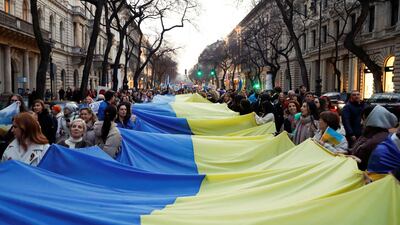
Supporters hold a Ukrainian flag at a solidarity march to mark the first anniversary of the Russian invasion of Ukraine, in Budapest, Hungary. Reuters -
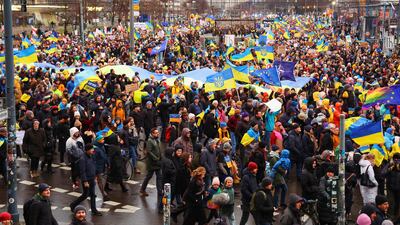
A protest to mark the one-year anniversary of the Russian invasion of Ukraine, in Berlin. Reuters -
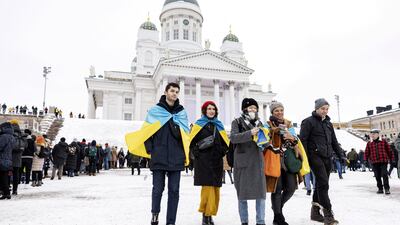
Supporters in front of Helsinki Cathedral during Light for Ukraine candlelight memorial event at Senate Square in Helsinki, Finland. Reuters -
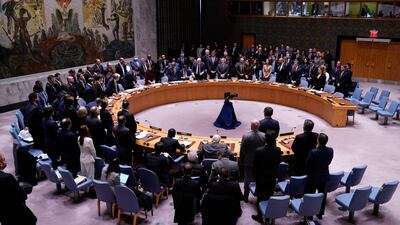
Representatives stand for a moment of silence during the United Nations Security Council meeting on the maintenance of peace and security of Ukraine at the UN headquarters in New York. AFP -
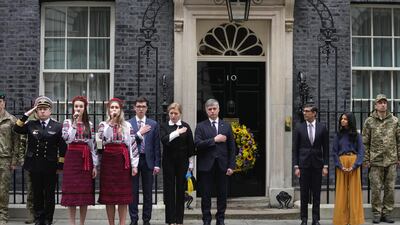
Britain's Prime Minister Rishi Sunak and his wife Akshata Murty, with Ukrainian ambassador to the UK Vadym Prystaiko, centre, his wife Inna and members of the Ukrainian Armed Forces outside 10 Downing Street in London, as they observe a minute's silence. AP -
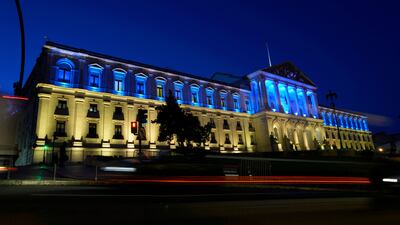
The Portuguese Parliament is lit with the blue and yellow of the Ukrainian flag, in Lisbon AP -
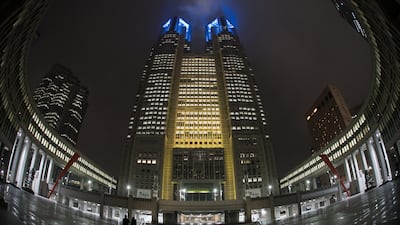
The Tokyo Metropolitan Government building is lit with the Ukraine national flag colours. Getty Images -
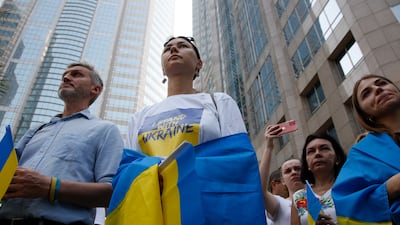
Supporters carry Ukrainian flags during a demonstration in Bangkok. EPA -
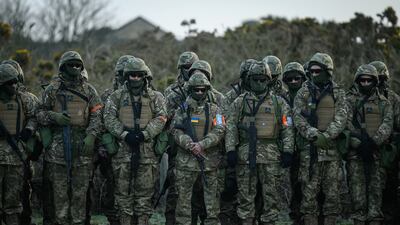
Ukrainian volunteers take part in prayers and observe a minute of silence, in south-east England. Getty -
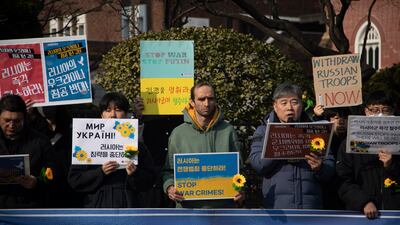
Protesters near the Russian embassy in Seoul, South Korea. EPA -
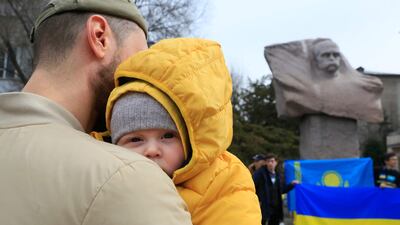
People lay flowers at a monument of Ukrainian poet, writer, artist, public and political figure Taras Shevchenko, in Almaty, Kazakhstan. AFP -
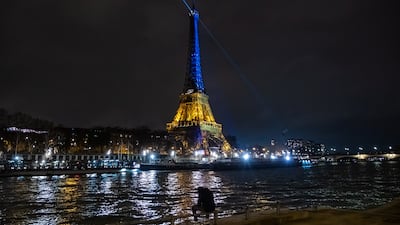
The Eiffel Tower in Paris is lit up in the colours of Ukrainian flag. EPA -
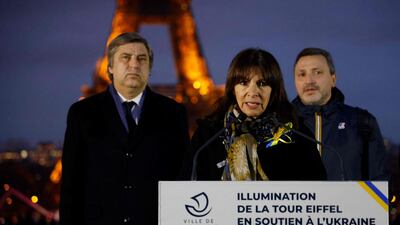
Paris Mayor Anne Hidalgo speaks alongside the Ukrainian ambassador to France, Vadym Omelchenko, during the event. AFP -
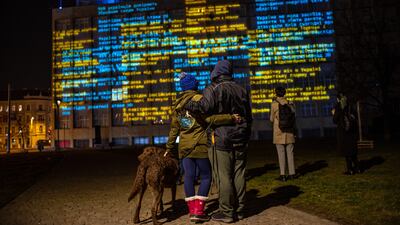
Watching video-mapping on the Czech Interior Ministry building, in Prague. EPA -
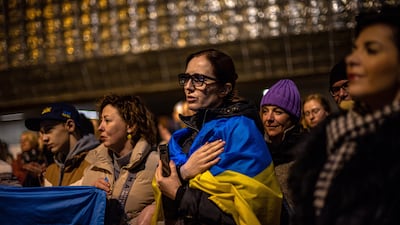
A woman expresses her solidarity with Ukraine at the Czech National Theatre, in Prague. EPA -
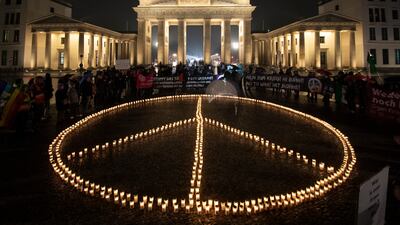
Activists place candles forming the peace sign in front of the Brandenburg Gate, in Berlin. AP -
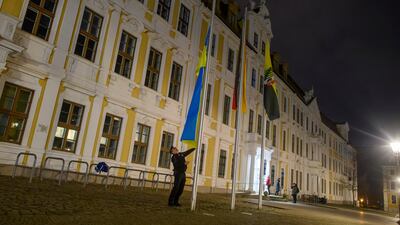
A police officer raises the Ukrainian flag in front of the state parliament of Saxony-Anhalt in Magdeburg, Germany. AP -
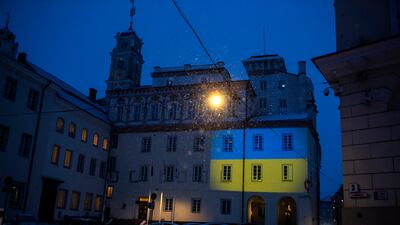
A Vilnius University building is illuminated in blue and yellow in support of Ukraine, in Vilnius, Lithuania. AP -
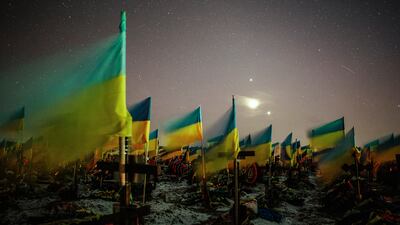
Ukrainian flags placed over the graves of fallen Ukrainian soldiers in a military cemetery in Kharkiv, north-eastern Ukraine. EPA -

A commemoration event with a light installation at the Field of Mars cemetery where hundreds of Ukrainian soldiers are buried, in Lviv, western Ukraine. Getty -
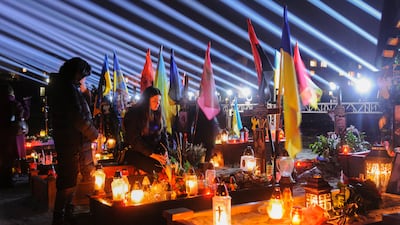
Friends and relatives of fallen Ukrainian soldiers take part in a prayer as Rays of Memory illuminate the night sky over Lychakiv military cemetery in Lviv. EPA -
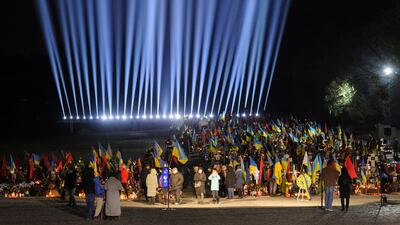
Rays of memory illuminate the sky over Lychakiv military cemetery in Lviv. EPA -
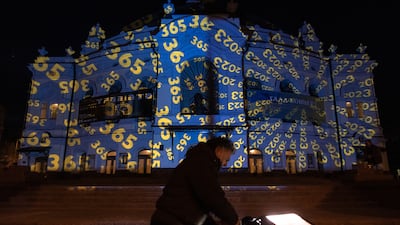
The National Opera of Ukraine building illuminated by Swiss artist Gerry Hofstetter in the colours of the Ukrainian flag, in Kyiv. Getty -
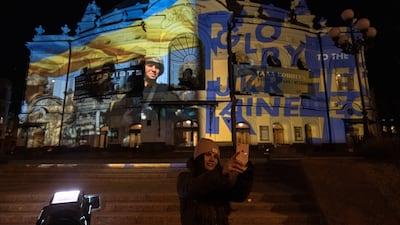
A woman takes selfies in front of The National Opera of Ukraine, illuminated by Swiss artist Gerry Hofstetter. Getty -

A candlelit vigil in front of the Russian consulate, in New York. Reuters -
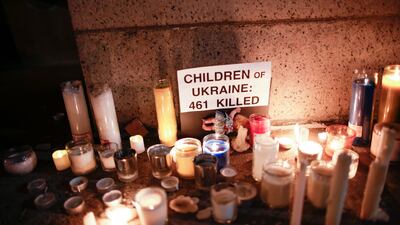
Candles lit outside the Russian consulate in New York during a vigil to commemorate children killed in Ukraine. AFP -

A silent candlelit vigil in New York. Reuters -
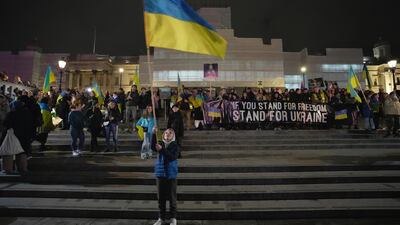
A Trafalgar Square vigil organised by the Ukrainian and US embassies in London. AP -
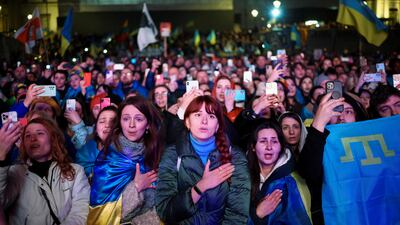
A vigil for Ukraine at Trafalgar Square in London. Reuters -
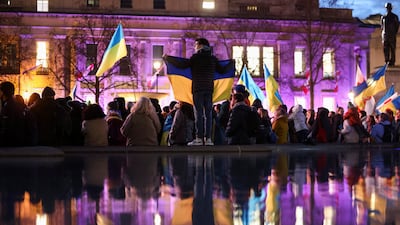
The Trafalgar Square vigil. Reuters -
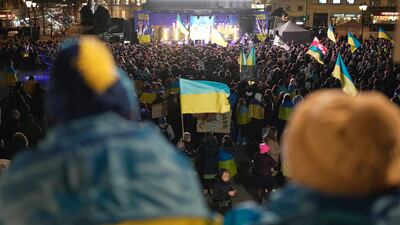
Crowds gather at Trafalgar Square. AP -
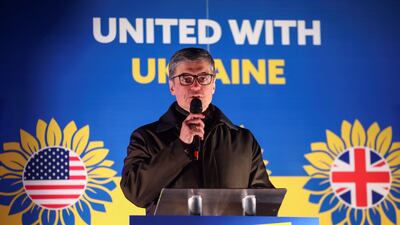
The Ukrainian ambassador to the UK, Vadym Prystaiko, addresses the London vigil. Reuters -
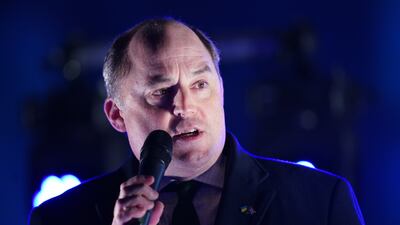
British Defence Secretary Ben Wallace speaks at the vigil. PA -
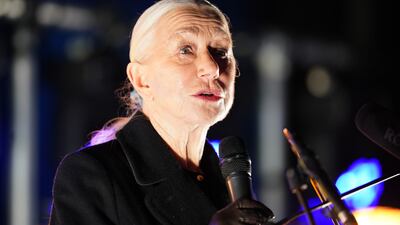
Actress and activist Helen Mirren addresses the London vigil. PA -
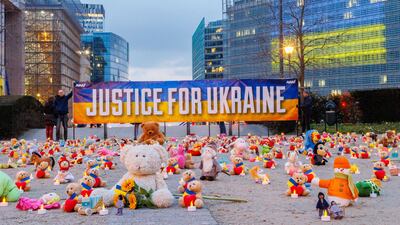
Teddy bears and other toys left by Ukrainian refugees and members of the Avaaz global activist network at Schuman Roundabout, in front of the European Commission, in Brussels. AP -
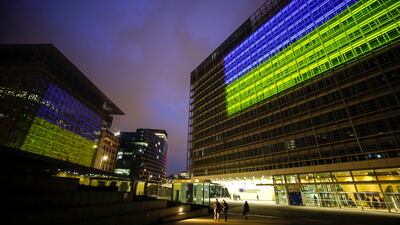
The EU Council and Commission buildings illuminated in the colours of the Ukrainian flag. EPA -
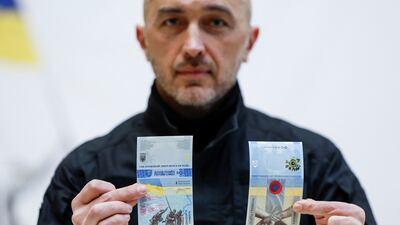
Governor of the National Bank of Ukraine Andriy Pyshnyi holds banknotes marking the first anniversary of Russia's invasion on Ukraine, in Kyiv. Reuters -
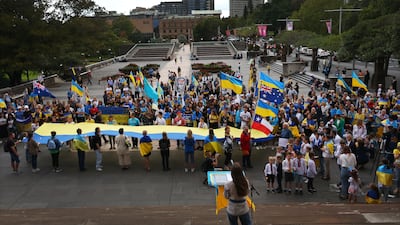
Supporters gather at St Mary's Cathedral Square during the 365 Days Strong rally and candlelight vigil in Sydney. Getty -

France's ambassador to Ukrain Etienne de Poncins, left, and the French Culture Minister Rima Abdul-Malak visit Independence Square in central Kyiv. AFP


As of today, the war isn’t going well for Moscow. In the process, it has deprived itself of its status as an international player and taken itself out of what seemed to be a “tripolar world” alongside the US and China. Russia is, at best, a regional player with limited capabilities today. The current scenario has given Washington reason to believe that Russia is weaker – and that without a strong Russia, China is also weaker.
Concerns about Russia are now primarily over its nuclear capabilities, and no longer over its conventional military prowess. Some today view Russia as a power unable to change the world but still able to destroy it. They will point to, for example, President Vladimir Putin’s announcement last Tuesday to suspend Russia’s New Start nuclear arms treaty with the US. It might be reassuring that he did not fully withdraw from it, but it is worrying that Moscow has linked the treaty’s revival with its demand that Nato stop sending arms shipments to Ukraine – which is next-to-impossible.
In his speech last week, Mr Putin blamed the West for starting the war by refusing to guarantee Moscow that it will never bring Ukraine into Nato. Likewise, US President Joe Biden’s statements and speeches during his surprise visit to Ukraine before a scheduled trip to Poland did not suggest he was in a mood for political solutions either.
Both leaders affirmed in their respective speeches that the US-Russia stand-off goes far beyond Ukraine, and that the world is now more dangerous, with no way to build a bridge over the gaping chasm between the two countries. The European leaders are lining up behind American leadership, endorsing the Biden administration’s view that the war is now about values such as democracy and requires unparalleled unity among Nato member states. And this is regardless of the stands taken by the so-called Global South.
China has entered the fray because it rejects notions of a unipolar world. It has decided that its interests require its involvement in Ukraine, with a plan to end the war at a time when US officials allege that Beijing might supply arms to Russia for its war effort.

But western, and even Ukrainian, leaders have decided not to dismiss China’s peace initiative before understanding the substance of it. They know that a pragmatic Beijing worries about the adverse impact the war could have on its own interests. China has concluded that if Russia does not achieve its objectives in the war, it might have to stand alone against US-led Nato, and does not want to endorse anything that could undermine its long-term strategic interests.
The Chinese initiative will, nonetheless, be a hard sell in both the West and Russia. At the time of writing, the details are sketchy, but it is unlikely that the principles Beijing appears to uphold – including territorial integrity – will be acceptable to the Russians. The Chinese proposal of securing a ceasefire in return for Nato halting weapons shipments to Ukraine will also be a non-starter in the West, particularly as the latter prepares for a spring offensive aiming to defeat Russia. Moreover, the West is not sympathetic to China’s fears of a Russian defeat and from the beginning has sought to weaken rather than strengthen it.
What could China want if its initiative fails to stop the war and kickstart a peace process? It seeks to reconfigure its relations with the US before a decisive military outcome, especially if that outcome is a Ukrainian victory, in the emerging bipolar world.
The Ukraine war has certainly changed the world. It is forcing everyone to rethink both tactically and strategically because the old ways to resolve conflicts are obsolete and beyond resurrection. Today, there are few new mechanisms even amid fears we could eventually descend into a third world war.
The key problem is that all players are retreating into a state of hypervigilance without opening any window to search for international security guarantees. And as the rest of the world wonders what the month of March might bring, the era of militarised diplomacy continues – with military solutions, and not political ones, on the table.

