


The thaw in Anglo-French relations has begun. For the first time in five years, a British prime minster will attend a summit with a French president.
After an inglorious spell of frostiness, characterised by Boris Johnson’s boorishness, Liz Truss’s belligerence and ill-concealed French contempt for Britain’s departure from the EU, there are signs that Britain’s Rishi Sunak and France’s Emmanuel Macron can work together.
They will meet in Paris on March 10. If reports from France, so far unconfirmed by Buckingham Palace, are accurate, the summit will be followed by a state visit by King Charles, his first official overseas trip since becoming monarch, at the end of the month.
It would be premature to attach weighty significance to these two events. Such has been this period of cross-Channel hostility, the diplomatic equivalent of a quarrel between intransigent neighbours, that the iceberg of distrust may be slow to melt. Talk of a blossoming bromance between two leaders with much in common probably owes more to journalistic cliche than reality. Yet, there is ample evidence that Mr Sunak and Mr Macron share a spirit of pragmatic respect.
And both have pressing problems with restless electorates.
In Britain, workers – especially in public services – have turned deep-rooted grievances over pay and conditions into a winter of discontent comparable with the last spell of James Callaghan’s Labour government in the late 1970s. Strikes by a wide range of employees – including nurses, ambulance drivers, railway workers, postal staff and immigration officers, with junior doctors and teachers planning stoppages – are causing nationwide disruption.
Millions of households are suffering from wretched increases in the cost of living. The crisis has been aggravated by fall-out from war in Ukraine and the economic legacy of the Covid-19 pandemic. It has been deepened – as are so many of Britain’s woes – by the predictable (and predicted) failure of Brexit to deliver on the promise of quick and easily won benefits.
-

Ambulance workers on the picket line outside Croydon Street Ambulance Station in Bristol. Thousands of members of Unison, Unite and the GMB unions are set to walk out across England and Wales. PA -
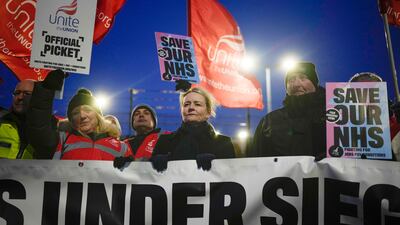
General secretary of Unite, Sharon Graham, joins ambulance workers on the picket line at the North West Ambulance Service in Chorley. Getty -
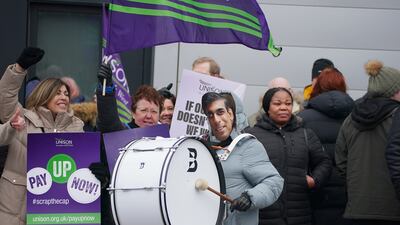
An ambulance worker wears a Rishi Sunak mask outside Royal Liverpool University Hospital. PA -

A picket line in Chorley. Getty -
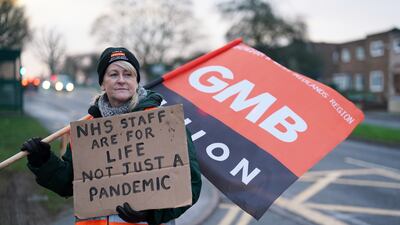
Ambulance workers on the picket line outside the Donnington Ambulance Hub. PA -
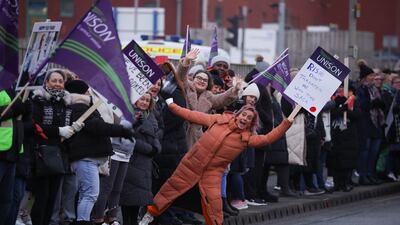
People take part in a strike outside Aintree University Hospital in Liverpool. Reuters


Across the English Channel, Mr Macron struggles with the sullen refusal of workers to accept his core objective of pushing through unpopular pension reforms. His government was apparently taken by surprise when more than a million people turned out to demonstrate against the proposed changes on January 19, with isolated but illegal power cuts imposed as part of the mobilisation.
In reality, Mr Macron is seeking fairly mild reforms. His plan would increase the age of retirement from 62 to 64 in stages between 2027 and 2030, and raise from 41.5 to 43 years the qualifying period of work before a full pension is payable. But the eight major unions are implacably opposed and are preparing for a protracted trial of strength.
The stakes are high for Mr Macron, whose fundamental strategy must prevail if the remaining four years of his mandate are not to be judged a failure. While some reports suggest that with 60-70 per cent of voters against him, he may be edging towards offering concessions, he cannot afford to be forced into retreat on the key principles of his reforms.
It is clear that the French and British leaders will need nerves of steel, and probably a reluctant willingness to compromise, in order to move forward from strikes and the rejection of reforms.
Mr Sunak’s battle for the hearts and minds of voters is complicated by the relentless stream of scandals associated with the government and governing Conservatives. He has ordered an ethics investigation over the tax affairs of his party chairman Nadhim Zahawi, who was forced to accept a punitive settlement with the authorities over a “careless, not deliberate” underpayment of his dues. Now it has emerged that a Conservative donor, Richard Sharp, helped Boris Johnson, at the time prime minister, secure a loan of up to £800,000 (about $983,000) weeks before being handed the job of chairman of the BBC.
Both Mr Zahawi, the Baghdad-born son of Iraqi Kurds, and Mr Sharp, a former banker, deny any wrongdoing. But the latest controversies, and Mr Sunak’s two fixed-penalty fines – for a breach of Covid-19 rules and, now, for not wearing a car seat belt – sit uneasily with his famous pledge, on taking office, to lead a government of “integrity, professionalism and accountability at every level”.
So far, Mr Macron and Mr Sunak have been reasonably successful in presenting themselves as resolute.
-
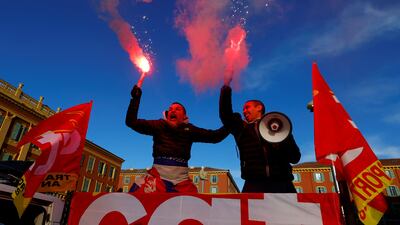
Protesters wield flares and CGT labour union flags during a demonstration against French government's pension reform plan in Nice. Reuters -

High school students put up placards that read "Retirement before Arthritis" in Paris during the nationwide strike on Thursday. Getty Images -
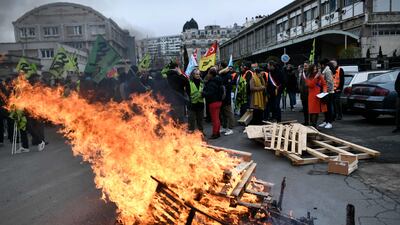
Wooden pallets burn as demonstrators gather during a rally outside the Gare de Lyon in Paris. AFP -

Empty platforms at Gare de l'Est Railway Station in Paris. Getty Images -
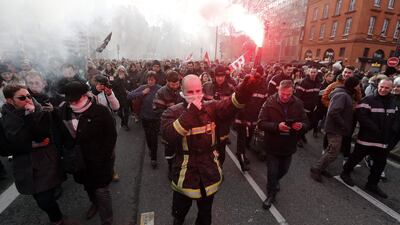
A firefighter lights a flare during demonstrations in Toulouse. EPA -

A rally called by French trade unions in Nantes. AFP -

Protesters wave flares during a rally in Marseille. AFP -
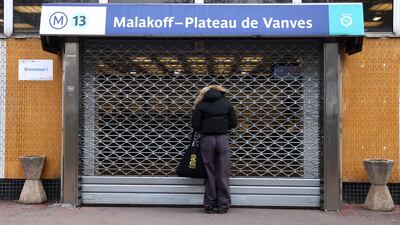
A commuter outside a closed metro station in Paris. EPA


Mr Sunak has made strenuous efforts to restore order to the government’s economic management after the wild and hugely damaging mini-budget of his predecessor as prime minister, Ms Truss, and her chancellor of the exchequer, Kwasi Kwarteng. Mr Macron still seems to possess one of the cooler heads among European leaders.
But much also depends of their ability to demonstrate a recognition of the need to listen with understanding to their voters’ grievances. Mr Macron misjudged the mood of the electorate over pensions and Mr Sunak should accept that he must do much better in response to disputes than rigidly pursuing what is widely seen as new anti-strike legislation.
There is another issue, of interest to Britain and France, that could prolong the troubled relations between the two countries. France, along with most of Europe, sees Brexit as incompatible with the Good Friday Agreement that brought a fragile peace to Northern Ireland. The British government, driven by pro-union sentiment, is unhappy with the post-Brexit protocol setting trading rules with the aim of avoiding a risky “hard border” between the Irish Republic, which is in the EU, and Northern Ireland. Diplomatic observers say France wants the matter resolved before it will commit to long-term co-operation in other areas.
A French presidential aide has been quoted as describing the visit by King Charles as “an opportunity to show the age-old attachment of his country to ours, beyond Brexit, and to be part of the family continuity, because Elizabeth II was Francophile and French-speaking”.
That, in itself, would be a welcome progression from the irrational spite and obstinacy of the past few years of Anglo-French discord.
But the leadership summit is arguably far more important. With so many headaches to face in the day-to-day running of their countries, Mr Macron and Mr Sunak will have plenty to discuss when they sit down for their tete-a-tete at the Elysee Palace.


