


At its core, the struggle over the future of Jerusalem isn’t only about religion. Though it may sound sacrilegious to some, the core issue extends beyond historical claims to holy sites or who gets to pray where and when. It’s also about power. Specifically, it’s about Israel’s objective to flaunt its power, while Palestinians make a last-ditch effort to salvage some shred of control over their lives.
This power struggle can be viewed through many lenses, but nowhere is it more clearly visible than in the tale of two Palestinian cities – East Jerusalem and Hebron – and the connections that bind their fate.
In 1994, after Baruch Goldstein, an extremist Israeli settler, massacred 29 Palestinian worshippers in Hebron’s Al Ibrahimi Mosque, the Israelis imposed several repressive measures that particularly affected Hebron and Jerusalem. The Israelis claimed that they implemented these measures in order to pre-empt any Palestinian retaliation for the massacre. And so, while an Israeli committed the crime, it was the Palestinians who paid the price.
In Hebron, Palestinians living in close proximity to the few hundred Israeli settlers who had illegally occupied buildings on Shuhada Street were evicted from their homes. Additionally, the Israeli military deployed more than a thousand well-armed soldiers and closed off major streets effectively shutting down the souq.
Where thousands of Hebronites once strolled and shopped, now there were empty streets and closed shops with graffiti covering the walls of Arab shops: Hebrew slogans reading "Death to the Arabs” and “Goldstein is our hero".

The stress and hardship this placed on Hebron was obvious, as was the disruption to the economic and professional well-being of the Palestinians who lived in the neighbouring towns and villages of the Hebron district. To protect the settlers travelling from the nearby settlement of Kiryat Arba, the Israeli military established numerous checkpoints and closed side roads. The situation borders on the absurd. Residents from two Palestinian villages could no longer drive the short distance to Hebron to shop and visit with relatives and friends. The route was cut by military blockades at two points, about 50 metres apart. Arabs driving from the villages were forced to park on one side and then walk to the next barricade to secure a taxi into Hebron.
Settler rioting, empty Arab shops, police beatings of Palestinians, the closure of the old city and the destruction of its economy, the daily harassment and pressure – this became daily life.
Equally distressing were the measures the Israelis implemented at Al Ibrahimi Mosque, the scene of the massacre. They took complete control of the building and physically divided it into Jewish and Muslim sections, with almost two-thirds reserved for a Jewish synagogue. While Israelis have relatively free access to the building, Palestinians are forced to wait in humiliating lines and pass through numerous Israeli-controlled checkpoints to enter. To add insult to injury, on dates of religious importance to Judaism, Israelis routinely close the entire mosque and its surroundings to Palestinians. And recently, Israel announced plans to seize land around the mosque to build a lift to provide access for Jewish worshippers.
I say that the fate of Jerusalem and Hebron are connected for two reasons. First, as part of the “protective” measures taken post-Goldstein, Israel instituted the complete closure of East Jerusalem from the rest of the West Bank. This closure was even more complete than the one instituted in Hebron, with profound economic, social, cultural, political, and even psychological consequences for the Palestinian population of East Jerusalem.
-
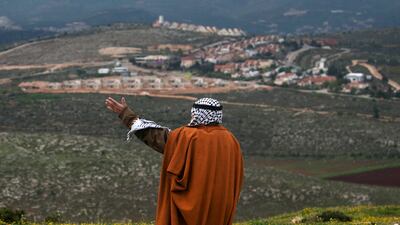
Abdallah Haj Mohamad, head of Jalud village's council, stands in front of the Jewish settlement of Shvut Rachel during a tour organised by Palestinian authorities to show the development of Israeli settlements in the occupied West Bank, on March 16, 2017. All photos: AFP -
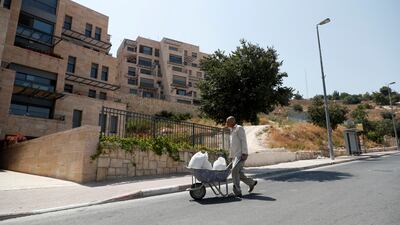
A picture taken on September 10, 2017 from Jabel Mukaber, a Palestinian neighbourhood In Israeli-occupied East Jerusalem, shows a worker pushing a cart in the Israeli settlement of Nof Zion. -
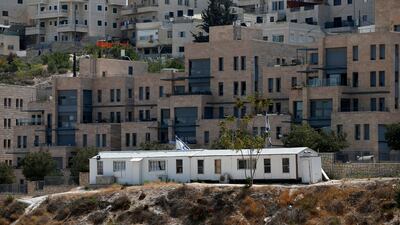
Another picture taken on September 10, 2017 from Jabel Mukaber shows the Israeli settlement of Nof Zion in the foreground. -
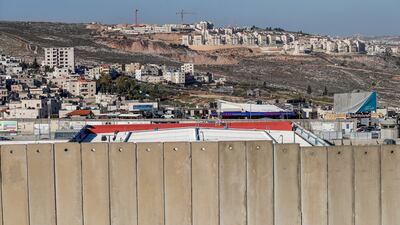
This picture taken on February 13, 2020 shows a section of Israel's separation barrier on the outskirts of Israeli-annexed East Jerusalem in the foreground, the Qalandia camp for Palestinian refugees in the occupied West Bank behind, and Israeli construction cranes at work on new housing units in the Jewish settlement of Kochav Ya'akov in the background. -

This picture taken on September 11, 2018 shows a view of the Palestinian Bedouin village of Khan al-Ahmar, located in a strategic spot in the occupied West Bank east of Jerusalem along the road to the Dead Sea near Israeli settlements. -
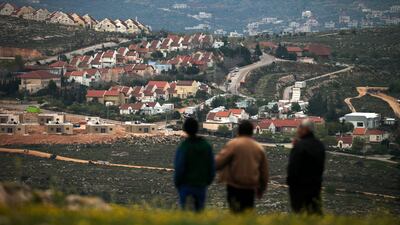
People look at the Jewish settlement of Shvut Rachel during a tour organised by the Palestinian authorities for ambassadors based in Tel Aviv and consuls based in Jerusalem to show the development of Israeli settlements in the occupied West Bank, on March 16, 2017. -

A picture taken on February 2, 2020, shows a general view of the Israeli settlement of Alon, in the Judaean desert, east of Jerusalem in the Israeli-occupied West Bank. -

A picture taken on January 27, 2020 shows the Israeli settlement Neve Yaakov, one of Jerusalem's neighbourhoods that falls between east Jerusalem and al-Ram in the occupied West Bank. -
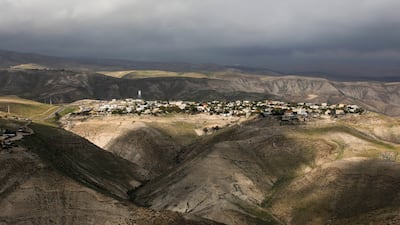
A picture taken on February 2, 2020, shows a general view of the Israeli settlement of Alon, in the Judaean desert, east of Jerusalem in the Israeli-occupied West Bank. -
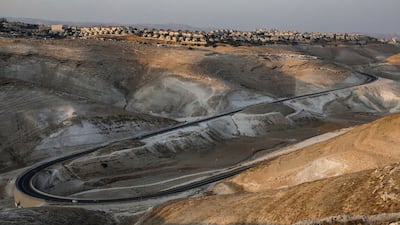
This picture taken from the Palestinian village of al-Sawahre, near the village of Abu Dis in the occupied West Bank on September 20, 2019 shows a view of the Israeli settlement of Maale Adumim.


The absence of jobs and opportunities for the young Palestinians in Jerusalem has produced both cynicism and despair, as has the closure, which, for all intents and purposes, cut the heart of Palestine away from the rest of its body.
Like their kinfolk in Hebron, as they lost control over their lives and futures, Palestinians in Jerusalem lost hope. And as they witness increasing settlement construction, land confiscations, and home demolitions as part of Israel’s effort to “Judaise” the city, that loss of hope has turned to resentment and resistance.
The one place, indeed the only place, where Palestinians feel any semblance of control is at Haram Al Sharif and Al Aqsa Mosque. And this brings me to the second reason why the fate of the two cities is inextricably linked.
When Palestinians see the increased numbers of heavily guarded Israelis invading the Haram area, the acts of incitement that accompany these “visits", and the declared intent of Israeli extremists to seize control of the area, they feel profoundly threatened. Their reaction is not as Israeli National Security Minister Itamar Ben-Gvir, a senior member of the current Israeli government, claims born of racism or anti-Semitism. Rather, it’s because they fear that what happened to Al Ibrahimi Mosque is what the future holds for Al Aqsa. And this they can’t abide. It is a religious issue to be sure, but, at its core, it’s about their need to protect the last semblance of control they feel they have.

