


The year 2023 will be an important one for Syria, but those hoping for an end to the civil war that has ravaged the country for more than a decade are likely to be disappointed. The situation might, in fact, become even more complicated in the year to come, thanks in no small part to the increasing influence of two other global political crises – in Ukraine and Iran.
While neighbouring states continue to watch Syria closely and with great concern, the events of 2022 in Ukraine and Iran have relegated its civil war to a secondary consideration for much of the international community. This is not just regrettable but dangerously myopic – Syria remains not just a regional but global security and humanitarian concern, increasingly affected by and entangled with the Ukraine and Iran crises as Russia and the Iranian regime desperately seek strategic leverage and advantage wherever they can find it.
One consequence of this "relegation" is that – quietly but no less profoundly – the "regime change" agenda has been dropped by the western states, which for a decade had called for Bashar Al Assad’s removal. While none are acknowledging it in public, the reality is that most western countries have grudgingly come to the conclusion that Mr Al Assad may now be the safest choice. It’s a classic case of "better the devil you know than the devil you don’t".
For what are the alternatives: Al Qaeda, ISIS, or the next Islamist extremist iteration coming to power? Other new leaders with no political experience emerging, trying to run a state that needs to be totally reconstructed and reformed, possibly leading to decades of instability? Neither option is palatable to the West, and indeed could lead to nightmare scenarios of a "failed state" further destabilising the Middle East. At least with Mr Al Assad, they know exactly what they’re getting.

Western regional allies agree, with the most dramatic regional change in this regard being in Turkish policy – President Recep Tayyip Erdogan, now far more worried about growing Kurdish regional political demands than Syrian policy, has gone from “not with Assad” just a few years ago to “not without Assad” today.
This Turkey-Syria marriage of convenience has been combined with a Turkish-Russian rapprochement, bringing Mr Erdogan into the circle of Syria-Russia-Iran relations. Last week, the Turkish, Syrian and Russian defence ministers held previously unannounced talks in Moscow, in the first ministerial-level meeting between Turkey and Syria since the start of the conflict 11 years ago. A Turkish Defence Ministry statement stated that the discussions focused on “the Syrian crisis, the refugee problem and efforts for a joint struggle against terror organisations present on Syrian territory".
Turkish threats of a further military intervention in Syria against these “terror organisations", something the Assad regime is actively seeking to avoid, loomed large in the talks. If Kurdish issues again arise in 2023, the threat of a Turkish military intervention remains very real, irrespective of the thawing of Ankara-Damascus relations.
In late November, Turkish Defence Minister Hulusi Akar told military commanders that Ankara was ready to “complete the tasks” against the YPG, the Syrian Kurdish militia, widely interpreted as a statement of Turkey’s willingness to launch a ground offensive in Syria. Mr Erdogan himself then said that Turkey would “come down hard on the terrorists from land at the most convenient time", and doubled-down on a commitment to build a “security corridor” in Syria across the Turkish border. His office reported on December 11 that Mr Erdogan had specifically called for such a corridor – to be 30 kilometres in length – in a call with Russian President Vladimir Putin, three weeks after Turkey launched strikes on Kurdish targets in Syria and Iraq in response to a bomb attack in Istanbul on November 13. The Turkish government blames Kurdish militias for the attack despite their denial of involvement in or knowledge of them.
-

Damascus International Airport was hit by an Israeli air strike on June 10. AP -
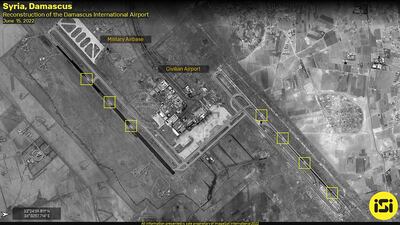
Flights were halted after the strike caused 'sizeable damage' to its only operational runway, authorities said. AFP / ImageSat International -
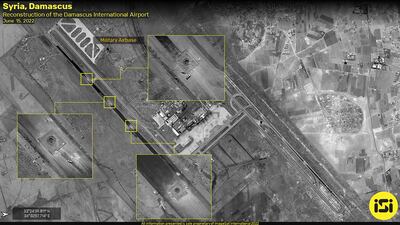
The runway will be operational 'within the next few days', Syria's transport minister told local media on June 12. AFP / ImageSat International -

Syria's Transportation Ministry said the air strike caused 'significant' damage to infrastructure and rendered the main runway unserviceable until further notice. The Syrian Observatory for Human Rights via AP


The Iran crisis also looms large, with Syria dramatically affected by the increasingly intimate Iran-Russia relationship that US intelligence officials are now calling a "full-blown military alliance". Russia’s use of Iranian drones in Ukraine has garnered significant international attention and condemnation, as more than 100 continuous days of political protests shock Iran and draw even further international opprobrium. As Russia and Iran become increasingly isolated, their need for each other and other strategic allies grows, drawing Syria and Mr Al Assad ever closer to Moscow and Tehran.
The continuation of the Assad regime thus poses one significant downside for the West and its allies, probably guaranteeing further entrenchment of the Russians and Iranians on the ground in Syria. This presents a strategic quandary not just for the likes of the US, the UK, and some of their regional allies, but potentially results in significant military engagement between Israel and Iran. Just yesterday, an Israeli missile strike on Damascus International Airport killed two soldiers, with one media report claiming that the strikes hit an outpost of Iran's Quds Force and militias it supports. While the international community focuses elsewhere, Syria could become the geography of a major escalation in Israel-Iran tensions and even a direct military conflict, further complicating the country's strategic and humanitarian crisis.
Syria continues to be a pawn in a wider, global geopolitical game. The Ukraine and Iran crises have in a number of ways overshadowed the decade-long civil war, relegating it to secondary importance, yet have also profoundly affected and changed it. Any resolution has become a relatively peripheral international political consideration, with the billions of dollars that would be needed to rebuild Syria unlikely to be forthcoming in the short and medium term with most funds available going instead to Ukraine. In any case, such funds are few and far between in the current global economic crisis.
All of this points to the possibility that the international attention required if Syria is to return to peace will, once again, not be forthcoming, with the country largely left to tackle its enduring and crippling issues alone. Its conflict will probably remain unresolved and roll on, with another year of misery in the offing for its long-suffering people.

