


Corruption and political dysfunction have belittled Iraqi sovereignty. Iran and Turkey have recently carried out simultaneous drone and missile attacks deep inside Iraqi Kurdistan. These assaults have caused casualties, stunted business and angered the Iraqi public. Further, such acts of aggression by its neighbours embarrass the Iraqi state and delegitimise its leaders who are in turn unwilling and unable to stand up for their country.
In attacking Iraq, Iran and Turkey are targeting their domestic audience. The Iranian regime is engulfed in countrywide anti-regime protests that were sparked by the murder of Mahsa Amini, a Kurdish woman, in September. Iran has sought to blame the protests on its Kurdish population. To deflect from events that invite a sense of deja vu of the 1979 revolution, the regime is attacking camps of Iranian opposition Kurdish groups that have been in Iraq for decades. Concurrently, Turkey has started a new military operation against the Kurdistan Workers' Party (PKK) in Iraq and the US-backed Syrian Democratic Forces militants in Syria accusing them of carrying out a recent terror attack in Istanbul. Akin to Iran, the Turkish government seeks to generate a boost of nationalism ahead of the 2023 elections.
Iran and Turkey are pushing against an open door in Iraq. Its military and political defences are down. Its response to such attacks has been feeble and feckless, amounting to little more than issuing statements. It had demonstrated a sliver of diplomatic heft when it filed a complaint against Turkey at the UN Security Council for killing nine civilians at a tourist resort in July. However, Baghdad has not dared take such action against Iran.
When Iran in March hit the home of a Kurdish energy executive in Erbil with a dozen ballistic missiles on unsubstantiated allegations that it was an Israeli base, many Iraqi leaders toed the Iranian line. Similarly, at the closed parliamentary session held on November 22 to discuss attacks on Kurdistan, several Iraqi representatives blamed Kurdistan Regional Government (KRG) and justified Iran’s actions. Neither the Iraqi government nor the KRG have taken the proverbial grievance airing measures of summoning Tehran’s ambassador and consul general or recalling their representatives in Tehran. In fact, as if out of sheer chutzpah, following its attacks inside Iraq, Iran called on the Security Council to shut down Iranian Kurdish groups in Iraq.

Such Iraqi weakness and lack of agency is embarrassing but not surprising. The rot in its corrupt and corrupting clientelist political system has escalated into a national security threat, beyond mere red tape or economic waste. Doing away with meritocracy in favour of sectarian patronage in the military had gutted its capacity and led to the loss of a third of the country to ISIS in 2014.
In jockeying for power at home, many Iraqi political factions find in Iran or Turkey a patron and protector. Iran abuses its sectarian affinity and geographic proximity to Iraqi and Kurdish factions. As a state, however, Iran has systematically invested in keeping Iraq weak and dependent.
Pro-Iran militias challenge the authority of the Iraqi state and carry out Iran’s bidding in the region, as manifest in their attacks on Gulf states. Iran’s influence inside the Iraqi government, coupled with direct and indirect attacks on Iraq’s energy and power infrastructure, keeps Iraq hooked on Iranian overpriced electricity and gas imports. Another liability is Iraq’s food security, which is also reliant on imports from Turkey and Iran. Together, Iran and Turkey are drying up Iraqi rivers. Although they seldom agree, Iran and Turkey welcome this irresolute Iraq. The October protests of 2019 were in part a nationalist backlash against such regional abuses and Iraqi acquiescence.
The presence of the PKK and various Iranian Kurdish groups in Iraqi Kurdistan go back decades but they make opportune excuses for fresh strikes by Turkey and Iran. Given its extreme vulnerability, the KRG is also a convenient target – it can neither deter attacks, nor defend itself or count on Iraq for support. The concerted Iranian and Turkish strikes have not even broken the influential cleric Moqtada Al Sadr's silence. The worst is yet to come should Iran carry out its threat of a cross-border military incursion joined by militias on the Iraqi side.
However, like their Shiite and Sunni political partners in the Iraqi government, the two ruling Kurdish parties have invested in weakening the Iraqi state, and seek out Iran and Turkey as patrons and protectors. KRG leaders become Iraqis selectively, when under attack, for example. With the use of violence, Iran and Turkey are seeking to change the Kurdish calculus – to see the presence of the PKK and the various Iranian Kurdish opposition groups as liabilities, not leverage.
-
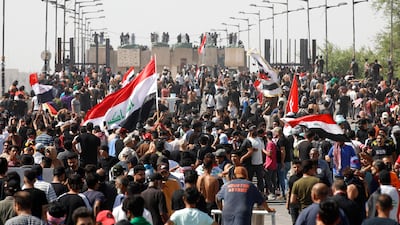
Protesters wave the Iraqi national flag as they attend a protest in Tahrir Square, Baghdad. AFP -
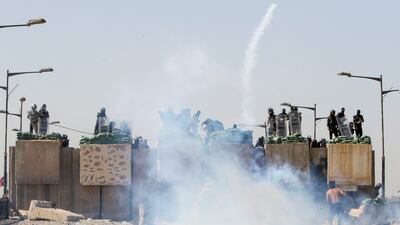
Anti-riot police, standing on barricades, disperse protesters with tear gas, in Baghdad. Reuters -
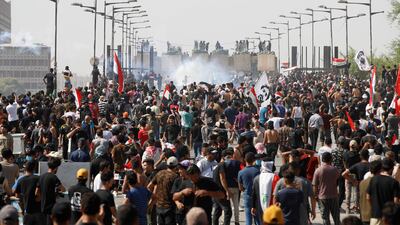
Tear gas rises as demonstrators gather in Tahrir Square in the centre of Baghdad. AFP -
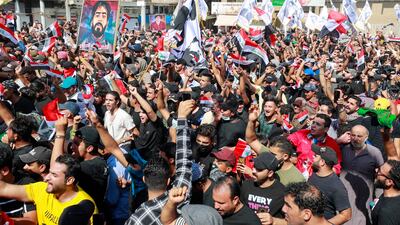
People were marking three years since anti-government protests swept through major cities in central and southern Iraq. AFP -
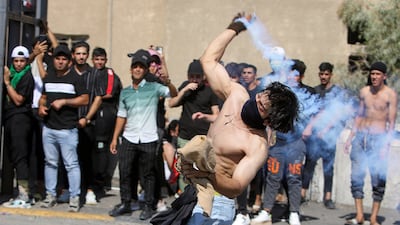
A protester hurls a tear gas canister. Reuters -
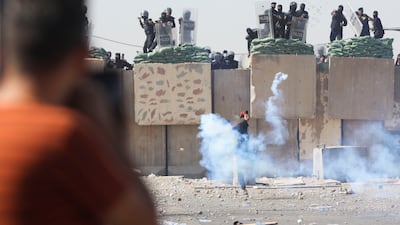
Anti-riot police clash with protesters. Reuters -
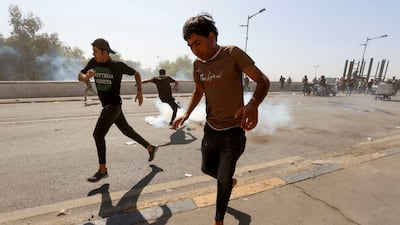
Fleeing from tear gas. Reuters -

A protester affected by tear gas is carried away. Reuters


Although the recent violent breach of Iraqi sovereignty does not target the US, it goes against the Biden administration’s efforts to de-escalate tensions in the Middle East and to focus on the challenges posed by the great powers. Iran and Turkey’s attacks both abuse and challenge this US stance, however. The US did condemn the Iranian attacks in particular, but the KRG has higher expectations, especially for greater air defence. However, to be heeded, such a request would have to come through Baghdad, which is unlikely. Per its strategic agreement with the Iraq, the US military mission there is narrowed to an advisory role and free from defence obligations. American hardware or not, Iraq seems to lack the political will to pursue procuring air defence systems.
The concurrent Iranian and Turkish attacks will test new Iraqi Prime Minister Mohammed Shia Al Sudani and his ability to stand up for his country's sovereignty. Foreign policy and national security are not Mr Al Sudani’s strongest suits. But his domestic agenda focused on fighting corruption and mending Erbil-Baghdad ties is well-placed as building blocks for a state more able at standing up for itself. The scale and depth of corruption in the elite and state have resulted in a series of unpatriotic allegiances that cripple Iraq against national security threats. In the interim, better KRG-Baghdad security co-ordination could secure the country’s borders and deny the neighbours further excuses. Only a clean and orderly house would enable Iraq to convincingly rally regional and international support for its sovereignty.

