Malaysia's King Sultan Abdullah Sultan Ahmad Shah, right, and newly appointed Prime Minister Anwar Ibrahim, left, take part in the swearing-in ceremony at the National Palace in Kuala Lumpur, Malaysia. AP
Malaysia's King Sultan Abdullah Sultan Ahmad Shah, right, and newly appointed Prime Minister Anwar Ibrahim, left, take part in the swearing-in ceremony at the National Palace in Kuala Lumpur, Malaysia


Anwar Ibrahim's government could be a force for stability


  • English
  • Arabic

November 24, 2022

He has had to wait nearly a quarter century, but Anwar Ibrahim finally became Prime Minister of Malaysia at 5pm on Thursday afternoon when he was sworn in by the country’s king. Viewed as a human rights poster child in the West due to his long imprisonment, and with suspicion by many others because of his association with Muslim Brotherhood figures, in 1998 Mr Anwar was then prime minister Mahathir Mohamad’s anointed successor – until he was dismissed by Dr Mahathir and then jailed.

In 2013, his opposition alliance gained the popular vote, but not a majority in parliament. After the 2018 election, which Mr Anwar’s liberal-leaning Pakatan Harapan alliance won, defeating the more conservative Barisan Nasional coalition for the first time ever, Mr Anwar was due to succeed Dr Mahathir again. But it became clear that the latter had no intention of letting Mr Anwar take over, ever, and the government fell due to the machinations of Dr Mahathir and his successor as prime minister, Muhyiddin Yassin.

On Sunday morning, after Malaysia’s latest general election, it still wasn’t clear if Mr Anwar would seize the prize at last. Pakatan had 82 out of the 222 seats in parliament – more than anyone else, but not a majority. The multiracial, multireligious country had never had a hung parliament before, and after the past four years, during which Malaysia had three different governments, it became clear that the King in Malaysia’s rotational monarchy, Sultan Abdullah of Pahang, whose task it was to name a new prime minister, was determined to ensure the next administration would be stable and lasting. No minority administration would be entertained.

Over the next five days, Malaysians checked their smartphones constantly to check which combination of parties looked likely to pass the magic 112 needed to form a majority. For the results had been unexpected. At the start of the election period, Barisan was so confident of winning outright that all the talk was about whether the incumbent prime minister, Ismail Sabri, would remain in place, or if Zahid Hamidi, president of the Barisan’s mainstay, Malay-only party, Umno, would force him out. With former prime minister Najib Razak, who helped Barisan barnstorm two state-level victories in the previous 12 months, in jail, Barisan’s campaign was lacklustre, and ended up producing their worst-ever result, with only 30 seats.

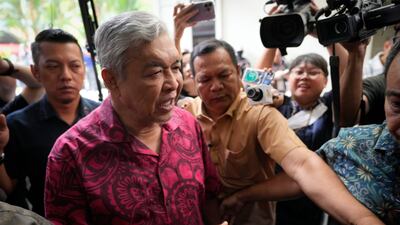
  • United Malays National Organisation president Ahmad Zahid Hamidi, centre, arrives at his party's headquarters in Kuala Lumpur, Malaysia. AP
    United Malays National Organisation president Ahmad Zahid Hamidi, centre, arrives at his party's headquarters in Kuala Lumpur, Malaysia. AP
  • Opposition Pakatan Harapan (PH) supporters celebrate at an election event in Subang. Malaysia has its first hung parliament after competing parties failed to win a majority, stoking political uncertainty in an economy on a fragile rebound. Bloomberg
    Opposition Pakatan Harapan (PH) supporters celebrate at an election event in Subang. Malaysia has its first hung parliament after competing parties failed to win a majority, stoking political uncertainty in an economy on a fragile rebound. Bloomberg
  • The country's next government appears to be leaning to the religious right as voters abandoned a coalition of Malay nationalists led by Mr Zahid's party. AFP
    The country's next government appears to be leaning to the religious right as voters abandoned a coalition of Malay nationalists led by Mr Zahid's party. AFP
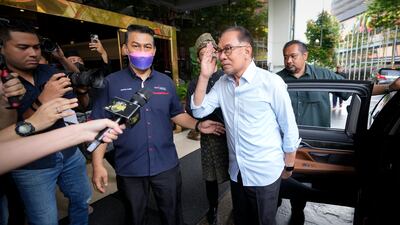
  • The reformist PH bloc led by opposition leader Anwar Ibrahim, centre, won 82 seats to beat the Malay-centric Perikatan Nasional alliance, led by former prime minister Muhyiddin Yassin, which won 73 seats. AP
    The reformist PH bloc led by opposition leader Anwar Ibrahim, centre, won 82 seats to beat the Malay-centric Perikatan Nasional alliance, led by former prime minister Muhyiddin Yassin, which won 73 seats. AP
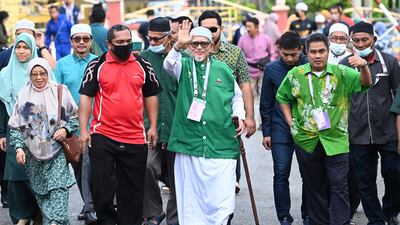
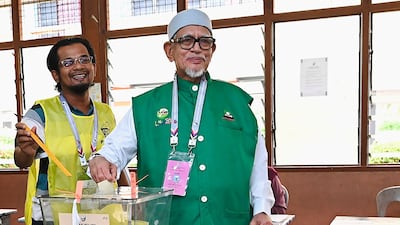
  • Mr Muhyiddin leads an alliance that includes the religious Pan-Malaysian Islamic Party led by Abdul Hadi Awang, centre. AFP
    Mr Muhyiddin leads an alliance that includes the religious Pan-Malaysian Islamic Party led by Abdul Hadi Awang, centre. AFP
  • Mr Abdul Hadi's party more than doubled its number of seats to 49 this year, from 18 in 2018. AFP
    Mr Abdul Hadi's party more than doubled its number of seats to 49 this year, from 18 in 2018. AFP
  • Mr Zahid, who is fighting dozens of corruption charges, faces pressure to resign after the UMNO's second drubbing at the polls. AP
    Mr Zahid, who is fighting dozens of corruption charges, faces pressure to resign after the UMNO's second drubbing at the polls. AP
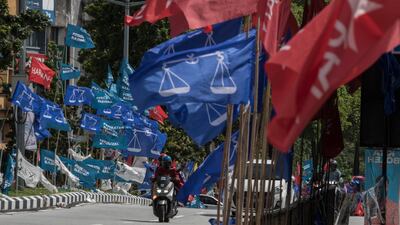
  • The campaign flags of Malaysia's ruling Barisan Nasional coalition, blue, and Mr Anwar's PH, red, in Kuala Lumpur. AP
    The campaign flags of Malaysia's ruling Barisan Nasional coalition, blue, and Mr Anwar's PH, red, in Kuala Lumpur. AP
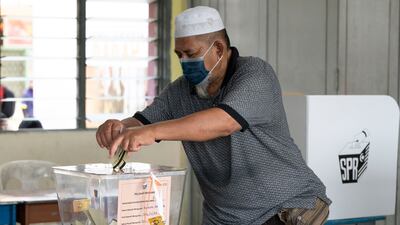
  • A man casts his ballot at a polling station in Seberang Perai, Penang state. AP
    A man casts his ballot at a polling station in Seberang Perai, Penang state. AP
  • Mr Muhyiddin delivers his speech after the announcement of the results in Subang, Malaysia. AP
    Mr Muhyiddin delivers his speech after the announcement of the results in Subang, Malaysia. AP
  • Mr Muhyiddin shows his inked finger as he casts his ballot at a polling station in Muar, a city in Malaysia's Johor state. AFP
    Mr Muhyiddin shows his inked finger as he casts his ballot at a polling station in Muar, a city in Malaysia's Johor state. AFP
  • Former Malaysia prime minister Mahathir Mohamad casts his vote at a polling station in Kuala Kedah, a district in Malaysia's Kedah state. Mr Mahathir lost in his longtime constituency of Langkawi, his first defeat in 53 years. AFP
    Former Malaysia prime minister Mahathir Mohamad casts his vote at a polling station in Kuala Kedah, a district in Malaysia's Kedah state. Mr Mahathir lost in his longtime constituency of Langkawi, his first defeat in 53 years. AFP
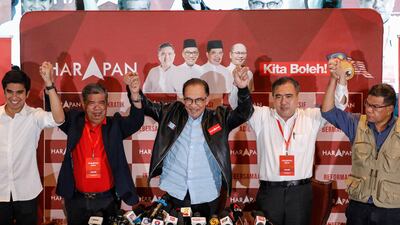
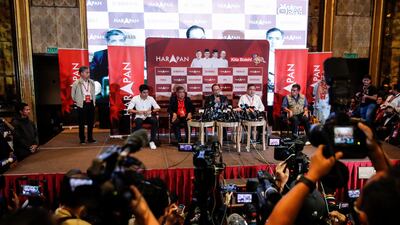
  • Mr Anwar and senior PH leaders celebrate during a press conference in Subang district, Kuala Lumpur. EPA
    Mr Anwar and senior PH leaders celebrate during a press conference in Subang district, Kuala Lumpur. EPA
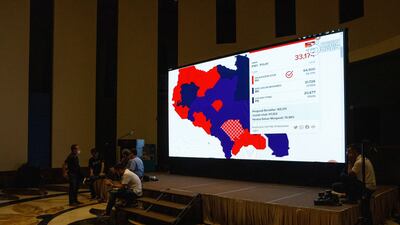
  • Members of the media watch voting results as they are announced at PH's camp in Subang, Malaysia. Bloomberg
    Members of the media watch voting results as they are announced at PH's camp in Subang, Malaysia. Bloomberg
  • Mr Anwar, centre, insists his alliance won a simple majority. EPA
    Mr Anwar, centre, insists his alliance won a simple majority. EPA

It was also a bad night for Dr Mahathir, who came a humiliating fourth in his Langkawi seat and lost his deposit; for former finance minister Tengku Razaleigh Hamzah, fondly known as “the best prime minister Malaysia never had”, who was out of the seat he had held since 1974; for Mr Anwar’s daughter, Nurul Izzah, who lost a seat that had been in the family since 1982; and for former health minister Khairy Jamaluddin, regarded by many – not least himself – as a future prime minister, who failed to win an opposition stronghold he’d been parachuted into by a leader said to be jealous of his popularity, Umno’s Zahid.

It wasn’t actually the best night for Mr Anwar’s Pakatan, either, as it was down eight seats. The real winner was the third coalition dominating peninsular Malaysia, Perikatan Nasional, helmed by Mr Muhyiddin, who had caused the Pakatan government to fall in 2020 when he led his Umno splinter party, Bersatu, into a new alliance with Barisan. Their 73 seats was a significant increase on the 39 they’d had before.

There may not appear to be anything especially alarming about a bloc led by a former prime minister, who’d also been deputy prime minister to Najib from 2009-16, when Mr Muhyiddin left Umno. Behind the reassuring front of “abah” – father – as Mr Muhyiddin liked to be known, however, was the fact that the other party in Perikatan is Parti Islam Se-Malaysia, or PAS. This religious party seems to have done very well with younger Malay voters. Mr Anwar’s daughter Nurul Izzah, for instance, lost to a 39-year-old religious teacher who is popular on TikTok. But PAS, whose numbers increased from 18 to 49, has a hardline Islamist ideology. The fact that its leader’s son congratulated the Taliban on their “victory” when they retook power in Afghanistan last year is all you need to know.

On Sunday, former law minister Zaid Ibrahim urged Pakatan and Barisan to think the unthinkable, and come together to stop “religious extremism” and “almost fascist kind of thinking”. “We cannot allow this country to be fundamentally changed forever,” as a government dominated by PAS would do, he said.

For decades their leaders had fought, often viciously. Barisan had always insisted there could be “no Anwar, no DAP” – a reference to a Chinese party that has long been a mainstay of Mr Anwar’s coalition. Pakatan declared Barisan to be irredeemably corrupt and racist. But the election changed everything. Compared to the Malay-Muslim ethno-religious hardcore nationalism of PAS-majority Perikatan, wrote Malaysian editor Terence Fernandez: “Suddenly, Umno is seen as the liberal Malay party that makes the effort to be inclusive of non-Malays and embraces the social fabric of the nation.”

There were floods during election season. Reuters

By Monday morning, Mr Anwar was meeting Umno president Zahid, to whom he has been personally if not politically close for more than 25 years, and other Barisan leaders. There was a plan. Mr Anwar was to be PM, Umno deputy president Mat Hassan, deputy PM, and Shafie Apdal, leader of a Sabah state-based party, deputy PM II – fulfilling a promise that Malaysia’s Borneo states would have a higher representation at the top of government.

There have been many to-ings and fro-ings in the days since, with Mr Muhyiddin declaring he had the numbers to form a government; the King calling his bluff, and asking him to form a unity government with Mr Anwar’s Pakatan, which he refused to do; a couple of Umno MPs, including outgoing prime minister Ismail Sabri, saying they would rather be expelled from the party than ally with Pakatan; and a meeting on Thursday morning of the country’s nine hereditary rulers to discuss the choice of prime minister.

In the end, however, the King’s wise call for a unity government has prevailed. Pakatan, Barisan, and the main parties from the Borneo states have a clear majority. Although Barisan did terribly in the election, the moderate voices in Umno will be empowered out of necessity by working with the reformist Pakatan. The increasing number of Malaysians I have heard asking why Umno – which is really the “indispensable party” for any stable government – couldn’t work with Pakatan now find their dream unexpectedly coming true. And Mr Anwar at last has his chance. Even those who have not been his supporters in the past must hope that he fulfils his promise. If it can keep together, this coalition could truly be a new dawn, and a new “harapan” – hope – for Malaysia.


The%20specs
%3Cp%3E%3Cstrong%3EEngine%3A%20%3C%2Fstrong%3E4.0-litre%20twin-turbo%20V8%0D%3Cbr%3E%3Cstrong%3EPower%3A%20%3C%2Fstrong%3E640hp%20at%206%2C000rpm%0D%3Cbr%3E%3Cstrong%3ETorque%3A%20%3C%2Fstrong%3E850Nm%20from%202%2C300-4%2C500rpm%0D%3Cbr%3E%3Cstrong%3ETransmission%3A%20%3C%2Fstrong%3E8-speed%20auto%0D%3Cbr%3E%3Cstrong%3EFuel%20consumption%3A%20%3C%2Fstrong%3E11.9L%2F100km%0D%3Cbr%3E%3Cstrong%3EPrice%3A%20%3C%2Fstrong%3EDh749%2C800%0D%3Cbr%3E%3Cstrong%3EOn%20sale%3A%20%3C%2Fstrong%3Enow%3C%2Fp%3E%0A
UAE currency: the story behind the money in your pockets
THE SPECS

Engine: 1.5-litre turbocharged four-cylinder

Transmission: Constant Variable (CVT)

Power: 141bhp 

Torque: 250Nm 

Price: Dh64,500

On sale: Now

The specs: Volvo XC40

Price: base / as tested: Dh185,000

Engine: 2.0-litre, turbocharged in-line four-cylinder

Gearbox: Eight-speed automatic

Power: 250hp @ 5,500rpm

Torque: 350Nm @ 1,500rpm

Fuel economy, combined: 10.4L / 100km

Multitasking pays off for money goals

Tackling money goals one at a time cost financial literacy expert Barbara O'Neill at least $1 million.

That's how much Ms O'Neill, a distinguished professor at Rutgers University in the US, figures she lost by starting saving for retirement only after she had created an emergency fund, bought a car with cash and purchased a home.

"I tell students that eventually, 30 years later, I hit the million-dollar mark, but I could've had $2 million," Ms O'Neill says.

Too often, financial experts say, people want to attack their money goals one at a time: "As soon as I pay off my credit card debt, then I'll start saving for a home," or, "As soon as I pay off my student loan debt, then I'll start saving for retirement"."

People do not realise how costly the words "as soon as" can be. Paying off debt is a worthy goal, but it should not come at the expense of other goals, particularly saving for retirement. The sooner money is contributed, the longer it can benefit from compounded returns. Compounded returns are when your investment gains earn their own gains, which can dramatically increase your balances over time.

"By putting off saving for the future, you are really inhibiting yourself from benefiting from that wonderful magic," says Kimberly Zimmerman Rand , an accredited financial counsellor and principal at Dragonfly Financial Solutions in Boston. "If you can start saving today ... you are going to have a lot more five years from now than if you decide to pay off debt for three years and start saving in year four."

FIXTURES

Monday, January 28
Iran v Japan, Hazza bin Zayed Stadium (6pm)

Tuesday, January 29
UAEv Qatar, Mohamed Bin Zayed Stadium (6pm)

Friday, February 1
Final, Zayed Sports City Stadium (6pm)

In numbers: China in Dubai

The number of Chinese people living in Dubai: An estimated 200,000

Number of Chinese people in International City: Almost 50,000

Daily visitors to Dragon Mart in 2018/19: 120,000

Daily visitors to Dragon Mart in 2010: 20,000

Percentage increase in visitors in eight years: 500 per cent

Try out the test yourself

Q1 Suppose you had $100 in a savings account and the interest rate was 2 per cent per year. After five years, how much do you think you would have in the account if you left the money to grow?
a) More than $102
b) Exactly $102
c) Less than $102
d) Do not know
e) Refuse to answer

Q2 Imagine that the interest rate on your savings account was 1 per cent per year and inflation was 2 per cent per year. After one year, how much would you be able to buy with the money in this account?
a) More than today
b) Exactly the same as today
c) Less than today
d) Do not know
e) Refuse to answer

Q4 Do you think that the following statement is true or false? “Buying a single company stock usually provides a safer return than a stock mutual fund.”
a) True
b) False
d) Do not know
e) Refuse to answer

The “Big Three” financial literacy questions were created by Professors Annamaria Lusardi of the George Washington School of Business and Olivia Mitchell, of the Wharton School of the University of Pennsylvania. 

Answers: Q1 More than $102 (compound interest). Q2 Less than today (inflation). Q3 False (diversification).

Who has lived at The Bishops Avenue?
  • George Sainsbury of the supermarket dynasty, sugar magnate William Park Lyle and actress Dame Gracie Fields were residents in the 1930s when the street was only known as ‘Millionaires’ Row’.
  • Then came the international super rich, including the last king of Greece, Constantine II, the Sultan of Brunei and Indian steel magnate Lakshmi Mittal who was at one point ranked the third richest person in the world.
  • Turkish tycoon Halis Torprak sold his mansion for £50m in 2008 after spending just two days there. The House of Saud sold 10 properties on the road in 2013 for almost £80m.
  • Other residents have included Iraqi businessman Nemir Kirdar, singer Ariana Grande, holiday camp impresario Sir Billy Butlin, businessman Asil Nadir, Paul McCartney’s former wife Heather Mills. 
Hunting park to luxury living
  • Land was originally the Bishop of London's hunting park, hence the name
  • The road was laid out in the mid 19th Century, meandering through woodland and farmland
  • Its earliest houses at the turn of the 20th Century were substantial detached properties with extensive grounds


THE%20FLASH
%3Cp%3E%3Cstrong%3EDirector%3A%3C%2Fstrong%3E%20Andy%20Muschietti%3Cbr%3E%3Cstrong%3EStars%3A%3C%2Fstrong%3E%20Sasha%20Calle%2C%20Ben%20Affleck%2C%20Ezra%20Miller%3Cbr%3E%3Cstrong%3ERating%3A%20%3C%2Fstrong%3E3%2F5%3C%2Fp%3E%0A
The%20Last%20White%20Man
%3Cp%3EAuthor%3A%20Mohsin%20Hamid%C2%A0%3C%2Fp%3E%0A%3Cp%3E192%20pages%C2%A0%3C%2Fp%3E%0A%3Cp%3EPublished%20by%3A%20Hamish%20Hamilton%20(UK)%2C%20Riverhead%20Books%20(US)%3C%2Fp%3E%0A%3Cp%3ERelease%20date%3A%20out%20now%20in%20the%20US%2C%20August%2011%20(UK)%3C%2Fp%3E%0A
Updated: November 24, 2022, 2:16 PM