


For more than 30 years, governments, scientists and industry leaders have been meeting to tackle the need to lower greenhouse gas emissions and avoid a climate emergency.
However, since these meetings began in 1988 – with the first session of the Intergovernmental Panel on Climate Change in Geneva – global carbon dioxide emissions have risen by more than 40 per cent, moving us ever closer to climate disaster.
We must raise annual investment levels to almost $5 trillion a year if we are to achieve a net-zero global economy by 2050.
The culmination of this relentless rise in carbon emissions, despite concerted international efforts to curb them, reveals that there has been a fundamental disconnect between rhetoric and intention.
Today, as we find ourselves ensnared in the worst energy crisis since the 1970s and as the Arab World prepares to host the next two UN climate change meetings, connecting words with actions must be the top priority for the presidencies of Egypt and the UAE.
Achieving this is no easy task. It requires the buy-in of the entire international community. And it requires an ongoing, year-round response.
Ahead of Cop27 in Sharm el-Sheikh, the Abu Dhabi International Petroleum Exhibition & Conference (Adipec) and the 24th council meeting of the International Renewable Energy Agency (Irena) provided two crucial checkpoints on energy security and climate progress.
Dr Sultan Al Jaber, Managing Director and Group CEO of Abu Dhabi National Oil Company, opened Adipec with a strong statement on global energy security, calling for “maximum energy, minimum emissions”.
Dr Al Jaber, who is also the UAE’s Special Envoy for Climate Change also said, “the solutions the world needs are also major opportunities for all of us,” adding that they can and must come from all forms of energy – from hydrocarbons to solar, wind and hydrogen.
-
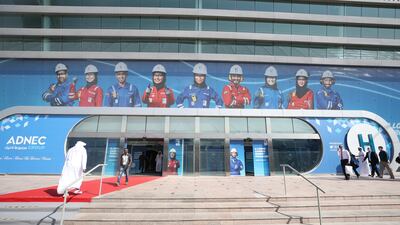
The Abu Dhabi International Petroleum Exhibition and Conference (Adipec) is expected to draw 2,200 exhibitors this year. All photos: Victor Besa / The National -

The National's stand at Adipec. -
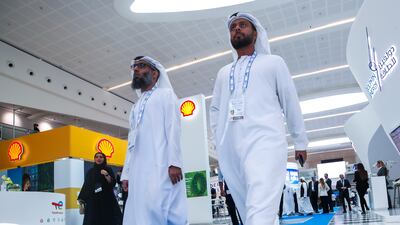
Adipec highlights oil and gas investment needs amid the current energy crisis. -
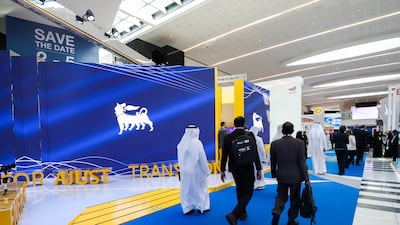
The conference features high-profile speakers, including energy ministers from the UAE, Saudi Arabia, India and Bahrain. -
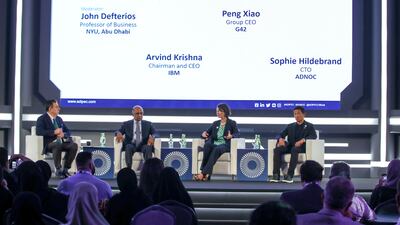
Executives discuss how to transform business operations through the power of business intelligence during a panel discussion at Adipec. -
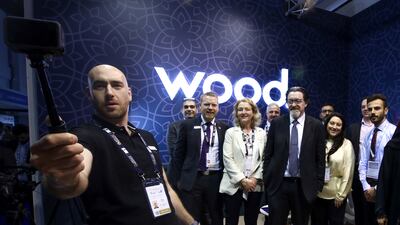
Employees of energy services business Wood pose for a group picture at Adipec. -
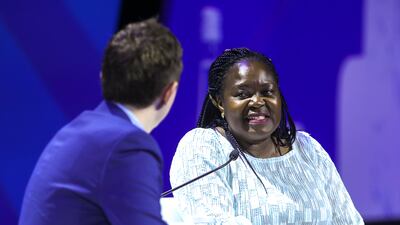
Ruth Ssentamu, Uganda's Minister of Energy and Mineral Development, responds to moderator Paul Wallace during a ministerial panel discussion on creating a 'just, equitable and sustainable future'. -
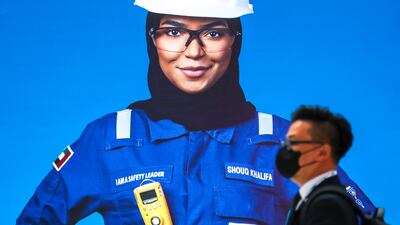
Global oil and gas spending is expected to shrink this year, despite crude hovering around $95 a barrel. -
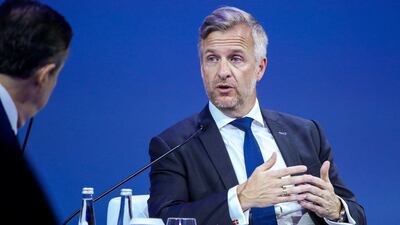
P&O Maritime Logistics chief executive Martin Helweg speaks during a panel discussion titled 'Globalisation under threat: managing supply chains in an age of disruption'. -
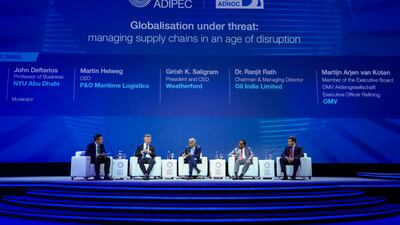
More than 40 ministers and 38 company heads, along with 12,000 delegates from around the world, deliver more than 350 sessions, organisers have said. -
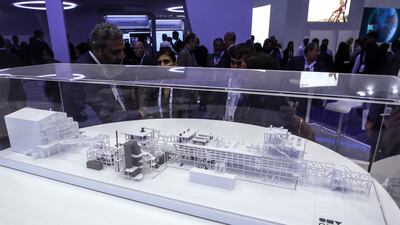
A model belonging to Austrian energy company OMV on display at Wood's stand at Adipec.


The message is clear: balancing investments in the energy system of today and the energy system of tomorrow is the only way to ensure energy security today while simultaneously advancing climate progress. They should not be treated as mutually exclusive, but rather as two sides of the same coin.
We must work to foster an innovative energy ecosystem that continues to deliver a reliable source of energy, while making renewable energy solutions more accessible and affordable for all.
This point was underscored by the UAE-US partnership to invest $100 billion in clean energy projects, with the aim of producing 100 gigawatts of clean energy globally by 2035.
The UAE-US Partnership for Accelerating Clean Energy is yet another sign that the Emirates is approaching the energy transition with key international partners.
To continue driving momentum, the UAE’s partnership with Irena continues to grow in significance.
At Irena’s meeting the week before Adipec, the 168-member organisation convened in Abu Dhabi to table the full range of climate-related topics, including energy transition in high-risk areas.
It has been said that those closest to the problem are also those closest to the solution. We need to listen to those communities on the front lines of climate change and how clean energy solutions can work on the ground.
Billions of people still lack access to modern energy services in many emerging markets, particularly in Sub-Saharan Africa. However, the investments urgently required to scale-up renewable energy capacity in these communities face major obstacles. They relate to policy, regulations, contract enforcement, currency exchange and grid transmission.
Meanwhile, climate change is unrelenting. Bringing with it heat waves, droughts and floods. All of which seriously impact food security in these high-risk areas.
Pushing back on this tide of climate challenges requires an innovative approach to policymaking – one that meets the objectives of climate, energy security and access, as well as the development of local renewable energy production capabilities.
The entire international community must throw its weight behind efforts to secure investment into higher-risk environments. We will not be able to ensure an inclusive energy transition without unwavering global support.
For its part, the UAE, as it moves from Irena’s Council Meeting to CopP27 – where it will have one of the largest delegations representing public and private entities – will demonstrate our steadfast commitment to deepening multilateral partnerships and boosting efforts to accelerate the world’s response.
That will include a focus on boosting sectors like hydrogen, developing a robust pipeline of talent to lead the charge towards the future energy system and increasing the number of women in climate diplomacy.
On this last point, we are sitting on a vast, untapped and under-represented pool of potential climate solutions, particularly in the field of renewable energy.

Gender equality remains a great challenge across the sector. Today, the solar photovoltaic sector is the largest employer among renewables, accounting for some 4.3 million jobs. It will remain the largest driver of job growth in the renewable energy sector, accounting for roughly 14 million jobs.
And yet, women are still frequently overlooked, under-valued or under-paid, limiting their ability to participate. In the energy industry, women make-up less than a quarter of the overall workforce and a third in the renewable energy sector.
Without women’s full engagement, renewable energy growth will fall short of its potential.
We addressed this very topic at the "Women in Diplomacy" event on the sidelines of the Irena meeting, where women leaders, including Reem Al Hashimy, the UAE’s Minister of State for International Cooperation, and Gauri Singh, Deputy Director-General of Irens, exchanged knowledge and experiences with international female ambassadors and diplomats from around the world on how we can accelerate the energy transition, with women leading the charge.
As global leaders have made clear in the run-up to Cop27, the headwinds of the climate crisis continue to shatter our social structures, exposing the gaps between energy access and affordability, economic growth and climate progress. But it must be our job to piece together the parts of a fragmenting world into a mosaic of solutions.

