


"In the face of great diversity, we believe that partnerships form the bridge to unite all of us in promoting peace and stability in the Asia-Pacific region," Filipino President Ferdinand Marcos Jr declared in his first speech before the UN General Assembly.
In his first global address, Mr Marcos Jr called on the international community to work towards "transcending our differences and committing to end war, uphold justice, respect human rights and maintain international peace and security".
By touching on common global concerns, from climate change to weapons of mass destruction and disruptive technological innovations, he projected global leadership. It also allowed him to shun more controversial issues, including the ongoing conflict in Ukraine, maritime disputes in the South China Sea, as well as the rights and corruption record of his own family.
Exactly 50 years after Ferdinand Marcos Sr established a dictatorship in the Philippines, his namesake son is seeking to open a new chapter in the family’s, as well as the country’s, relations with the outside world. Barely three months into office, he has signalled his commitment to a dynamic foreign policy that enhances the Philippines’ regional leadership, and pursues fruitful and balanced relations with all major powers, especially the US and China.
To this end, Mr Macros Jr chose Indonesia and Singapore, fellow South-East Asian countries, as his first foreign visits, while simultaneously wooing investments from and trade with both the US and China. In a number of ways, the Filipino leader is following in the footsteps of his father, who actively pursued warm relations with fellow developing nations as well as competing superpowers.
At the dawn of the post-colonial era, when western empires disintegrated in face of anti-colonial struggles from Africa to India, the Philippines occupied a distinctly challenging position.
On one hand, it was a staunch military ally of the US, which colonised the Philippines in the opening decades of the 20th century. Meanwhile, Filipino nationalists sought to enhance the country’s strategic autonomy and build bridges with other post-colonial nations in Asia. Chief among them was Carlos Romulo, a Pulitzer Prize-winning writer, Second World War hero and the first Asian president of the UN General Assembly, who would soon become the Philippines’ longest-running foreign secretary.
-
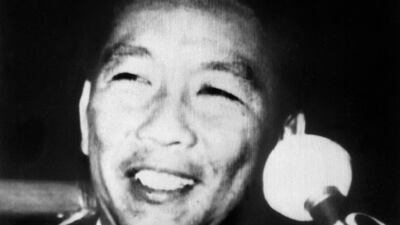
Ferdinand Marcos was president of the Philippines from December 1965 to February 1986. AFP -
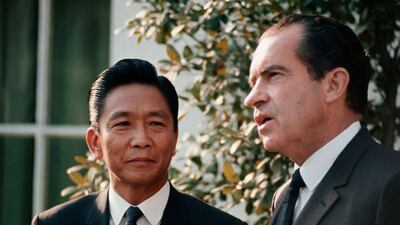
Former US president Richard Nixon speaks with Marcos during his visit to the White House on April 1, 1969. Getty Images -
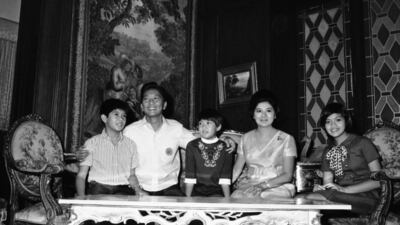
Marcos sits with his wife, Imelda, and their children, from left, Bongbong, Iren and Immee in Manila in November 1969. AP -
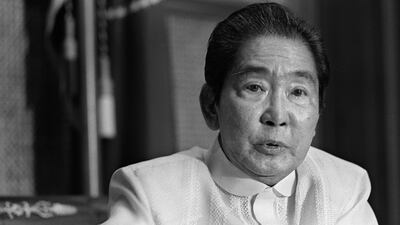
Marcos is interviewed on March 11, 1985, by Georges Biannic, Agence France Presse regional director for Asia and the Pacific, at Malacanang Palace in Manila. AFP -
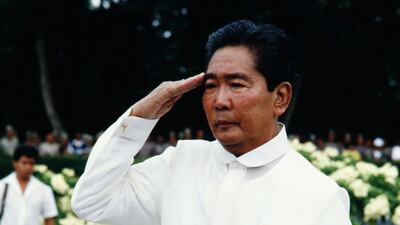
Marcos salutes during the 84th anniversary of the foundation of the Philippine Constabulary in Manila on August 25, 1985. AFP -
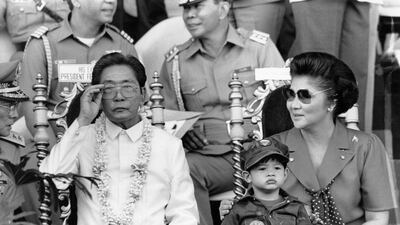
Marcos and his wife, Imelda, appear before about 35,000 college students undergoing two-year compulsory military training in Manila on November 15, 1985. AFP -

Marcos speaks to journalists during his campaign in his home province of Ilocos Norte on December 17, 1985. Reuters -
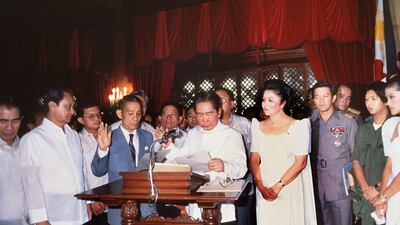
Marcos takes the oath of office on February 24, 1986, in Manila while his wife looks on. AFP -
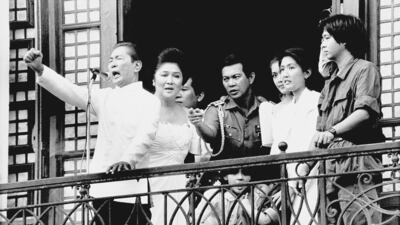
Marcos, Imelda and Ferdinand Marcos Jr, far right, stand on the balcony of Malacanang Palace on February 25, 1986, right after Marcos took the oath of office. AP -
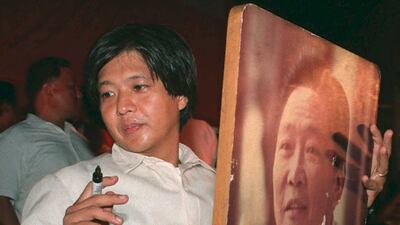
Ferdinand Marcos Jr, also known as 'Bongbong', autographs a portrait of his father during a campaign rally in Manila on May 5, 1995. AFP


The Bandung Conference in 1955, which gathered leaders of newly independent nations from all the major continents, proved a decisive moment in the Philippines’ emerging foreign policy. There, Romulo crossed swords with leading post-colonial leaders, most notably India’s Jawaharlal Nehru, who zeroed in on mobilising global co-operation against new forms of western imperialism. In contrast, the Filipino diplomat was “opposed to every form of domination, subjugation, or the exploitation of peoples", including from the communist bloc nations, most notably the Soviet Union.
Drawing from his Korean War experience, which saw the Korean Peninsula torn asunder by rival superpowers, Romulo foresaw China’s border wars with India as well as the Soviet intervention in Afghanistan. Decades after their spirited debate, Nehru reportedly told his Filipino colleague: “Gen Romulo, how right you were at Bandung. And how wrong was I.”
Ferdinand Marcos Sr, who would become the longest-serving Filipino president, would largely embrace Romulo’s foreign policy vision. While the Philippines maintained its treaty alliance with the US, it also cultivated ties with post-colonial states across Asia, Africa and Latin America as well as with Maoist China, the Soviet Union, and members of the Warsaw Pact in Eastern Europe.
Crucially, the Philippines also became among the founding members of the Association of South-East Asian Nations. This allowed Marcos Sr to project himself as one of Asia’s grand statesmen and a paramount leader in the region. By adopting a multi-vector foreign policy, Marcos Sr enhanced both his personal as well as the Philippines' strategic room for manoeuvre.
Half-a-century later, his son embarked on a similar mission just months into office. Mr Marcos Jr chose Indonesia and Singapore, two pillars of Asean integration in recent decades, as his first foreign destinations. In both Jakarta and Singapore, Mr Marcos Jr secured various agreements for enhanced defence and strategic collaboration.
To boost post-pandemic recovery at home, the Filipino president also bagged close to $14 billion in investment pledges from the two key South-East Asian countries. Along with his Singaporean and Indonesia counterparts, Mr Marcos Jr projected regional leadership by emphasising his commitment to jointly uphold a rules-based order in the region.
In many ways, Indonesia and Singapore, two nations that have deftly managed bilateral relations with competing superpowers throughout the decades, also serve as role models for Mr Marcos Jr. Vowing to pursue an “independent” foreign policy, he has, unlike most of his predecessors, refused to choose between either the US or China.
Instead, Mr Marcos Jr has welcomed expanded co-operation with both superpowers, while making his red lines crystal clear. With respect to Beijing, he has taken an uncompromising stance on the maritime disputes in the South China Sea. He also suspended a number of Chinese infrastructure projects due to concerns over high interest rates and insufficient financing.
With Washington, Mr Marcos Jr has made it clear that he wants a mutually beneficial and equitable relationship based on trade rather than aid.
Having clarified the boundaries of bilateral relations with the two superpowers, the Filipino leader held cordial meetings with multiple top officials from both countries over the past three months.
During his meeting with US Secretary of State Antony Blinken in August, he praised the “constant evolution” in bilateral relations. Upon visiting New York ahead of his UN speech, Mr Marcos Jr wooed American private investments by touting the Philippines’ new investor-friendly legislation as well as a booming middle class, which represents a major consumer market and offers a high-quality labour force.

Mr Marcos Jr emphasised how “truly grateful” he is to American investors, who have been the backbone of his country's $30bn BPO industry. At the same time, it’s China that represents a major potential source for public infrastructure investments.
In terms of economic recovery, Mr Marcos Jr has described China as the Philippines’ “strongest partner”. Despite mounting public debt, Manila is determined to press ahead with a huge infrastructure project for the foreseeable future. The bulk of former president Rodrigo Duterte’s $160bn-$180bn “build, build, build” infrastructure projects are yet to be finalised.
Thanks to periods of economic protectionism at home, the future of America’s trade and investment policy in Asia is still uncertain. So far, the Biden administration’s Indo-Pacific Economic Framework is largely an expression of Washington’s intent to expand its economic footprint in the region rather than a concrete policy.
In contrast, China’s established global expertise in public infrastructure development, and its Belt and Road Initiative, would be crucial to the attainment of Mr Marcos Jr’s economic goals. Last month, the Philippines and China relaunched bilateral trade and investment negotiations in order to expedite joint infrastructure projects. On its part, Beijing has promised to help “achieve more tangible fruits” amid generally warm bilateral relations in recent years.
Just months into office, Mr Marcos Jr has demonstrated his commitment to ushering in a new era of stability and dynamism in Philippine foreign policy. Whether he sustains his initial momentum is far from certain. But what’s clear is that for the first time in recent memory, after wild swings in its foreign policy, the Philippines finally enjoys warm relations with both US and China.

