


Three decades after returning from a short-lived yet luxurious exile, the Marcoses are back in the Malacanang presidential palace. Ferdinand Marcos Jr, the namesake son of the former Filipino dictator, won an emphatic victory in the election this year, garnering close to 60 per cent of the votes.
The last time a Filipino president enjoyed such a large electoral mandate was in the 1960s, when Marcos Sr became the first post-war Filipino leader to win re-election.
Quite understandably, the powerful dynasty’s full restoration to power has shocked much of the world. Before being unseated following the 1986 “People Power” Revolution, the regime had been notoriously decadent and brutal during its two-decades-long reign.
A return to the presidential palace a month ago, however, was the upshot of decades of dysfunctional democracy under various democratically elected administrations. Indeed, Filipinos had become fed up with broken promises and inept governance. Mr Marcos Jr won a majority of votes in every major demographic category across all socio-economic classes and age groups.
However, far from swiftly recreating an authoritarian regime in his father’s image, the son has signalled a new era of political moderation, traditional statesmanship and technocratic governance. In both his inauguration speech and his first State of the Nation address last month, Mr Marcos Jr systematically eschewed controversial issues in favour of emphasising his vision for national unity and economic prosperity.
Throughout his presidential campaign, Mr Marcos Jr vaguely spoke of “unity”, without providing any specific policy details or a feasible vision of national rejuvenation. Yet, his notoriously ambiguous appeals to national reconciliation resonated among many Filipinos, who lamented decades of political polarisation and incompetence.
Shunning most public debates, he deliberately avoided direct exchanges with his rivals. He also avoided personally criticising other presidential candidates during the campaign, thereby projecting himself as an above-the-fray political figure, who transcends petty factionalism and toxic partisan politics.
-
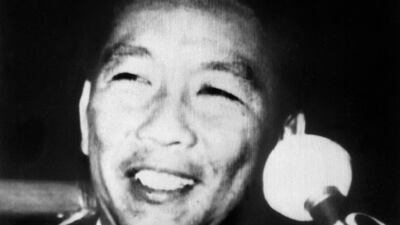
Ferdinand Marcos was president of the Philippines from December 1965 to February 1986. AFP -
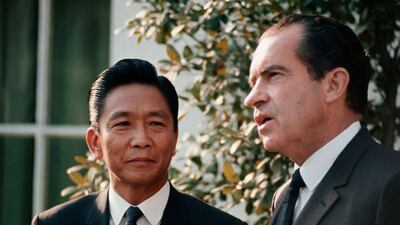
Former US president Richard Nixon speaks with Marcos during his visit to the White House on April 1, 1969. Getty Images -
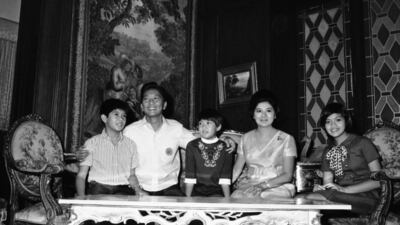
Marcos sits with his wife, Imelda, and their children, from left, Bongbong, Iren and Immee in Manila in November 1969. AP -
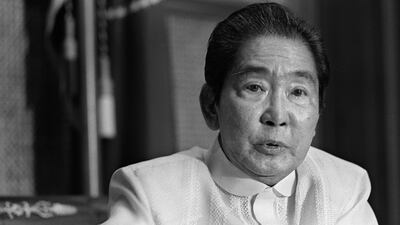
Marcos is interviewed on March 11, 1985, by Georges Biannic, Agence France Presse regional director for Asia and the Pacific, at Malacanang Palace in Manila. AFP -
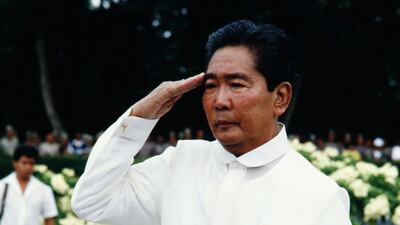
Marcos salutes during the 84th anniversary of the foundation of the Philippine Constabulary in Manila on August 25, 1985. AFP -
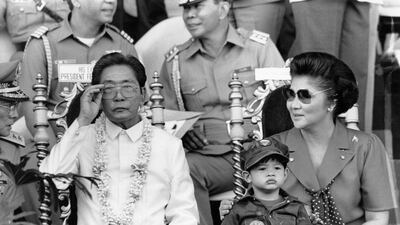
Marcos and his wife, Imelda, appear before about 35,000 college students undergoing two-year compulsory military training in Manila on November 15, 1985. AFP -

Marcos speaks to journalists during his campaign in his home province of Ilocos Norte on December 17, 1985. Reuters -
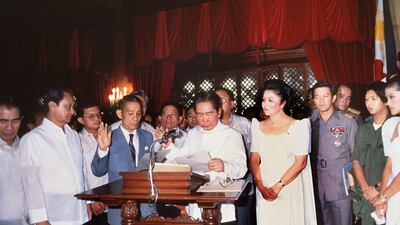
Marcos takes the oath of office on February 24, 1986, in Manila while his wife looks on. AFP -
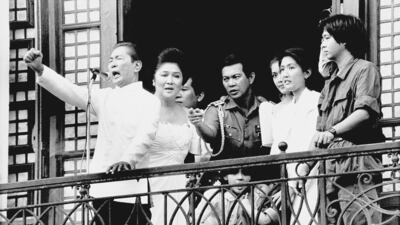
Marcos, Imelda and Ferdinand Marcos Jr, far right, stand on the balcony of Malacanang Palace on February 25, 1986, right after Marcos took the oath of office. AP -
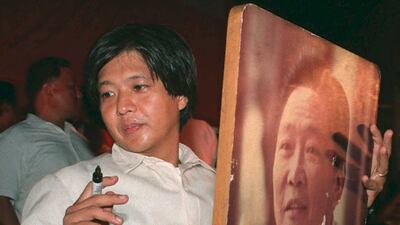
Ferdinand Marcos Jr, also known as 'Bongbong', autographs a portrait of his father during a campaign rally in Manila on May 5, 1995. AFP


Ironically, his refusal to provide precise policy details helped him to build a broad coalition with various factions of the political elite, who found a likeminded partner in the powerful dynasty. His most crucial ally was then presidential daughter Sara Duterte, who decided to run in tandem with Mr Marcos Jr for the vice presidency instead of contesting the highest office herself.
He also largely avoided discussing controversial issues, including his family’s history or the overall state of human rights, corruption and lack of press freedom in the Philippines. He was careful not to touch on any of these hot-button issues in his inauguration speech and the State of the Nation address.
Since his swearing in on June 30, Mr Marcos Jr has tried to embody his “unity” promises by overseeing the establishment of a relatively inclusive and capable cabinet, while keeping trusted friends and key allies on his side. He handed the Department of Education to Ms Duterte, who won the vice-presidency with a similarly decisive electoral margin. He backed the bid of Martin Romualdez, his relative and a longtime legislator, as speaker of Congress.
At the same time, Mr Marcos Jr has appointed a number of progressive figures to key positions. He named Arsenio Balisacan head of the influential National Economic Development Authority (Mr Balisacan served in the same capacity in the reformist Benigno Aquino III administration more than a decade ago). Longtime technocrat Benjamin Diokno, who served as central banker and budget secretary in recent past, was appointed finance secretary.
The President has, meanwhile, placed veterans in charge of strategically important ministries. Former top general Jose Faustino took over the Department of National Defence, while career diplomat Enrique Manalo became foreign secretary. By assembling a capable and relatively inclusive cabinet, Mr Marcos Jr has essentially signalled his commitment to effective and reliable governance.
In contrast to Rodrigo Duterte, the President has so far refused to discuss the need for constitutional changes or the continuation of his predecessor’s bloody “drug war” against drug suspects and cartels. But, unlike reformist presidents in the past, neither has he discussed human rights issues.
Right off the bat, Mr Marcos Jr has made it clear that economics would be his primary policy thrust, at least in his first years in office. The first one-third of his State of the Nation address in July was all about economics, including his plans for rapid growth, high investments and expanded infrastructure development. This makes perfect political sense; a recent survey by Pulse Asia Research Inc, a Philippines-based polling agency, shows that inflation, unemployment, wages and poverty are four of the top concerns for a majority of citizens.
The new government has laid out an ambitious economic agenda. Last month, Mr Diokno, the finance secretary, told his counterparts in the G20 ministerial meeting that Manila’s medium-term fiscal framework is aimed at reducing the budget deficit, promoting fiscal sustainability, and enabling robust economic growth.

Over the longer term, the Marcos administration says it aims to complete the bulk of flagship projects worth $100 billion, started under Mr Duterte’s “Build, Build, Build” initiative, and keep infrastructure spending as a share of Gross Domestic Product between 5 to 6 per cent. Mr Marcos Jr, concurrently serving as agriculture secretary, has also promised debt-forgiveness for farmers and aggressive land and agriculture reforms.
The challenge for the new administration, however, is that it has inherited an economic conundrum. Asia’s "rising tiger economy" a decade ago has been devastated by the Covid-19 pandemic.
It suffered five consecutive quarters of recession between 2020 to 2021, with the GDP shrinking by almost double digits in the first year of the pandemic. The Duterte government had engaged in massive borrowing, which pushed debt-to-GDP ratio to a 16-year-high, prompting policymakers to call for belt-tightening and “fiscal consolidation” in order to avoid a debt crisis down the road.
Inflation reached a three-year high of 6.1 per cent in June, much higher than the government’s 2 to 4 per cent target. Last year, almost a quarter of Filipinos lived in poverty, underscoring the vulnerability of millions of families to even a tiny increase in food prices.
The new government has promised to clamp down on inflation by ramping up food imports and direct deals with food and fertiliser-exporting countries, expanding subsidies to vulnerable communities, and cooling down demand through tighter monetary policy.
Whether Mr Marcos Jr can effectively manage multiple challenges remains to be seen. But judging by how he has deliberately shunned controversial and divisive issues in his first month in office, it is likely that economic issues will remain the President's main preoccupation. Indeed, rather than engaging in divisive rhetoric and political polarisation that was a feature of the previous president, Mr Marcos Jr has so far focused on basic governance and mundane policy issues.
This has astonished not only his critics but his allies, too. Whether he continues on the same path, only time will tell.

