


In the closing days of June, Nato transformed itself into an organisation with a clear worldview. The transatlantic alliance launched a vision for strategic change both within and beyond Europe. It designated Russia an adversary, considering it its most significant and direct threat, and China a foe that should not be underestimated, requiring a cohesive and forward-thinking strategy to address the threat it could pose.
Russia’s war against Ukraine has overturned the relationship between the West and Russia. The war is not expected to end soon and may not conclude with a decisive victory or defeat for either country. But the winner has been Nato. The war has effectively turned the Baltic Sea into a Nato lake and expanded the alliance to include Sweden and Finland, when once the Russian goal was to stop its further expansion.
The Nato summit in Madrid was not a mere spectacle – it was both politically and militarily significant. Its outcomes include increasing forces on Russia’s western doorstep from 40,000 personnel to 300,000, mostly in Poland and the Baltic States, and opening the door to US military deployment in Eastern Europe, particularly in Poland. US President Joe Biden left the summit reassured by the consensus on Ukraine and by a European-wide agreement to increase its member states' contributions to the alliance's budget to 2 per cent of their GDPs.
Russian President Vladimir Putin may bide his time before responding to Nato's challenge, but he is unlikely to back down on a recent decision involving Kaliningrad, a Russian exclave sandwiched between Poland and Lithuania. With Lithuania banning the passage of sanctioned Russian goods across its territory and into Kaliningrad, Moscow is looking for a compromise to resume transit. Failing that, the region could become another flashpoint in the broader conflict with the West.
Amid the Nato and G7 summits, meanwhile, there have been notable developments further east.
Leaders of the Caspian littoral states – Azerbaijan, Iran, Kazakhstan, Russia and Turkmenistan – met in Ashgabat, where Mr Putin pushed for an upgrading of relations with Iran. Earlier, at the virtual Brics summit hosted by China, Beijing and Moscow approved the accession of Iran and Argentina to the group. These moves are likely to open the door for Tehran to acquire both political leverage and economic opportunities.
Moscow seeks to establish a structure to counterbalance the G7 grouping, which includes the largest economies in the West. Until the Ukraine conflict began in 2014, Russia was part of a larger "G8", but now Mr Putin would like to see Brics pose a serious challenge to G7. But according to one expert who didn't wanted to be named, Brics is little more than a political poster, given the differences between China and India, the grouping’s largest members. Still, Iran’s accession has long-term implications in the context of the troika that also comprises China and Russia.
Mr Putin and Iranian President Ebrahim Raisi reaffirmed the importance of signing a bilateral strategic co-operation pact soon, expected to take place during the former’s visit to Tehran later this year. The leaders also agreed to fully entrust Iran with the task of preserving the Assad regime in Syria.
There is still a sliver of hope for a breakthrough in the nuclear talks between Iran and the five permanent members of the UN Security Council, plus Germany. But according to all sides, the odds for that happening are decreasing, especially given Tehran’s insistence that Washington remove from its terror list the Islamic Revolutionary Guard Corps (IRGC). The Iranian regime also says it will not reveal what is concealed in its nuclear programme. The Biden administration has so far refused to yield on both demands, but Mr Putin has assured Mr Raisi of Russian support of Iran’s interests at the Vienna talks.
As one official I spoke to put it, “the final bell has not been rung yet” to announce that the talks are dead. Iran is in dire need to get US-led sanctions against it lifted. The Biden administration and key European governments are also desperate for a breakthrough. For his part, Mr Putin is interested in brokering a deal that could help improve his credibility in the international community.
-
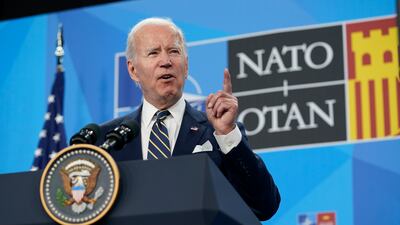
US President Joe Biden speaks at a news conference on the final day of the Nato summit in Madrid. AP -

British Prime Minister Boris Johnson holds a news conference. PA -
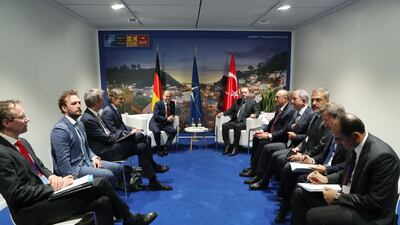
Turkish President Recep Tayyip Erdogan meets German Chancellor Olaf Scholz. AFP -
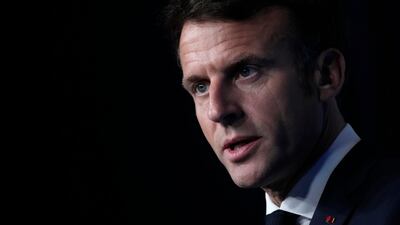
French President Emmanuel Macron speaks during the final day of the Nato summit. AP -
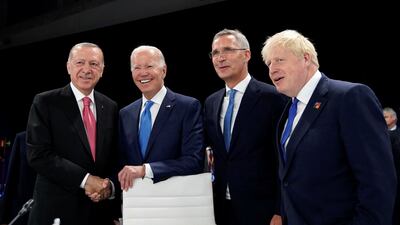
Turkish President Recep Tayyip Erdogan and US President Joe Biden shake hands as Nato secretary general Jens Stoltenberg and British Prime Minister Boris Johnson look on at a Nato summit in Madrid. Reuters -
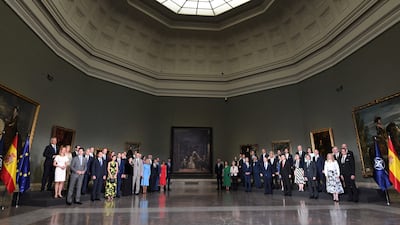
Heads of state of Nato member countries and their spouses pose for a group photo during a visit to the Prado Museum, in Madrid. AFP -
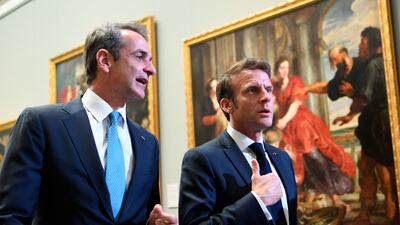
French president Emmanuel Macron, right, and Greek Prime Minister Kyriakos Mitsotakis during the Prado Museum visit. AP -
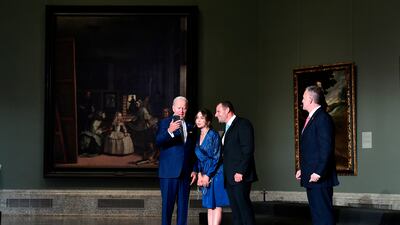
Mr Biden takes a selfie with Maltese Prime Minister Robert Abela and his wife Lydia Abela as they visit the Prado Museum. AP -
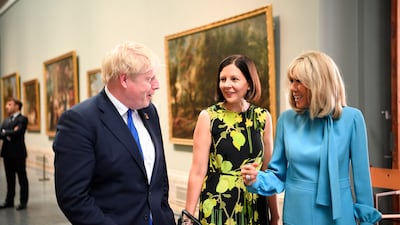
British Prime Minister Boris Johnson, the first lady of France, Brigitte Macron, right, and Belgian Prime Minister Alexander De Croo's wife Annik Penders have a conversation at the museum. AP -
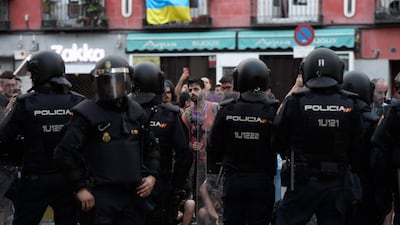
Spanish police stand in front of protesters during an anti-Nato demonstration near Tirso de Molina square in Madrid. AFP -
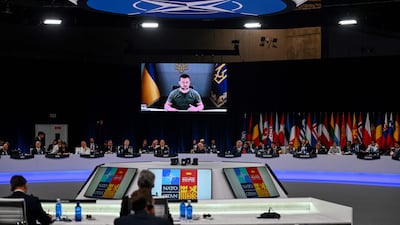
Ukrainian President Volodymyr Zelenskyy appears on a giant screen as he delivers a statement at the start of the first plenary session of the Nato summit. AFP -
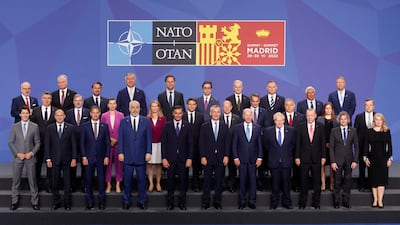
World leaders pose for a photo during the summit. Reuters -
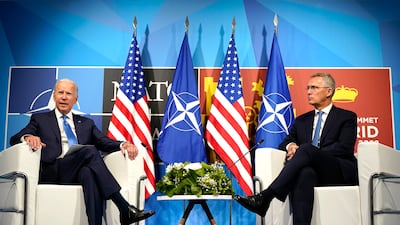
US President Joe Biden, left, and Nato Secretary General Jens Stoltenberg. AP -
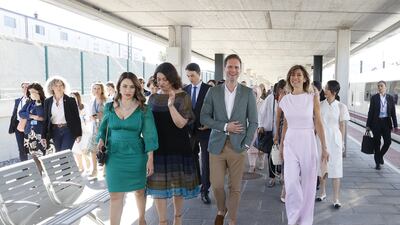
Maria Begona Gomez, wife of Spanish Prime Minister Pedro Sanchez, the first Lady of Lithuania, Diana Nausediene, first lady of Malta, Lydia Abela, and Gauthier Destenay, the husband of Luxembourg's Prime Minister, before a visit to the royal site of San Idelfonso in Segovia. EPA -
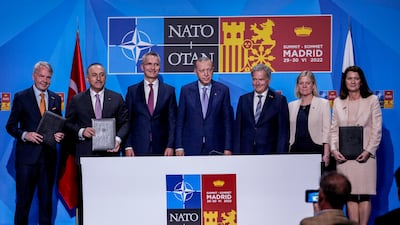
Finnish Foreign Minister Pekka Haavisto, Turkish Foreign Minister Mevlut Cavusoglu, Jens Stoltenberg, Turkish President Recep Tayyip Erdogan, Finland's President Sauli Niinisto, Sweden's Prime Minister Magdalena Andersson and Sweden's Foreign Minister Ann Linde pose for a picture after signing an agreement in Madrid. AP -
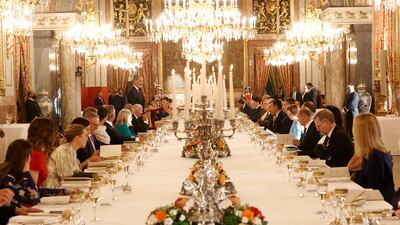
King Felipe VI of Spain addresses leaders during a dinner at the Royal Palace in Madrid. Reuters -
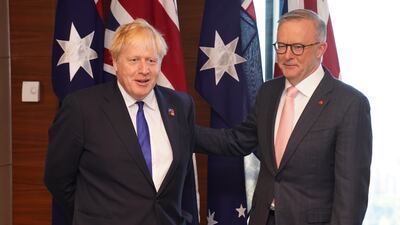
Mr Johnson meets Australian Prime Minister Anthony Albanese. PA -
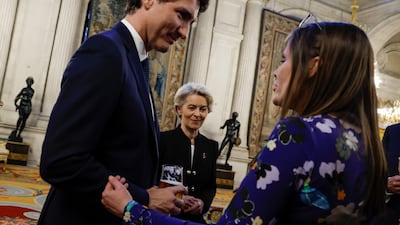
Canada's Prime Minister Justin Trudeau and European Commission President Ursula von der Leyen attend a reception at the Royal Palace in Madrid. AP -
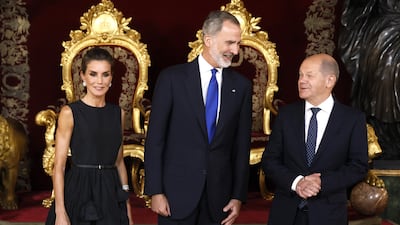
Spain's King Felipe VI and Queen Letizia greet German Chancellor Olaf Scholz, right, during a royal reception for heads of governments and states. EPA -
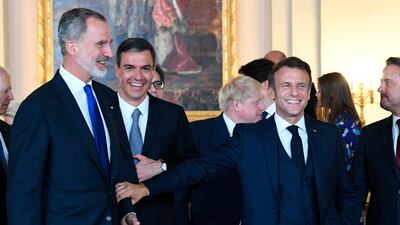
King Felipe VI, left, Mr Sanchez, second left and Mr Macron before the dinner. AP -
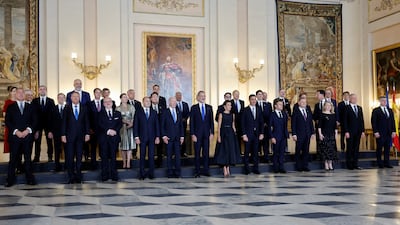
Nato leaders pose for a 'family photo' with King Felipe and Queen Letizia in Madrid. Reuters -
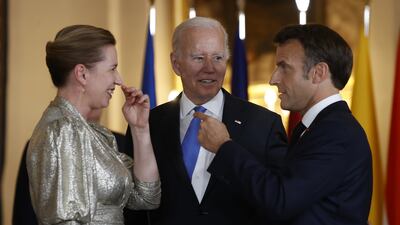
Denmark's Prime Minister Mette Frederiksen, left, with Mr Biden and Mr Macron. EPA -
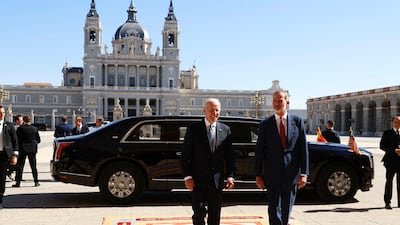
Mr Biden, left, and King Felipe arrive for a meeting at the Royal Palace in Madrid. Reuters -
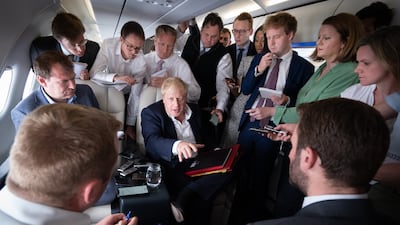
Mr Johnson talks to journalists on his plane during a flight from Germany – where he was attending the G7 summit – to the Nato summit in the Spanish capital. PA -

Mr Erdogan, second left, meets Mr Stoltenberg, Mr Niinisto of Finland and Ms Andersson of Sweden before the summit. Reuters -
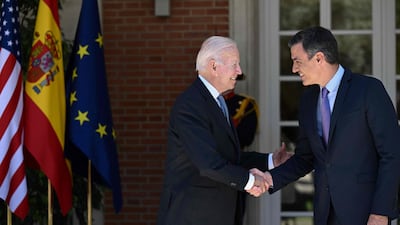
Mr Biden shakes hands with Prime Minister Sanchez of Spain at the Palace of Moncloa, in Madrid. AFP -
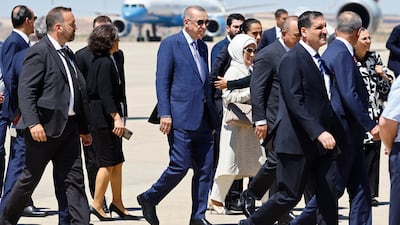
Mr Erdogan, centre, arrives at the Torreon air base in Madrid. AP -
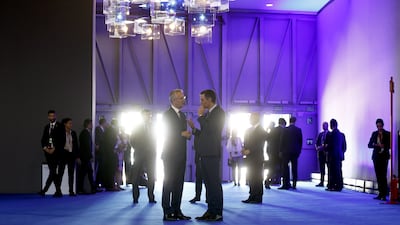
Mr Sanchez, right, speaks with Mr Stoltenberg before the summit. EPA -
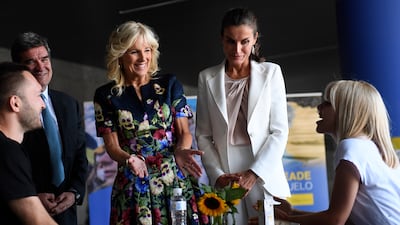
US first lady Jill Biden, centre left, and Spain's Queen Letizia speak with a family during a visit to a reception centre for Ukrainian refugees in Madrid. AP -
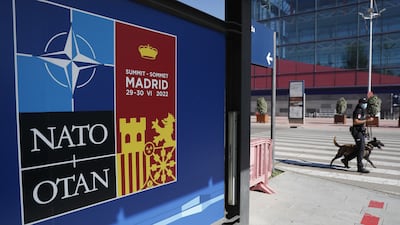
Spanish police patrol outside the Ifema convention centre before the Nato summit in Madrid. EPA -
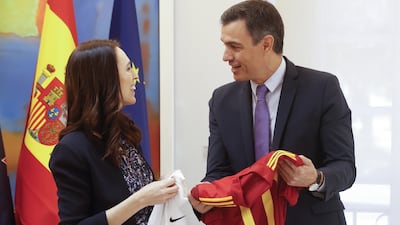
Mr Sanchez and his New Zealand counterpart Jacinda Ardern hold the jerseys of their national football teams during a meeting at Moncloa Palace. EPA -
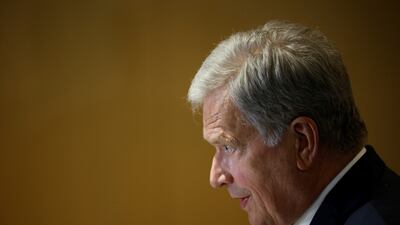
Finland's President Niinisto speaks during a briefing in Madrid before the Nato summit. Reuters -
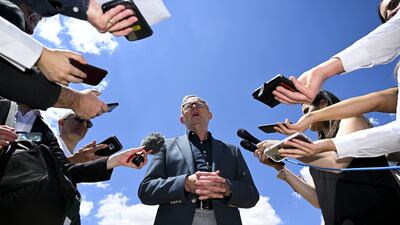
Australian Prime Minister Anthony Albanese speaks to the media after arriving at Torrejon Airbase in Madrid. EPA -
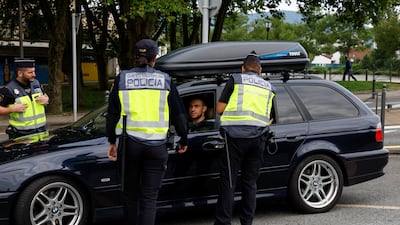
Spanish police officers control traffic on the Spain-France border in Irun. Reuters -

Mr Stoltenberg speaks at a press conference to preview the Nato summit at the alliance's headquarters in Brussels, Belgium. AFP -
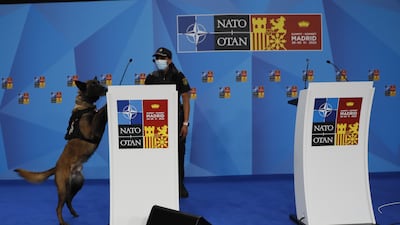
Spanish police use sniffer dogs to check a podium at the Ifema centre in Madrid. EPA -
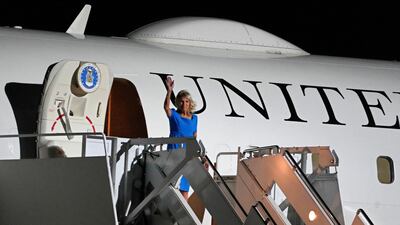
US first lady Jill Biden waves on arrival at Torrejon air base in Madrid. Reuters


If the negotiations fail, however, Moscow and Tehran intend to blame the US and Israel for it, and exploit the failure to further their individual interests. For example, Russia could start delivering weapons to Iran, as per an arms deal that has been disrupted by the international sanctions regime. The delivery of some of these weapons might be free of charge for now. Russian weapons delivered to Iran are likely to be shared with Hezbollah fighters in Syria and Lebanon, and a small-scale conflict between Iran and Israel could benefit Tehran. For the Iranian regime's hands will have been freed to engage in brinkmanship in the region that the IRGC is desperately seeking.
I am given to understand, however, that Mr Putin has told Mr Raisi that Moscow is not interested in seeing a conflict erupt between Iran and Israel at this juncture. The reasons are unclear but may include the Kremlin not wanting another diplomatic headache at this stage. Moreover, former Israeli prime minister Benjamin Netanyahu is in a position to return to power following the recent fall of Naftali Bennett's government; and Mr Putin and Mr Netanyahu, it must be noted, have enjoyed an exceptionally good relationship.
As Israel is headed for its fifth parliamentary election in three years, all eyes will be on Mr Biden's multi-stop tour of the Middle East scheduled for later this month. The trip will be important for strategic, economic and energy-related reasons.

