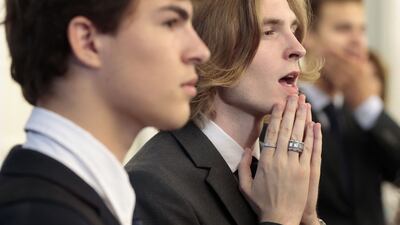
French President Emmanuel Macron during a tech conference in Paris on Friday. Bloomberg


Is the 'Macron adventure' truly over?


  • English
  • Arabic

June 20, 2022

After the seismic electoral event that removed legislative authority from French President Emmanuel Macron, far-right leader Marine Le Pen had every right to appear before adoring supporters beaming with jubilation and pride.

Her National Rally movement (RN) dramatically increased its share of parliamentary seats from eight to 89.

It was an achievement greater than even she had expected. And it effectively dismantled the “republican front” in which voters of opposing political persuasions have traditionally buried differences to deny power to her party.

The RN’s record score also completed a remarkable image makeover.

Co-formed as the Front National by her father, Jean-Marie Le Pen, its historic association is with racism, Islamophobia, anti-Semitism and more than a hint of sympathy for French wartime collaborationists and those who violently resisted Algerian independence.

The left-wing and Green alliance Nupes, led by the veteran far-left polemicist Jean-Luc Melenchon, made significant advances of its own in Sunday’s decisive second round of voting.

Nupes becomes the biggest opposition force in the National Assembly with 133 seats, almost doubling the combined strength of its component parts.

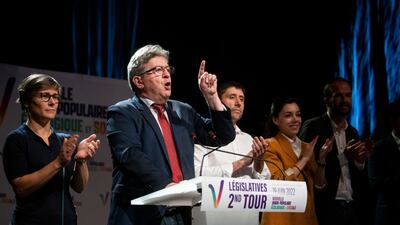
Jean-Luc Melenchon, leader of the France Unbowed party, speaks to supporters following the first round of voting in the parliamentary election on Sunday. Bloomberg
Both radical leaders have charisma, with oddly similar promises

With more than half the electorate abstaining, the results left Mr Macron – re-elected as president in April – and allies with just 245 of the Assembly’s 577 seats, 44 short of an absolutely majority.

It reduces his movement, La Republique En March (the republic on the move), to a state of political paralysis. While the constitution permits limited lawmaking without a vote, he must otherwise seek pacts with others, notably the conventional right and centre-right Les Republicains, also in disarray and split on whether to co-operate.

Mr Macron had urged voters renew their faith in his centrist government and reject extremes of left and right. But this, along with lacklustre campaigning, amounted to a major miscalculation of the public mood.

In a country where the “extremist” label is routinely attached to Ms Le Pen and Mr Melenchon, extremism has arguably emerged as the new normal. The combined vote for the RN and Nupes was more than two million higher than for the Macronist alliance Ensemble.

Both radical leaders have charisma. Their populist policies, with oddly similar promises to block later retirement and offer generous help to working-class voters struggling with rocketing prices, overcame any suspicion. Centrists warned that big-spending, protectionist policies were economically incoherent; plenty of voters clearly felt they could hardly be worse off than under Mr Macron’s government.

Ms Le Pen owes part of her electoral flourish to an energetic drive to detoxify her movement’s reputation, making large sections of the public forgive or forget its sinister past. The presence of Eric Zemmour, even more far-right, in both presidential and legislative elections, gave her the rare bonus of high moral ground.

  • Marine Le Pen, the leader of the far-right National Rally, addresses reporters after her party won 89 seats in the 577-seat parliament. AP
    Marine Le Pen, the leader of the far-right National Rally, addresses reporters after her party won 89 seats in the 577-seat parliament. AP
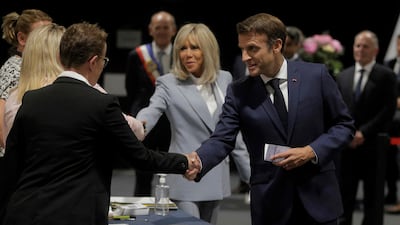
  • French President Emmanuel Macron and his wife Brigitte Macron arrive to vote in the second stage of French parliamentary elections at a polling station in Le Touquet, northern France, on Sunday. AFP
    French President Emmanuel Macron and his wife Brigitte Macron arrive to vote in the second stage of French parliamentary elections at a polling station in Le Touquet, northern France, on Sunday. AFP
  • Jean-Luc Melenchon of the Nupes alliance addresses a meeting in Paris after voting in the second round of parliamentary polls. Bloomberg
    Jean-Luc Melenchon of the Nupes alliance addresses a meeting in Paris after voting in the second round of parliamentary polls. Bloomberg
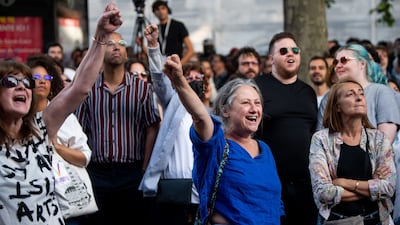
  • Nupes supporters cheer Jean-Luc Melenchon as parliamentary election results are announced in Paris. Bloomberg
    Nupes supporters cheer Jean-Luc Melenchon as parliamentary election results are announced in Paris. Bloomberg
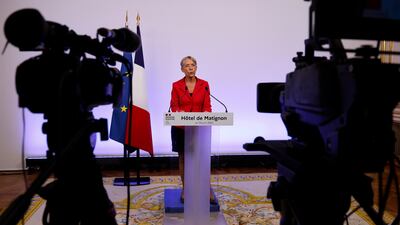
  • France's Prime Minister Elisabeth Borne gives a speech after the first results of the parliamentary elections at Matignon in Paris. EPA
    France's Prime Minister Elisabeth Borne gives a speech after the first results of the parliamentary elections at Matignon in Paris. EPA
  • Rodrigo Arenas, newly-elected member of parliament who belongs to the Nupes alliance, arrives at the National Assembly in Paris. Reuters
    Rodrigo Arenas, newly-elected member of parliament who belongs to the Nupes alliance, arrives at the National Assembly in Paris. Reuters
  • Sylvain Maillard, MP for President Macron's En Marche party, and supporters check poll results during the second round of the French parliamentary elections in Paris. EPA
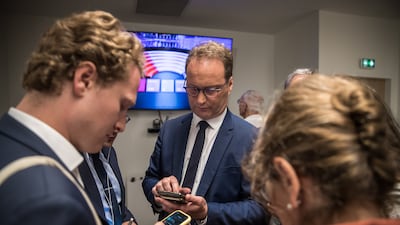
    Sylvain Maillard, MP for President Macron's En Marche party, and supporters check poll results during the second round of the French parliamentary elections in Paris. EPA
  • Marine Le Pen embraces a supporter as she arrives to deliver a speech at Henin-Beaumont in the Pas De Calais on Monday. AFP
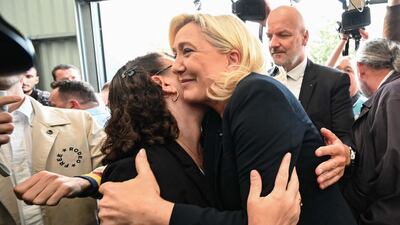
    Marine Le Pen embraces a supporter as she arrives to deliver a speech at Henin-Beaumont in the Pas De Calais on Monday. AFP
  • Jean-Luc Melenchon speaks to supporters and media outside Nupes headquarters in Paris. Reuters
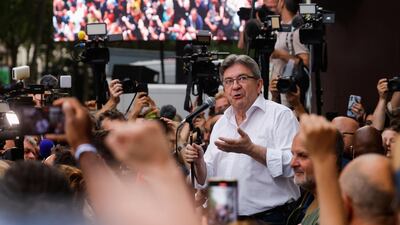
    Jean-Luc Melenchon speaks to supporters and media outside Nupes headquarters in Paris. Reuters
  • In Paris, supporters of Nupes celebrate as the first results of the parliamentary elections are announced. AFP
    In Paris, supporters of Nupes celebrate as the first results of the parliamentary elections are announced. AFP
  • Supporters of Les Republicains right-wing party listen to results in Paris. AFP
    Supporters of Les Republicains right-wing party listen to results in Paris. AFP
  • Volunteers empty a voting box a polling station at Bischheim, near Strasbourg, eastern France. AP
    Volunteers empty a voting box a polling station at Bischheim, near Strasbourg, eastern France. AP
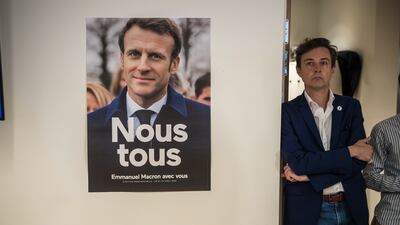
  • A poster of French President Emmanuel Macron at an electoral party in Paris. EPA
    A poster of French President Emmanuel Macron at an electoral party in Paris. EPA

When Mr Macron won his second term at the Elysee Palace on April 24, with 58.5 per cent of the vote in the run-off against Ms Le Pen, it was a result that flattered to deceive.

On a personal level, the legislative elections have exposed a disturbing level of public disenchantment. If many in France unquestionably admire him, others see only a cold, arrogant elitist out of touch with day-to-day concerns.

He largely impresses on the international stage, his carrot-and-stick mixture of diplomacy, tough words and sanctions after Russia’s invasion of Ukraine striking a chord with many in France.

But the statesmanlike qualities proved insufficient to protect him from the ravages of inflation, distrust of his policies on crime and immigration and a feeling that he talks down to ordinary people.

“Too proud for his own good,” said one moderate voter, from la Sarthe in western France, in response to Sunday’s election results.

Mr Melenchon and Ms Le Pen were more scathing.

“The rout of the presidential party is complete,” said Mr Melenchon, who opted not to defend his own seat but hoped for even stronger results that would have installed him as a hostile prime minister, pitting parliament against the Elysee.

French far-right party Rassemblement National (RN) leader Marine Le Pen embraces a supporter as she arrives to deliver a speech after the first results of the parliamentary elections in Henin-Beaumont, northern France, on June 19, 2022. - The vote is decisive for the French president's second-term agenda following his re-election in April, with the 44-year-old needing a majority in order to push through promised tax cuts and welfare reform and raise the retirement age. (Photo by DENIS CHARLET / AFP)

“The people have spoken,” said Ms Le Pen, hailing the end of the “Macron adventure” and the relegation of his government to minority status. She is stepping down from the RN presidency to concentrate on leading her parliamentary troops, now easily numerous enough to qualify as an official, publicly funded group.

What this means for Mr Macron’s movement that brought together elements of left, centre and right to transform the French political landscape ahead of his emphatic election as president in 2017, is less clear.

“The situation is unprecedented,” Prime Minister Elisabeth Borne conceded. “The National Assembly has never experienced such a configuration under the Fifth Republic. As a central force in the Assembly, we must assume a particular responsibility. We will work [immediately] to build a majority of action."

One useful example of such action might be an effort to encourage more people to use the new title of Mr Macron’s party, Renaissance. Given the scale of reconstruction needed after a chastening political rebuff, it seems more appropriate than "the republic on the move".


World record transfers

1. Kylian Mbappe - to Real Madrid in 2017/18 - €180 million (Dh770.4m - if a deal goes through)
2. Paul Pogba - to Manchester United in 2016/17 - €105m
3. Gareth Bale - to Real Madrid in 2013/14 - €101m
4. Cristiano Ronaldo - to Real Madrid in 2009/10 - €94m
5. Gonzalo Higuain - to Juventus in 2016/17 - €90m
6. Neymar - to Barcelona in 2013/14 - €88.2m
7. Romelu Lukaku - to Manchester United in 2017/18 - €84.7m
8. Luis Suarez - to Barcelona in 2014/15 - €81.72m
9. Angel di Maria - to Manchester United in 2014/15 - €75m
10. James Rodriguez - to Real Madrid in 2014/15 - €75m

The more serious side of specialty coffee

While the taste of beans and freshness of roast is paramount to the specialty coffee scene, so is sustainability and workers’ rights.

The bulk of genuine specialty coffee companies aim to improve on these elements in every stage of production via direct relationships with farmers. For instance, Mokha 1450 on Al Wasl Road strives to work predominantly with women-owned and -operated coffee organisations, including female farmers in the Sabree mountains of Yemen.

Because, as the boutique’s owner, Garfield Kerr, points out: “women represent over 90 per cent of the coffee value chain, but are woefully underrepresented in less than 10 per cent of ownership and management throughout the global coffee industry.”

One of the UAE’s largest suppliers of green (meaning not-yet-roasted) beans, Raw Coffee, is a founding member of the Partnership of Gender Equity, which aims to empower female coffee farmers and harvesters.

Also, globally, many companies have found the perfect way to recycle old coffee grounds: they create the perfect fertile soil in which to grow mushrooms. 

The biog

Favourite pet: cats. She has two: Eva and Bito

Favourite city: Cape Town, South Africa

Hobby: Running. "I like to think I’m artsy but I’m not".

Favourite move: Romantic comedies, specifically Return to me. "I cry every time".

Favourite spot in Abu Dhabi: Saadiyat beach

Another way to earn air miles

In addition to the Emirates and Etihad programmes, there is the Air Miles Middle East card, which offers members the ability to choose any airline, has no black-out dates and no restrictions on seat availability. Air Miles is linked up to HSBC credit cards and can also be earned through retail partners such as Spinneys, Sharaf DG and The Toy Store.

An Emirates Dubai-London round-trip ticket costs 180,000 miles on the Air Miles website. But customers earn these ‘miles’ at a much faster rate than airline miles. Adidas offers two air miles per Dh1 spent. Air Miles has partnerships with websites as well, so booking.com and agoda.com offer three miles per Dh1 spent.

“If you use your HSBC credit card when shopping at our partners, you are able to earn Air Miles twice which will mean you can get that flight reward faster and for less spend,” says Paul Lacey, the managing director for Europe, Middle East and India for Aimia, which owns and operates Air Miles Middle East.

Fixtures:

Wed Aug 29 – Malaysia v Hong Kong, Nepal v Oman, UAE v Singapore
Thu Aug 30 - UAE v Nepal, Hong Kong v Singapore, Malaysia v Oman
Sat Sep 1 - UAE v Hong Kong, Oman v Singapore, Malaysia v Nepal
Sun Sep 2 – Hong Kong v Oman, Malaysia v UAE, Nepal v Singapore
Tue Sep 4 - Malaysia v Singapore, UAE v Oman, Nepal v Hong Kong
Thu Sep 6 – Final

THE BIO: Mohammed Ashiq Ali

Proudest achievement: “I came to a new country and started this shop”

Favourite TV programme: the news

Favourite place in Dubai: Al Fahidi. “They started the metro in 2009 and I didn’t take it yet.”

Family: six sons in Dubai and a daughter in Faisalabad


Name: Peter Dicce

Title: Assistant dean of students and director of athletics

Favourite sport: soccer

Favourite team: Bayern Munich

Favourite player: Franz Beckenbauer

Favourite activity in Abu Dhabi: scuba diving in the Northern Emirates 


Terror attacks in Paris, November 13, 2015

- At 9.16pm, three suicide attackers killed one person outside the Atade de France during a foootball match between France and Germany- At 9.25pm, three attackers opened fire on restaurants and cafes over 20 minutes, killing 39 people- Shortly after 9.40pm, three other attackers launched a three-hour raid on the Bataclan, in which 1,500 people had gathered to watch a rock concert. In total, 90 people were killed- Salah Abdeslam, the only survivor of the terrorists, did not directly participate in the attacks, thought to be due to a technical glitch in his suicide vest- He fled to Belgium and was involved in attacks on Brussels in March 2016. He is serving a life sentence in France

Updated: June 20, 2022, 6:46 PM