Vahid Fotuhi is founder and chief executive of Blue Forest, a global developer of mangrove conservation and reforestation projects
June 08, 2022
During a recent Friday afternoon, I met with the local tribal chiefs and community members in Adiake, a breezy fishing village on the banks of the Gulf of Guinea in eastern Ivory Coast.
Sitting on firm wooden chairs by the coastline and looking onwards to the calm sea, we discussed my plans to plant 160,000 mangroves in a deforested area not far from where we were sitting. While the community members seemed receptive to the idea, it was clear that they were not entirely convinced.
“What happens after the seedlings are planted?” said one of the tribal heads with a stern voice. “Who will care for them for 10 years to make sure they grow to become healthy mature trees?”
This is a valid point. Most tree-planting projects look to cover only the cost of the planting and maybe a few years of monitoring.
“What happens if we help you plant them and in five years a public official decides to parcel off the area and sell it to developers?” pronounced another weary tribal official.
It’s a phenomenon that is not uncommon. The coastlines where mangroves grow are usually coveted by developers for real estate projects and aquaculture investment, typically crab or shrimp farms. I have seen this happen time and time again. There is very little that the local community can do other than to stand by and watch as their mangroves get hacked away.
This is especially painful for fishing communities as those mangrove forests represent vital nesting grounds for a wide variety of fishes that they depend on for their livelihood. Once the mangroves disappear so too does their source of income.
And it’s not only developers or cunning officials that are slashing away at mangrove forests for personal gains.
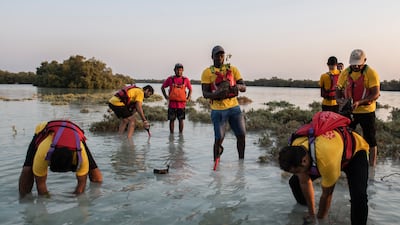
People plant mangroves during an event organised by Companies for Good on Jubail Island, Abu Dhabi. All photos: Vidhyaa Chandramohan
To fight climate change, the UAE is carrying out projects such as reducing emissions and planting mangroves.
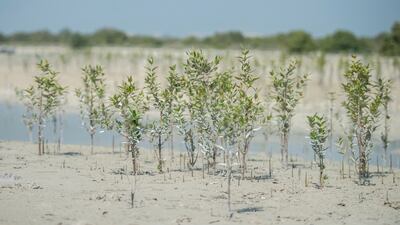
Mangroves, trees that survive in salty water, play an important part in the ecosystem.
By 2030, the UAE intends to plant 100 million mangroves.
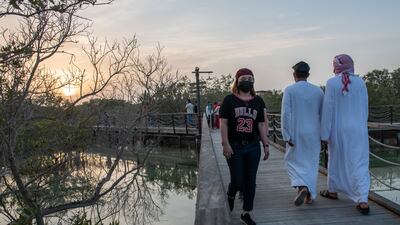
Visitors at Jubail Mangrove Park. Schools and businesses are planting saplings as part of the UAE's campaign.
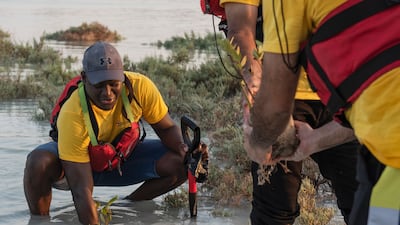
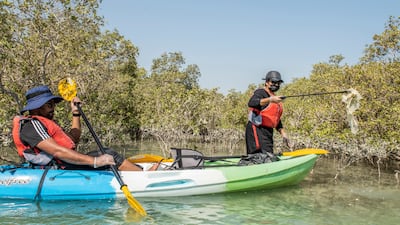
Volunteers during a mangrove clean-up organised by the World Wildlife Fund and Seahawk Abu Dhabi.
Young mangroves can be damaged by plastic and other waste dumped into the sea.
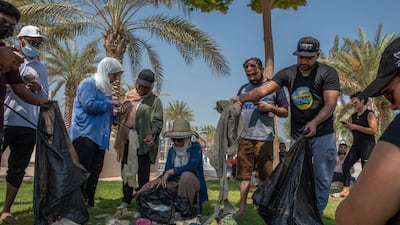
Volunteers sort rubbish gathered during a clean-up of mangroves in Abu Dhabi.
After collecting debris from the mangroves, volunteers use an app to track their progress.
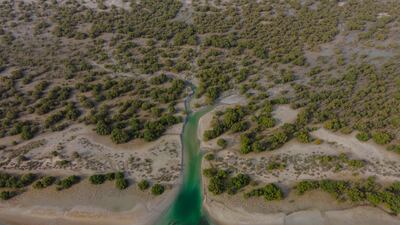
The grey mangrove is the species that grows extensively in UAE.
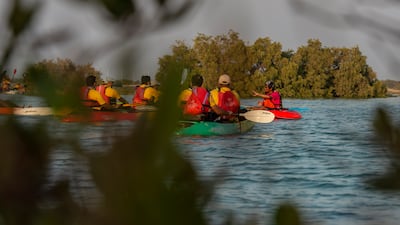
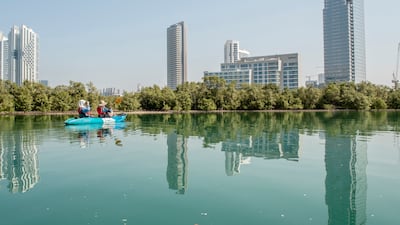
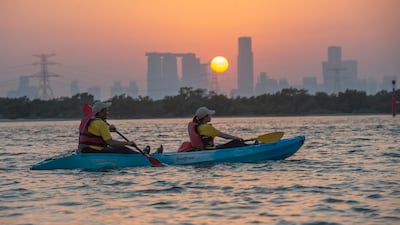
Visitors enjoy an evening paddle by the mangroves and a sunset view of Abu Dhabi.
As populations increase around the globe, there are more mouths to feed and therefore more source of income required. Most mangrove forests are located in tropical and sub-tropical regions within countries that are in the developing stage, with many of their people living close to the poverty line. Many of those communities tend to live close to coastlines, and close to mangrove forests.
This makes for a lethal combination: a growing number of people, looking for sources of income, and an idle mangrove forest full of natural riches and no way of defending itself.
Mangrove trees are very dense and can burn for a long time. They are also averse to getting degraded due to exposure to salt. This makes them ideal for charcoal making and for construction equipment, namely wall frames for homes. As a result, they are commonly targeted by people looking to make some quick cash by cutting them and selling them to merchants for charcoal fabrication or construction material.
As populations grow, so does the pressure on our mangrove forests. Already, we have lost half of the planet’s mangrove forests. And each year we are losing 1 per cent of the world’s remaining mangroves. This suggests that in 50 years there will be no more mangroves.
Aside from being a vital nesting ground for fishing communities, these forests also shield coastlines from natural disasters such as tsunamis and cyclones. If you take away the mangroves, you take away their coastal defences as well, thus exposing already vulnerable communities to potentially lethal disaster.
Yet, despite the security and biodiversity benefits, mangroves remain under-appreciated. That’s because those benefits are not directly resulting in benefits that people can count and put in their pockets. On the other hand, converting the trees to charcoal results in direct and measurable returns. It’s a losing battle for our dear mangroves.
Luckily, the mangrove tree has a third superpower, one which could ultimately ensure its survival. Mangrove trees have the ability to sequester up to five times more carbon dioxide than terrestrial trees. And they can hold those harmful gases in their trunks and the soil surrounded their vast network of roots for a millennium. And therein lies the answer: carbon capture.
Today, there is a growing marketplace of corporates who are looking to offset the CO2 volumes, which they cannot eliminate, via nature-based solutions, notably long-term reforestation projects.
These mangrove reforestation projects not only help to restore forests for 20-30 years but also provide people from local communities with livelihood improvements and jobs.
In fact, mangrove reforestation projects today command a premium over conventional terrestrial projects because of the significant co-benefits that the mangroves offer, such as coastal protection, biodiversity improvement and climate adaptation.
Mangroves are often exploited, particularly in poorer regions. Vahid Fotuhi
As a result, there is a surge in demand for what is called “blue carbon”, carbon-offset projects based in wetland environments, such as mangrove projects. Suddenly, the mangrove trees are worth more in the ground than they would be as charcoal or wood beams for a new house. Suddenly the mangrove trees have value.
Granted there is some development work to be done before communities can structure mangrove restoration projects and start generating carbon credit revenues. But the mechanisms are now firmly in place. And while they are far from perfect, the gaps that need to be filled have already been identified.
They include the need to put in place long-term monitoring programmes to ensure that each tree can be tracked and measured to ensure the permanence of these schemes. Another issue has been the channelling of funds from the carbon project developers to the local communities that are effectively the ”parents” of the mangrove forests. Again, technology is enabling the tracing of the funds to show exactly where they end up and how they are used so that flow can be audited and optimised.
The carbon markets are providing our remaining mangrove forests with a voice. They are allowing the mangrove trees to defend themselves, to stand up for themselves.
Local communities such as the one in Adiake can now leverage the carbon markets to channel capital from the polluters to the protectors. This provides hope for our coastal mangrove forests and the diverse communities that live side by side these unique forests.
Vahid Fotuhi is founder and chief executive of Blue Forest, a global developer of mangrove conservation and reforestation projects

Tamkeen's offering
Option 1: 70% in year 1, 50% in year 2, 30% in year 3
Option 2: 50% across three years
Option 3: 30% across five years
Analysis
Members of Syria's Alawite minority community face threat in their heartland after one of the deadliest days in country’s recent history. Read more
Send “thenational” to the following numbers or call the hotline on: 0502955999
2289 – Dh10
2252 – Dh 50
6025 – Dh20
6027 – Dh 100
6026 – Dh 200
Ten tax points to be aware of in 2026
1. Domestic VAT refund amendments: request your refund within five years
If a business does not apply for the refund on time, they lose their credit.
2. E-invoicing in the UAE
Businesses should continue preparing for the implementation of e-invoicing in the UAE, with 2026 a preparation and transition period ahead of phased mandatory adoption.
3. More tax audits
Tax authorities are increasingly using data already available across multiple filings to identify audit risks.
4. More beneficial VAT and excise tax penalty regime
Tax disputes are expected to become more frequent and more structured, with clearer administrative objection and appeal processes. The UAE has adopted a new penalty regime for VAT and excise disputes, which now mirrors the penalty regime for corporate tax.
5. Greater emphasis on statutory audit
There is a greater need for the accuracy of financial statements. The International Financial Reporting Standards standards need to be strictly adhered to and, as a result, the quality of the audits will need to increase.
6. Further transfer pricing enforcement
Transfer pricing enforcement, which refers to the practice of establishing prices for internal transactions between related entities, is expected to broaden in scope. The UAE will shortly open the possibility to negotiate advance pricing agreements, or essentially rulings for transfer pricing purposes.
7. Limited time periods for audits
Recent amendments also introduce a default five-year limitation period for tax audits and assessments, subject to specific statutory exceptions. While the standard audit and assessment period is five years, this may be extended to up to 15 years in cases involving fraud or tax evasion.
8. Pillar 2 implementation
Many multinational groups will begin to feel the practical effect of the Domestic Minimum Top-Up Tax (DMTT), the UAE's implementation of the OECD’s global minimum tax under Pillar 2. While the rules apply for financial years starting on or after January 1, 2025, it is 2026 that marks the transition to an operational phase.
9. Reduced compliance obligations for imported goods and services
Businesses that apply the reverse-charge mechanism for VAT purposes in the UAE may benefit from reduced compliance obligations.
10. Substance and CbC reporting focus
Tax authorities are expected to continue strengthening the enforcement of economic substance and Country-by-Country (CbC) reporting frameworks. In the UAE, these regimes are increasingly being used as risk-assessment tools, providing tax authorities with a comprehensive view of multinational groups’ global footprints and enabling them to assess whether profits are aligned with real economic activity.
Contributed by Thomas Vanhee and Hend Rashwan, Aurifer
The Prison Letters of Nelson Mandela
Edited by Sahm Venter
Published by Liveright
When: The one-off Test starts on Friday, May 11 What time: Each day’s play is scheduled to start at 2pm UAE time. TV: The match will be broadcast on OSN Sports Cricket HD. Subscribers to the channel can also stream the action live on OSN Play.
INFO
What: DP World Tour Championship When: November 21-24 Where: Jumeirah Golf Estates, Dubai Tickets:www.ticketmaster.ae.
Founders: Abdulmajeed Alsukhan, Turki Bin Zarah and Abdulmohsen Albabtain.
Based: Riyadh
Offices: UAE, Vietnam and Germany
Founded: September, 2020
Number of employees: 70
Sector: FinTech, online payment solutions
Funding to date: $116m in two funding rounds
Investors: Checkout.com, Impact46, Vision Ventures, Wealth Well, Seedra, Khwarizmi, Hala Ventures, Nama Ventures and family offices
Avatar: Fire and Ash
Director: James Cameron
Starring: Sam Worthington, Sigourney Weaver, Zoe Saldana
Rating: 4.5/5
Game Of Thrones Season Seven: A Bluffers Guide
Want to sound on message about the biggest show on television without actually watching it? Best not to get locked into the labyrinthine tales of revenge and royalty: as Isaac Hempstead Wright put it, all you really need to know from now on is that there’s going to be a huge fight between humans and the armies of undead White Walkers.
The season ended with a dragon captured by the Night King blowing apart the huge wall of ice that separates the human world from its less appealing counterpart. Not that some of the humans in Westeros have been particularly appealing, either.
Anyway, the White Walkers are now free to cause any kind of havoc they wish, and as Liam Cunningham told us: “Westeros may be zombie land after the Night King has finished.” If the various human factions don’t put aside their differences in season 8, we could be looking at The Walking Dead: The Medieval Years.
Our family matters legal consultant
Name: Dr Hassan Mohsen Elhais
Position: legal consultant with Al Rowaad Advocates and Legal Consultants.
THE SPECS
2020 Toyota Corolla Hybrid LE
Engine: 1.8 litre combined with 16-volt electric motors
Transmission: Automatic with manual shifting mode
Power: 121hp
Torque: 142Nm
Price: Dh95,900
THE CLOWN OF GAZA
Director: Abdulrahman Sabbah
Starring: Alaa Meqdad
Rating: 4/5
So what is Spicy Chickenjoy?
Just as McDonald’s has the Big Mac, Jollibee has Spicy Chickenjoy – a piece of fried chicken that’s crispy and spicy on the outside and comes with a side of spaghetti, all covered in tomato sauce and topped with sausage slices and ground beef. It sounds like a recipe that a child would come up with, but perhaps that’s the point – a flavourbomb combination of cheap comfort foods. Chickenjoy is Jollibee’s best-selling product in every country in which it has a presence.
Famous left-handers
- Marie Curie
- Jimi Hendrix
- Leonardo Di Vinci
- David Bowie
- Paul McCartney
- Albert Einstein
- Jack the Ripper
- Barack Obama
- Helen Keller
- Joan of Arc
The biog
Name: Salem Alkarbi
Age: 32
Favourite Al Wasl player: Alexandre Oliveira
First started supporting Al Wasl: 7
Biggest rival: Al Nasr
The essentials
What: Emirates Airline Festival of Literature
When: Friday until March 9
Where: All main sessions are held in the InterContinental Dubai Festival City
Price: Sessions range from free entry to Dh125 tickets, with the exception of special events.
Hot Tip: If waiting for your book to be signed looks like it will be timeconsuming, ask the festival’s bookstore if they have pre-signed copies of the book you’re looking for. They should have a bunch from some of the festival’s biggest guest authors.
Kopa Trophy (Best player under 21 – Men’s) Lamine Yamal (Barcelona / Spain)
Best Young Women’s Player Vicky López (Barcelona / Spain)
Yashin Trophy (Best Goalkeeper – Men’s) Gianluigi Donnarumma (Paris Saint-Germain and Manchester City / Italy)
Best Women’s Goalkeeper Hannah Hampton (England / Aston Villa and Chelsea)
Men’s Coach of the Year Luis Enrique (Paris Saint-Germain)
Women’s Coach of the Year Sarina Wiegman (England)
Mercer, the investment consulting arm of US services company Marsh & McLennan, expects its wealth division to at least double its assets under management (AUM) in the Middle East as wealth in the region continues to grow despite economic headwinds, a company official said.
Mercer Wealth, which globally has $160 billion in AUM, plans to boost its AUM in the region to $2-$3bn in the next 2-3 years from the present $1bn, said Yasir AbuShaban, a Dubai-based principal with Mercer Wealth.
“Within the next two to three years, we are looking at reaching $2 to $3 billion as a conservative estimate and we do see an opportunity to do so,” said Mr AbuShaban.
Mercer does not directly make investments, but allocates clients’ money they have discretion to, to professional asset managers. They also provide advice to clients.
“We have buying power. We can negotiate on their (client’s) behalf with asset managers to provide them lower fees than they otherwise would have to get on their own,” he added.
Mercer Wealth’s clients include sovereign wealth funds, family offices, and insurance companies among others.
From its office in Dubai, Mercer also looks after Africa, India and Turkey, where they also see opportunity for growth.
Wealth creation in Middle East and Africa (MEA) grew 8.5 per cent to $8.1 trillion last year from $7.5tn in 2015, higher than last year’s global average of 6 per cent and the second-highest growth in a region after Asia-Pacific which grew 9.9 per cent, according to consultancy Boston Consulting Group (BCG). In the region, where wealth grew just 1.9 per cent in 2015 compared with 2014, a pickup in oil prices has helped in wealth generation.
BCG is forecasting MEA wealth will rise to $12tn by 2021, growing at an annual average of 8 per cent.
Drivers of wealth generation in the region will be split evenly between new wealth creation and growth of performance of existing assets, according to BCG.
Another general trend in the region is clients’ looking for a comprehensive approach to investing, according to Mr AbuShaban.
“Institutional investors or some of the families are seeing a slowdown in the available capital they have to invest and in that sense they are looking at optimizing the way they manage their portfolios and making sure they are not investing haphazardly and different parts of their investment are working together,” said Mr AbuShaban.
Some clients also have a higher appetite for risk, given the low interest-rate environment that does not provide enough yield for some institutional investors. These clients are keen to invest in illiquid assets, such as private equity and infrastructure.
“What we have seen is a desire for higher returns in what has been a low-return environment specifically in various fixed income or bonds,” he said.
“In this environment, we have seen a de facto increase in the risk that clients are taking in things like illiquid investments, private equity investments, infrastructure and private debt, those kind of investments were higher illiquidity results in incrementally higher returns.”
The Abu Dhabi Investment Authority, one of the largest sovereign wealth funds, said in its 2016 report that has gradually increased its exposure in direct private equity and private credit transactions, mainly in Asian markets and especially in China and India. The authority’s private equity department focused on structured equities owing to “their defensive characteristics.”