


Much has been written about the double standards in political commentary regarding the war in Ukraine. This has been on display in the way that Ukrainian refugees have been welcomed (while Arab refugees have found doors closed); that the Ukrainian right to self-determination and resistance to invasion has been supported (while these same rights are denied to Palestinians); and that the US and Europeans have decried the illegality of invading a sovereign nation (while ignoring our own histories of having done the same to many other countries). There have been so many examples of double standards, as well as articles calling them out. But one additional and sometimes subtle form of bigotry on display in some comparisons of Ukraine and the Arab World is particularly galling. It requires a response.
Here’s an example from a prominent New York Times columnist comparing the world’s response to Russia’s preparation to invade Ukraine with its response to Saddam Hussein’s invasion of Kuwait: “Kuwait is a small authoritarian emirate, representing few grand political ideals, in a war-torn region. Ukraine is a democracy of more than 40 million people, on what was a largely peaceful continent home to major democracies.”
There is so much that is objectionable in these two sentences; most egregious is the point that underlies the writer’s thinking, that is, Ukrainians are more deserving of being defended than Kuwaitis. Looking more closely at what he is saying reveals the bias (and ignorance of history) that led to this observation. We can dismiss the comparative size of the two countries. Size isn’t really the issue. While I have no direct evidence to make this claim, I would feel certain the writer wouldn’t claim that Egypt, because of its size, is more worthy of defence than Israel. As for the forms of government involved, the writer clearly doesn’t understand that Kuwait, while being a traditional society, has a vibrant political culture, complete with highly competitive parliamentary elections. The parliament has a long history of challenging government ministers, frequently clashing with them on matters of policy and accountability. And while it’s true that Ukraine has a democratically elected executive, its governance has not been without turbulence, the presence of unsavoury characters, and charges of corruption. In any case, the form of government can’t be the measure of a nation’s worthiness to exist or a people’s right to self-determination.
-
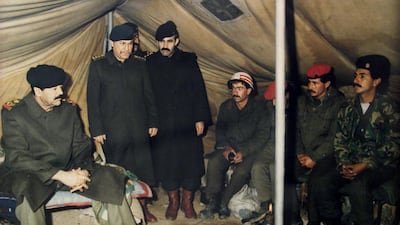
Saddam Hussein (L) with Iraqi troops in occupied Kuwait in 1990-1991. AFP -
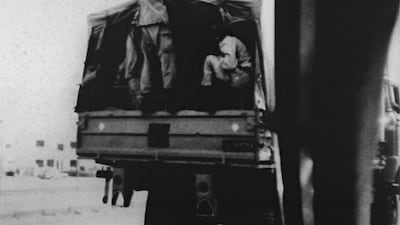
Iraqi soldiers in Kuwait City on August 3, 1990. AFP -

Sheikh Fahd Al Ahmed al-Sabah (C), brother of Emir of Kuwait, during the 1982 World Cup in Valladolid, Spain. He was killed by Iraqi troops during the invasion of Kuwait in 1990. AFP -
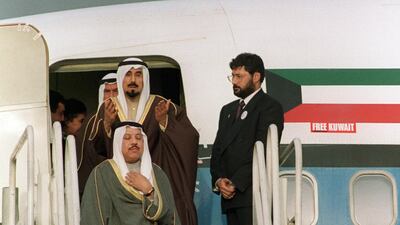
Sheikh Jaber Al Ahmad Al Sabah (top), Emir of Kuwait, disembarks on March 14, 1991 upon his arrival at Kuwait after seven months in exile during the Iraqi occupation of his country. AFP -
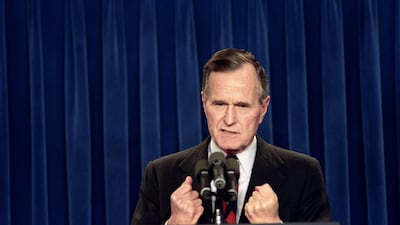
US President George Bush, the architect of the liberation of Kuwait, in Washington, on November 30, 1990. AFP -
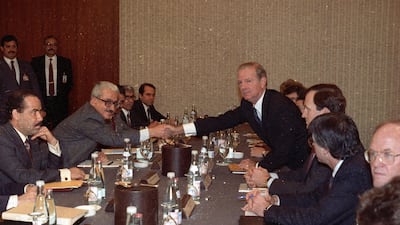
US Secretary of State James Baker (5th R) and Iraqi Foreign Minister Tariq Aziz in Geneva January 9, 1991. The meeting failed to convince Saddam to leave Kuwait, setting the scene for the Gulf War. Reuters -
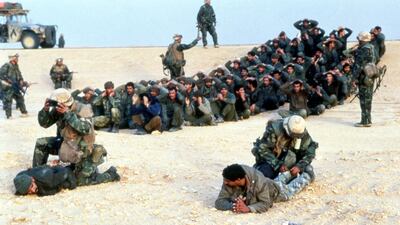
Iraqi prisoners of war in Saudi Arabian after giving themselves up to US troops in 1991. AP -
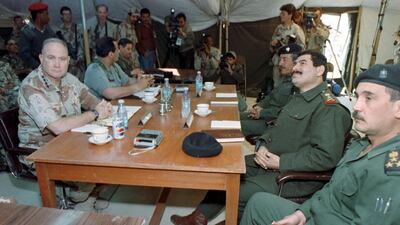
Allied Forces Commander Norman Schwarzkopf (L) meeting with Iraqi General Sultan Hashim (2nd R) in Safwan in Iraq on March 3, 1991, to set conditions for Iraq's surrender in the Gulf War. Reuters -
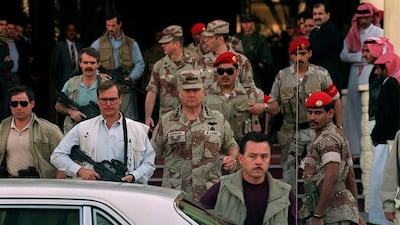
US General Norman Schwarzkopf (C), in Riyadh on February 10, 1991. AFP -
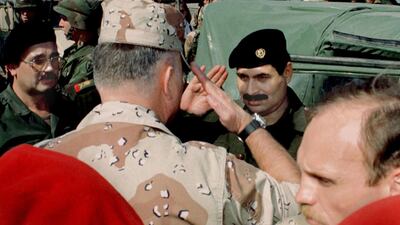
US General Norman Schwarzkopf (L), Allied Gulf War Commander, and General Sultan Hashim of Iraq (R) after talks to discuss Iraqi surrender terms in the Gulf War, in Safwan in south Iraq, on March 3, 1991. Reuters -
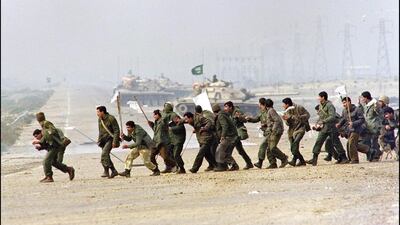
Iraqi soldiers carrying surrender flags on February 25, 1991 in Kuwait City. AFP -
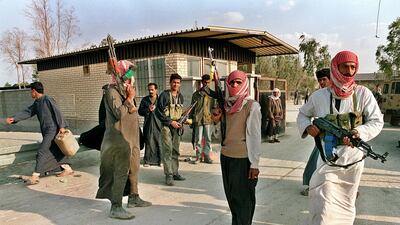
Shiite rebels on the outskirts of the southern Iraqi city of Nasiriyah on March 27, 1991. Saddam crushed the rebellion, although he was defeated in the Gulf War. AFP -
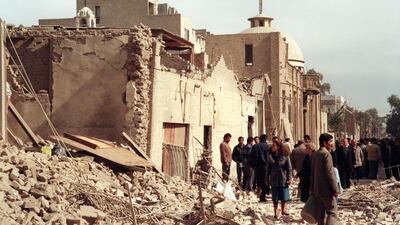
A photo dated February 16, 1991 showing damage near a church caused by an allied bombing raid in Baghdad. AFP -
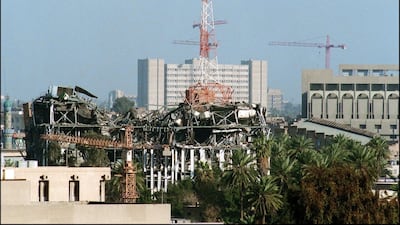
A view dated March 8, 1991 of damage in downtown Baghdad from an Allied air strike or missiles raid. AFP -
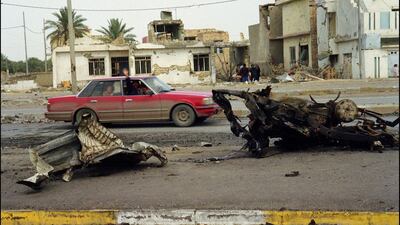
A car on February 7, 1991 in Samawa, south of Baghdad, after an allied bombing raid. AFP


From the above quote, it appears that the Times’ columnist feels Ukraine is more deserving of support than Kuwait is because Ukraine comes from “largely peaceful Europe” while Kuwait is located in the “war-torn” Arab World. In other words, invasions and violence are to be expected with the Arabs, but not Europeans. In merely two lines, the writer demonstrates a willful ignorance of history coupled with a dose of bigotry. “Largely peaceful?” In the last century, Europeans fought two bloody World Wars in which they killed more than 60,000,000 people on their continent.
The first of these wars saw millions of young men sacrificed as pawns in a competition between European powers. This was followed by the birth of fascism in Germany, Italy, and Spain, which then gave way to an even more deadly war that witnessed an effort to exterminate the Jewish people, mass murders of Poles, Russians, Gypsies, and others, and cruel and indiscriminate mass bombings of cities (by both sides). At war’s end, Europe was divided with the establishment and expansion of the Soviet Union, which repressed and murdered millions as it consolidated its control and the brutal suppression of rebellions against its rule. With the end of communist rule, there was more violence in Bosnia, Kosovo, Chechnya, Georgia, and Ukraine, coupled with the rise of far-right racist movements in many European countries.
During the last century, when European powers weren’t engaged in murderous conflicts among themselves, they were fighting wars to expand their colonial holdings or, by mid-century, using brutish repression in a last ditch effort to maintain their hold over the colonies they were in danger of losing to independence movements. During this period, millions of Arabs, Africans, and Asians lost their lives seeking to throw off the European colonisers, who had conquered their lands, exploited their treasures and denied them their rights. But the legacy of “largely peaceful” Europe didn’t end with their departure from the lands they had despoiled.
To serve their purposes, European colonial powers drew artificial lines dividing peoples and creating new states out of whole cloth. In other instances, they courted one indigenous community and placed it in a dominant position over others – often pitting religious, tribal or ethnic groups against one another. In still others they gave lucrative concessions to compliant partners, allowing them to prosper at the expense of their compatriots. Thus, in almost every region they colonised, European powers left a legacy of division and the seeds of future conflict. The bottom line: Europe hasn’t been “largely peaceful,” and blame for the Arab World being “war torn” can be found in the way European powers ruled, divided and distorted the Arab polity.
My intention in writing isn’t to dump on Europe or totally absolve Arabs from responsibility for their current situation. Nor has it been to pick on one New York Times writer, as this same observation has been shared by others. Rather, my purpose has been to make clear that the invasion of Ukraine isn’t a solitary blot on an otherwise pure European landscape. Russia has been condemned for its invasion and Ukrainians deserve their freedom – not because they are Europeans from a “largely peaceful” continent, but because invasion and occupation by bullies is wrong wherever it occurs and occupation is wrong wherever it occurs.

