


In the ongoing duel between Russia and the West, whose leader seems to be winning? US President Joe Biden or Russian President Vladimir Putin? It’s hard to tell.
Over the past few days, Mr Biden has appeared to be decisive, pushing back against what the West perceives to be Russia’s diktats against Nato, the US-led security alliance. He deserves some credit for uniting Europe around one policy against the Kremlin, and for threatening the latter with possibly devastating sanctions – if it dared to invade Ukraine.
Mr Putin has appeared to the world as a man of steel, by letting Nato know that drawing Russia’s neighbours into its orbit amounts to a threat to its national security. He has also made it clear that Moscow will not sit idly by.
The Russian leader has determined that Nato won’t intervene in a direct war with Moscow for the sake of saving the Donbass region of eastern Ukraine, which has come under the control of forces said to be loyal to the Kremlin. Indeed, if Ukraine’s east seceded from the union, it’s unlikely the West will do anything about it.
So, to the question of whose leader is winning, does it matter? After all, in this game of brinksmanship, further escalation is expected, as both leaders and their administrations come under pressure to do something. In a previous column, I had written that Russia may have raised the stakes too high on Ukraine, thereby pushing itself into. I had also written about the headwinds diplomats were facing in their bid to establish some sort of a grand bargain.
Russian Foreign Minister Sergey Lavrov’s diplomatic engagement with the West has so far achieved little, given the latter’s suspicion that Russia is fabricating pretexts to justify an invasion of Ukraine. Nato has also spoken with one voice, effectively telling Moscow that – whether Russia likes it or not – the alliance alone will determine which country can join it, and that Moscow’s ultimatums won’t work.
-
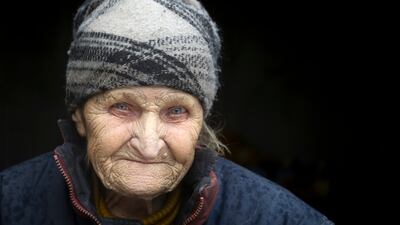
Lidia, 92, a Ukrainian who has lived here during the time of the conflict, stands at the entrance to her house in the territory controlled by pro-Russian militants, near the front line with Ukrainian government forces in Luhansk, Ukraine. AP -
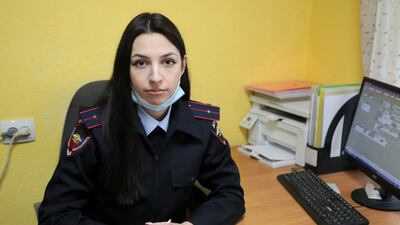
Olga Matvienko, an inspector at the migration service office, in Donetsk, Ukraine, says the number of people applying for Russian passports has increased in recent weeks. AP -

Valentyna Konstantynovska, 79, is taught to use a weapon during training for civilians, organised by the Azov Special Forces Unit of Ukraine's National Guard, in Donetsk. AP -
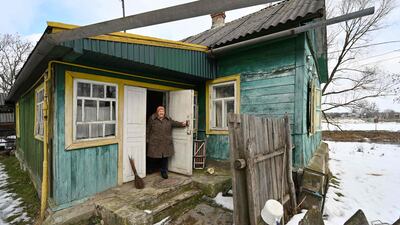
Ukrainian pensioner Lidiya Silina, 87, at her house near the border between Belarus and Ukraine. Russia has stationed troops in Belarus in recent weeks. AFP -
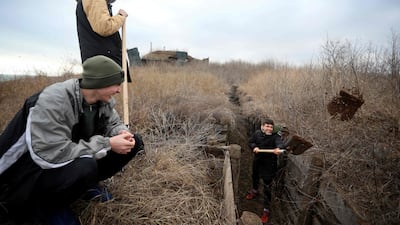
Ukrainian teenagers dig trenches for soldiers facing off with Russian-backed separatists, in the Mariupol region. AFP -

A young woman handles a weapon during basic combat training for civilians, in Mariupol. AP -
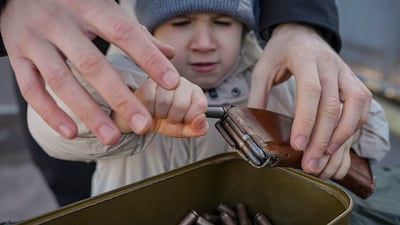
A small child struggles to remove ammunition from a clip during a basic combat training for civilians, in Mariupol. AP -
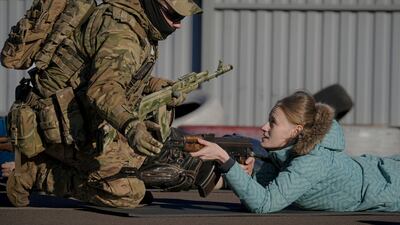
Civilians are being trained in Mariupol, where President Volodymyr Zelensky travelled to mark what he had declared Ukraine's 'Day of Unity'. AP -

A plane set as a monument to a former military base near the Three Sisters border crossing between, Ukraine, Russia and Belarus, in Senkivka, Ukraine. Getty Images -

A military instructor teaches a schoolboy to shoot with Kalashnikov rifles, during a training session in Lviv. AFP -

A salesperson works in a grocery store in Orlivka. Tensions with Russia have hit the economy hard, Ukrainian authorities say. Getty Images -
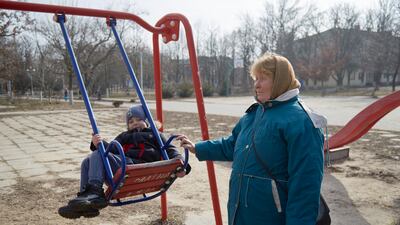
A child on a swing with his grandmother in Prymorsk, Ukraine, as Russian forces conduct large-scale military exercises in Belarus, across the border. Getty Images -
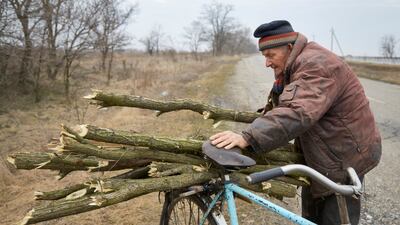
Pensioner Viktor collects firewood in Novokostyantynivka. European natural gas prices surged as the US rejected Russia’s claims that it was pulling back troops. Getty Images -
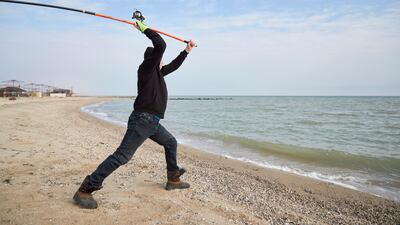
A fisherman tests his new fishing rod on a beach in Prymorsk, Ukraine. Getty Images -
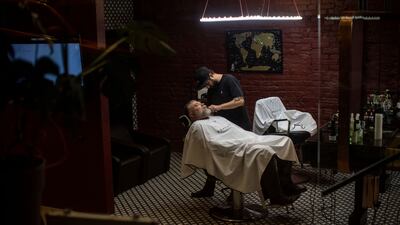
A customer in a barber shop in Kiev. Bloomberg -
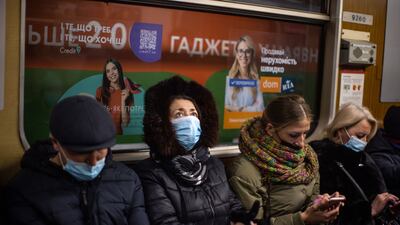
Passengers travel on a train in Kiev. Ukrainians have gone back to work, but are “not naive to the fact of how serious the situation is”, reports say. Bloomberg -
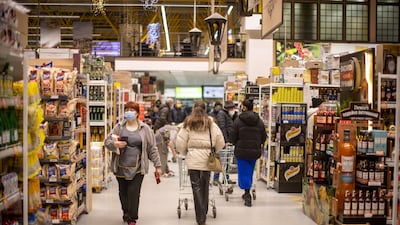
Shoppers in a supermarket in Kiev. Bloomberg -
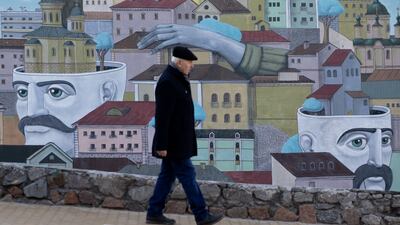
A large street mural in Kiev. Getty Images -
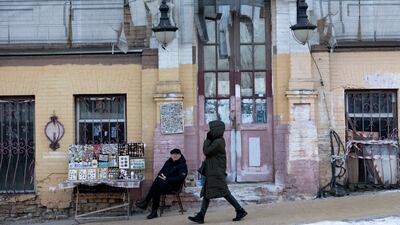
A woman walks past a vendor on a street in the Ukrainian capital. Getty Images -
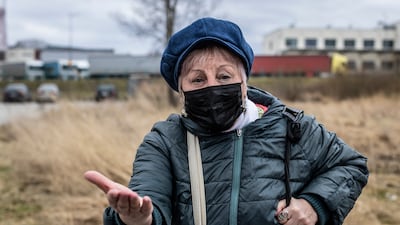
Ania, 67, a Ukrainian, gestures on the pedestrian border cross in Medyka, south-east Poland. AFP -
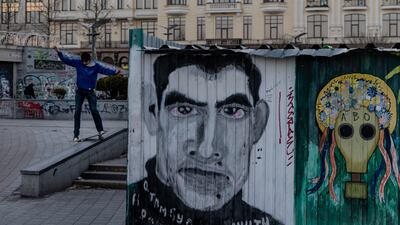
A skateboarder performs a trick behind a mural of poet and activist Vasyl Stus, in Kiev. Getty Images -

A woman gets her hair done at a beauty salon in Kiev. Getty Images -
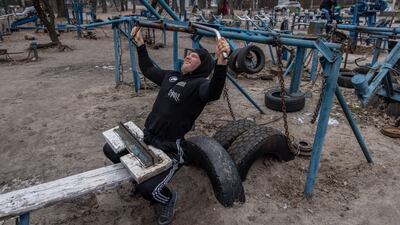
A man works out at Kiev's popular outdoor gym. Getty Images -
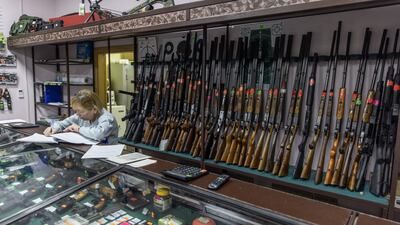
A woman works in a gun shop in the capital. Getty Images


The Russian leadership is torn between those who will stand with it against the West for strategic reasons and those who won’t because invading Ukraine doesn’t justify damaging its economy. After all, no major threat has emerged to Russia just because the Baltic states joined Nato more than 20 years ago.
Moscow is on the defensive, declaring that it does not intend to invade Ukraine and that all the talk about invasion is coming from the West, particularly the US. In a sense, Moscow appears to be wary of war and yet, unable to backtrack from it. Germany and France, both Nato members who are part of the “Normandy Quartet” alongside Russia and Ukraine, are unwilling to pressure Kiev to agree to amend its constitution to become a federal state or agree to implement the Minsk Agreement on the terms Russia insists on. While both the West and Ukraine support the continuation of the Minsk Process, Russia does not want just a “process”.
Only the US seems to have the bandwidth to launch an initiative to potentially replace the Minsk Process, whether in the context of resolving the Donbass issue, or repairing relations between Russia and Nato, or having a serious dialogue about European security. In the meantime, Washington seems to be closing in on an agreement with Iran to revive the 2015 nuclear deal, which previous US president Donald Trump had withdrawn America from in 2018.
Mr Biden’s firm handling of the Ukraine situation is likely to rally western support that would then shield him from domestic and international criticism if and when he signs a deal with Iran; for it would be a deal that empowers the regime in Tehran to threaten the interests of America’s partners in the region.
So, while Mr Biden has the opportunity to portray himself as the leader of the free world, it has to be said that he cares little whether the deal with Iran will be opposed or approved by the Arab states. The US president seeks to cut a deal at any cost. It is the outcome of the US’s pivot away from its traditional alliances in the Middle East and reduced investment in its traditional partners.
In any case, Mr Biden’s current focus is on dealing with what he considers to be Russian provocation.
Where does Mr Putin go from here? He could exploit an important different of opinion within Nato on the possible sanctions regime the West could enforce on Russia should it invade Ukraine. Sanctions imposed on Russia, after all, would adversely affect the economies of some European countries. Moscow can also exploit the West’s own worries about war erupting in Ukraine.
There is undoubtedly widespread concerns that, while a cold war would be costly for all sides, a hot war would benefit no one barring, perhaps, the major arms manufacturers. To be sure, an arms race becomes a natural by-product of the ongoing militarised diplomacy.

