


They’d probably be foes in any other universe.
One’s an ageing conservative; the other’s a progressive-minded comedian. One’s a lifelong politician who’s been in charge for nearly two decades; the other leveraged celebrity to win the top political post less than three years ago. One’s a Muslim regularly accused of anti-Semitism; the other’s Jewish and lost relatives in the Holocaust. One pals around with Russian President Vladimir Putin; the other views him as his nemesis.
Yet last week, Turkish President Recep Tayyip Erdogan and his Ukrainian counterpart, Volodymyr Zelenskiy, met for more than three hours, signed a landmark free trade deal and proclaimed each other true friends.
Maybe each respects the way the other stands up to countries they view as bullies. Over the past decade, few countries have been as pushy with a neighbour as Russia has been with Ukraine – witness Crimea, the Donbas and the 130,000 Russian troops twiddling their thumbs along the Ukrainian border in recent weeks.
Mr Erdogan’s nemesis is the West, more specifically the US-Nato-EU triumvirate that has sought to dictate Ankara’s behaviour almost since the country’s founder, Mustafa Kemal Ataturk, embraced secularism and western modernity. One might say that just as Mr Erdogan seeks greater independence by breaking from Ataturk’s West-leaning precedent, Mr Zelenskiy hopes to cement Ukraine’s independence by finalising its break from Russia.
The two states do share some history. In the 15th century, Crimea, led by Turkic Muslim Tatars, came under the control of the Ottoman Empire. In the 16th century, the Ottomans took control of Odessa, largely to halt the advance of Russian tsars. Around that time, a slave girl from western Ukraine caught the eye of young Sultan Suleiman. He took the unusual step of marrying Roxelana, who emerged as one of the most influential women of the Ottoman era − an era often invoked by Mr Erdogan.
Because of the way the tsars snatched bits of the crumbling Ottoman Empire − Crimea, the Balkans and the Caucasus − Turkish leaders have for centuries seen Ukraine as a bulwark against Russian expansionism. Despite oft-friendly ties with Russia today, Turkey has persistently backed Ukrainian claims on Crimea, due to the Tatar connection, and quietly supported the Ukrainian Orthodox Church’s 2018 split from the Russian Orthodox Church after 300 years.
More recently, Ankara has sold Kiev some two dozen of its advanced drones, which made an impact in eastern Ukraine in October, upsetting Moscow but giving Turkey another showcase for the pride of its defence sector. During Mr Erdogan’s visit, they agreed to build a facility outside Kiev that will produce Turkish drones with Ukrainian engines.
Turkey is already among the top foreign investors in Ukraine, with annual trade now expected to reach $10 billion. The countries established passport-free travel in 2017 and last year, the number of Ukrainian tourists visiting Turkey doubled to two million. “Rather than pouring oil on the flames, we are acting with the logic of how can we cool tensions,” Mr Erdogan, who tested positive for Covid-19 on Saturday, said in Kiev.

The Turkish leader has repeatedly offered to mediate the stand-off, even while arming Ukraine risks upsetting Russia. We don’t yet know where it is, but there will surely be a line Ankara will not cross, as Moscow has leverage on the two issues that have most hurt Mr Erdogan domestically: the troubled economy and growing resentment towards more than four million refugees.
Russia is Turkey’s largest supplier of natural gas and tourists, so if Turkey were to join Nato’s planned sanctions against Moscow, Moscow could potentially throw the Turkish economy into a tailspin. Russia could also encourage Syrian President Bashar Al Assad to launch a major offensive in Syria’s Idlib province, potentially driving two million more refugees into an increasingly xenophobic Turkey.
A parade of western leaders has visited Kiev in recent days to reiterate their support and last week, the US committed to sending 3,000 troops to Poland and Romania. Other Nato members have been deploying warships, fighter jets and troops to the Black Sea and neighbouring states, though Turkey is not among them, much as it refrained from joining western sanctions for Russia’s Crimea annexation in 2014.
“The West, until now, has not made any contribution to resolving this issue,” Mr Erdogan said on the weekend. “I can say they are only making things worse.”
-
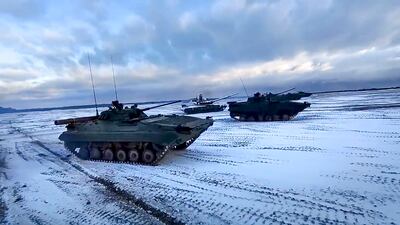
Russian and Belarus troops held joint combat training at firing ranges in Belarus as tensions remain high under the looming threat of war with Ukraine. AP Photo -
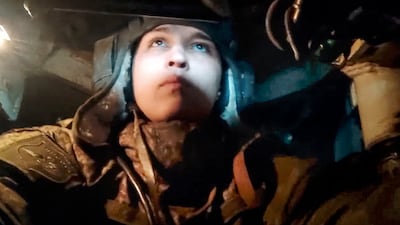
A soldier drives an armoured vehicle at Brestsky firing range, Belarus. AP Photo -
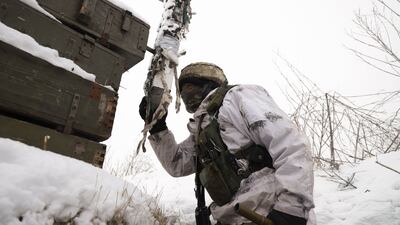
A Ukrainian serviceman carries out checks not far from the pro-Russian militant-controlled city of Donetsk, Ukraine. EPA -
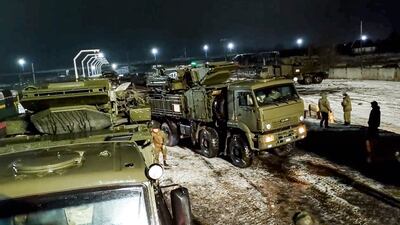
A Russian military vehicle drives off a railway platform after arriving in Belarus. AP Photo -
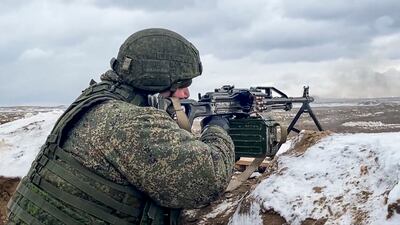
A soldier takes aim during a Russian and Belarusian military drill at Brestsky firing range. AP Photo -

A Ukrainian serviceman repairs a shelter near Donetsk, Ukraine. EPA -
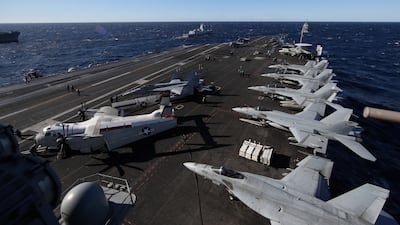
Aircraft are lined up on 'USS Harry S Truman' in the Adriatic Sea. The Truman strike group is operating under Nato command and control along with several other Nato allies for co-ordinated maritime manoeuvres, anti-submarine warfare training and long-range training. Reuters -
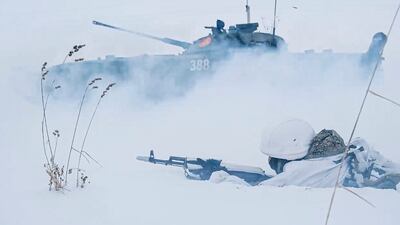
Russian soldiers attend the Yurginsky training ground in the Kemerovo region, Russia. AP Photo -
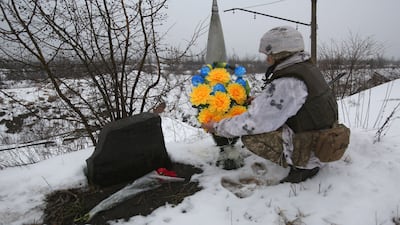
A Ukrainian serviceman lays flowers where one of his friends was killed in 2017 near Avdiivka. Anatolii Stepanov / AFP -

A Ukrainian serviceman stands guard in a dugout on the frontline with the Russia-backed separatists near Avdiivka. AFP -
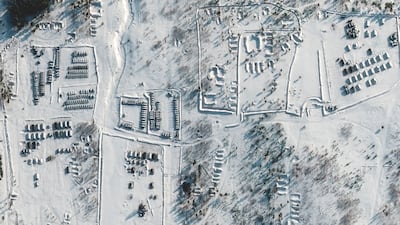
This satellite image shows troops gathered at a training ground in Pogonovo, Russia. AP Photo


In recent days, Russia has added dozens more tactical battalions to its forces along the border, while in the Black Sea, it has reportedly gathered the largest Russian naval grouping since the fall of the Soviet Union. Moscow has repeatedly stated that its massing of forces did not originate as a threat to Kiev, but as a response to Nato expansion, which it sees as a security threat.
Yet, the Kremlin seems to reserve a special place in its heart for Ukraine. With the 1994 Budapest Memorandum, Ukraine gave up its nuclear arsenal in exchange for a commitment by Russia, along with the US and UK, to respect its independence, sovereignty and existing borders, and refrain from the use of force, or even the threat of force, against it.
But Moscow twice helped install pro-Russian leaders in Kiev before Ukrainians pushed back with revolutions, in 2004 and 2014. Then came the Crimea annexation and the Russian-backed conflict in eastern Ukraine, which has led to more than 14,000 dead, according to the UN.
Now we have the current stand-off. “True sovereignty of Ukraine is possible only in partnership with Russia,” Mr Putin wrote in a 5,000-word treatise last year. “Together we have always been and will be many times stronger and more successful. For we are one people.”
Perhaps Ukraine’s steely grip on its fragile democratic independence in the face of a persistent threat sends the message to Turkey that its defiance to the West is just. For Ukraine, Turkey’s independent foreign policy may represent the dream of allying with great powers without being subsumed by them.
Whatever their reasons, it’s good for both that opposites attract.

