


During his visit to Beijing, partly to attend the opening ceremony of the Winter Olympics, Russian President Vladimir Putin met his Chinese counterpart, Xi Jinping, who threw his country’s support behind Moscow over the ongoing Ukraine crisis. They may not have signed any military agreements but they jointly denounced the West and its security alliance, Nato, for their role in rising tensions across Eastern Europe.
Meanwhile, the foreign ministers of Germany and France, who were scheduled to visit Kiev this week, are unlikely to revive the 2014 Minsk Protocol that also involves Russia and Ukraine. The set of agreements had sought to end the war in the Donbas region of Ukraine, where Russian-backed forces were battling the government. And Turkey’s attempts to bring together Ukraine and Russia, with whom Ankara enjoys favourable relations, have so far yielded little.
In other words, the door to diplomacy appear closed today, with the Russian leadership continuing to hold the keys to reopening it. If it takes seriously the cost of escalation – which could come in the form of harsh economic sanctions imposed on its economy and its leadership by the West – then the only way forward is an agreement between Russia and Nato.
But few can tell what Mr Putin will do amid a tug of war between his country’s diplomats and its generals, who are offering different prescriptions to end the crisis. A previously postponed meeting between Russian Foreign Minister Sergey Lavrov and US Secretary of State Antony Blinken could take place this week, but the problem still lies in the substance of what each diplomat wants to be at the heart of their talks. Washington seeks to talk about Europe’s security issues, while Moscow would like to focus on the guarantees it has demanded from Nato on Ukraine – specifically its possible membership in the alliance, which is a red line for Moscow. Nato has so far rejected this and other demands.
-
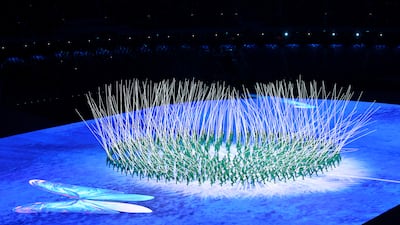
Performers create a flower display with LED lights during the opening ceremony of the Beijing 2022 Winter Olympics at the Beijing National Stadium on Friday, February 04, 2022. Getty -

Performers during the opening ceremony of the Beijing 2022 Winter Olympics. AFP -
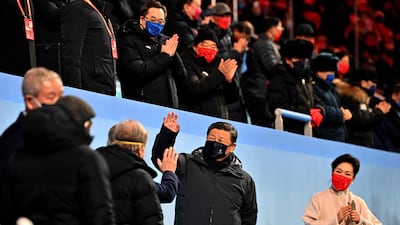
China's President Xi Jinping, centre, and his wife Peng Liyuan, right, greet other attendees during the opening ceremony of the Beijing 2022 Winter Olympics. AFP -
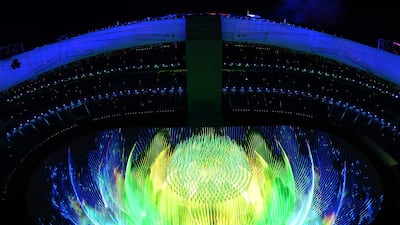
An overview of the National Stadium during the opening ceremony. AFP -
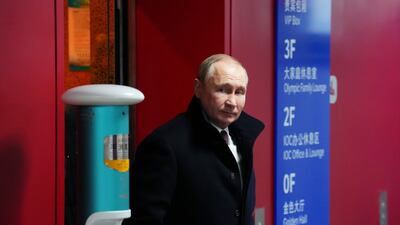
Russia President Vladimir Putin arrives for the opening ceremony. Getty -
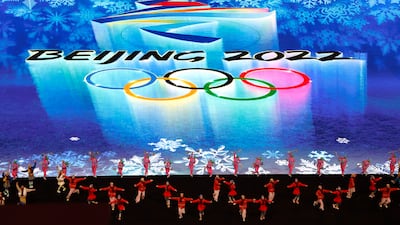
Dancers perform during the opening ceremony on Friday. EPA -
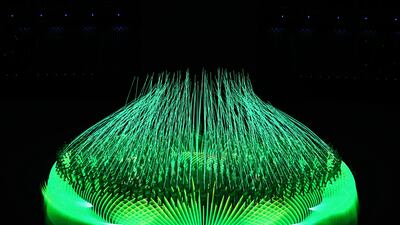
Performers create a flower display with LED lights during the opening ceremony. Getty -
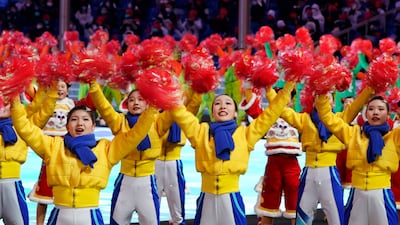
Dancers perform during the pre-show ahead of the opening ceremony of the 2022 Winter Olympics, Friday, Feb. 4, 2022, in Beijing. (AP Photo/Jae C. Hong) -
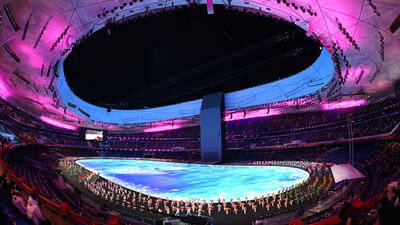
View inside the stadium as performers dance during the opening ceremony. Getty -
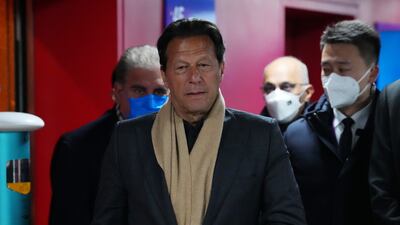
Pakistan Prime Minister Imran Khan at the opening ceremony. Getty -
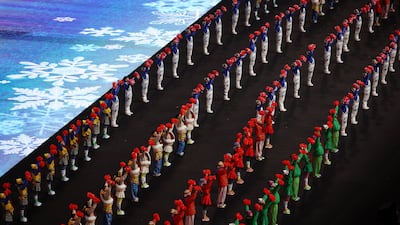
Performer’s dance during the opening ceremony. Getty -
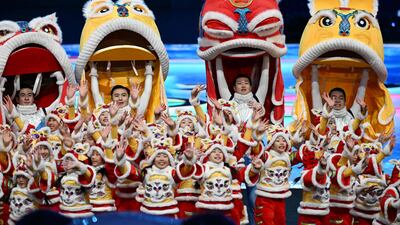
Performers during the opening ceremony of the Beijing 2022 Winter Olympics at the National Stadium on Friday, February 4, 2022. AFP -
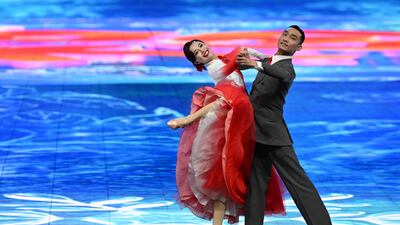
Performers take part in the opening ceremony of the Beijing 2022 Winter Olympic Games. AFP -

Firework display during the Opening Ceremony at the Beijing National Stadium. Getty -
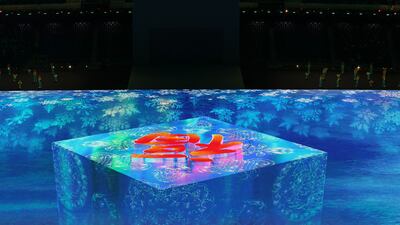
A projection display during the opening ceremony of the Beijing 2022 Winter Olympics. Getty -
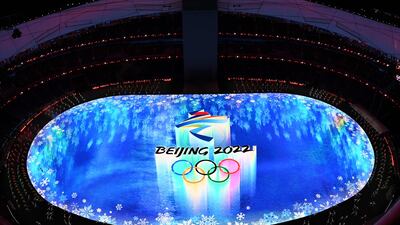
An overview of the stadium ahead of the opening ceremony of the Beijing 2022 Winter Olympic Games. AFP -
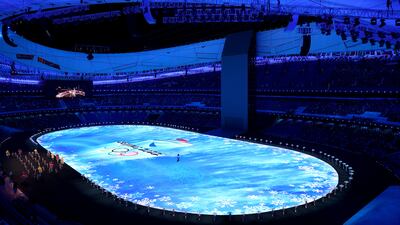
A general view inside the stadium during the opening ceremony of the Beijing 2022 Winter Olympics at the National Stadium. Getty -
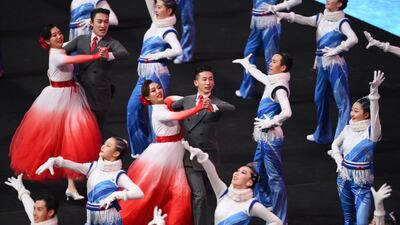
Performers dance during the opening ceremony of the Beijing 2022 Winter Olympics. Getty -

Hosts address the crowd during the pre-show ahead of the opening ceremony of the 2022 Winter Olympics. AP Photo -
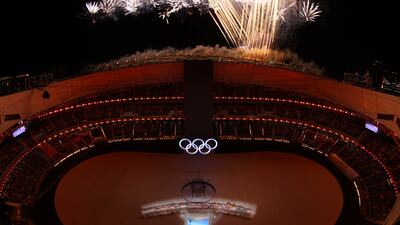
BEIJING, CHINA - FEBRUARY 04: A general view inside the stadium as fireworks are set off during the Opening Ceremony of the Beijing 2022 Winter Olympics at the Beijing National Stadium on February 04, 2022 in Beijing, China. (Photo by Richard Heathcote / Getty Images) -
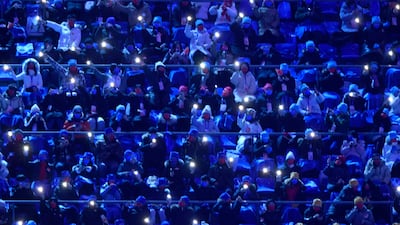
Inside the national stadium before the opening ceremony of the Beijing 2022 Winter Olympics. Reuters -
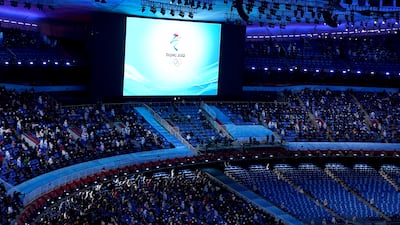
Inside the national stadium before the opening ceremony of the Beijing 2022 Winter Olympics. PA -
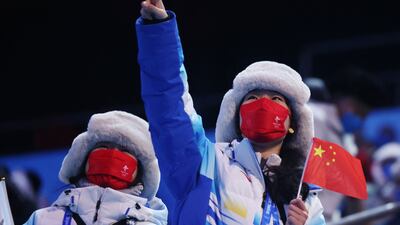
A woman wearing a face mask holds a Chinese national flag before the Beijing 2022 Winter Olympics. Reuters -
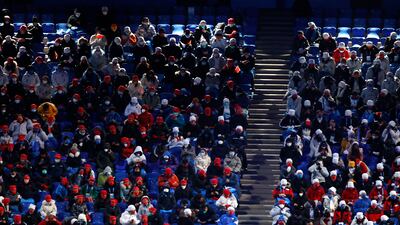
Spectators arrive for the Opening Ceremony of the Beijing 2022 Olympic Games at the National Stadium, also known as Bird's Nest, in Beijing China. EPA -
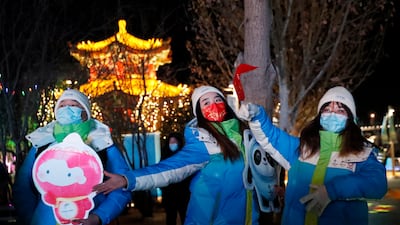
Volunteers hold placards of Bing Dwen Dwen and Shuey Rhon Rhon, mascots of the Beijing 2022 Winter Olympics and Paralympics, during a community event at an Olympics Live Site before the Beijing 2022 Winter Olympics opening ceremony, in Beijing, China. Reuters -
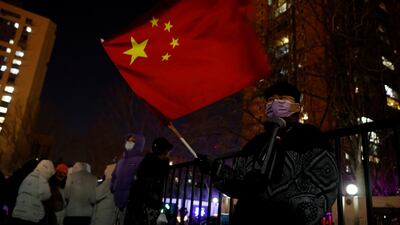
A man waves a Chinese flag as people gather near the National Stadium, also known as the Bird's Nest, for the opening ceremony of the Beijing 2022 Winter Olympics, in Beijing, China. Reuters -
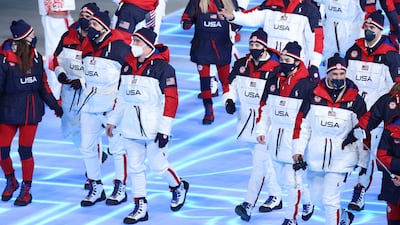
Members of Team United States during the opening ceremony. Getty -
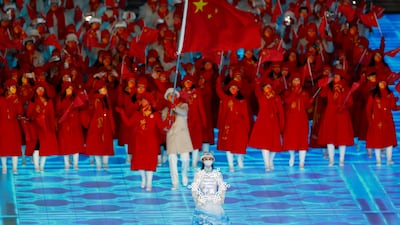
Athletes of China march during the opening ceremony. EPA -
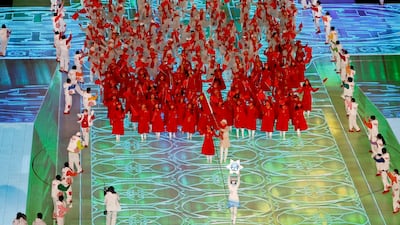
Athletes of China arrive for the opening ceremony. EPA -
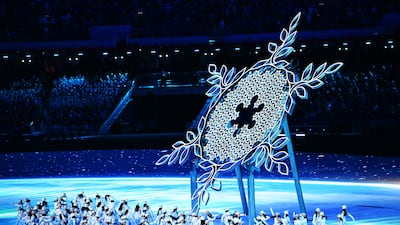
Dancers perform around the large snowflake during the opening ceremony. Getty -
Opening ceremony of the Beijing 2022 Winter Olympics. Getty -
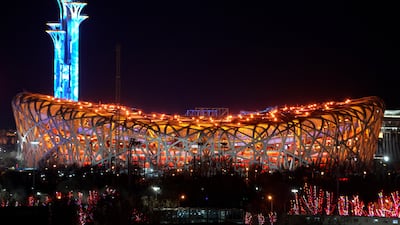
The Bird's Nest stadium during the opening ceremony. Reuters


With Moscow mindful that Beijing wants nothing to distract people from the Winter Games, it is unlikely we will see any further escalation or breakout of war right now – unless something unexpected occurs on the ground in Ukraine. Decision-makers in Russia and Nato are nonetheless considering all sorts of scenarios and making contingency plans.
Some are preparing for scenarios that currently appear impossible, such as reviving the Minsk Protocol brokered by the Europeans, bearing in mind that neither Moscow nor Kiev can turn back the clock when it comes to the facts on the ground in Donbas. Others are keeping an eye on neighbouring Belarus, where Russia has posted thousands of troops carrying out joint military exercises – merely hours away from the Ukrainian border – at the invitation of the Belarusian government. Poland, Lithuania and Latvia are all feeling anxious about the prospect of Russia using Belarus to encircle Ukraine.
Can Moscow spring a surprise against Ukraine just as it did in Syria by intervening in its civil war? After all, if not for Russian support of the Assad regime, the outcome of the conflict could well have been different. Can Moscow do a repeat of its actions in Chechnya in 1999, or in Crimea in 2014?
Some predict Mr Putin will turn the current crisis into an opportunity in his bid to force the US-led western order to sit at the negotiating table and discuss security arrangements in Europe. He can play the Iran card, too, by attempting to convince Tehran to make the necessary compromises to revive the 2015 nuclear agreement.
In fact, next week will be crucial for both the Vienna talks and the Ukraine crisis. And decision-makers in western capitals as well as in Moscow are weighing their options in the event the talks succeed or fail.
Russia is seemingly considering activating fronts far from Europe were the Ukraine crisis to lead to an all-out confrontation. Moscow may even be envisaging an anti-western bloc that includes China, Iran, Venezuela and some Caribbean states.

The developments in Vienna, however, are also adding to Moscow’s worries. While Russia considers Iran to be an ally, it anticipates a potential Iranian retaliation in the Middle East if the Vienna talks fail – and wants to take a different tack, since it does not want an animus with the Gulf states with whom it shares important interests and investments. Moscow also doesn’t want to have tensions with Israel, with whom Iran has an adversarial relationship – especially if the European crisis is contained. It is willing to use the Iran-Israel animus only as long as it furthers its own interests, especially should the situation in Eastern Europe spirals out of control.
Whatever be the outcome in Vienna, Moscow certainly seeks to move things forward in Syria, whose post-war future remains uncertain. Indeed, Mr Putin is keen to tout Syria as a success story for Russia. But Moscow is having to work with Iran and Hezbollah – Tehran’s Lebanese proxy, which has considerable influence in parts of Syria – in order to contain the West’s influence in the country. This constrains Russia and leaves it no longer with the upper hand.
Currently, Russian, Gulf, American and European diplomats all have a desire to nip potential conflicts in the bud.
The UAE has chosen to defuse tensions in the wake of the recent attacks on its installations by the Houthis, the Iranian-backed rebels in Yemen. Emirati diplomacy is at work to stop the dangerous escalation in the region and seeks a political solution in Yemen. The same applies to the Saudi-Iranian talks, the fifth round of which is to be held in Iraq despite hurdles. That these talks have not been cancelled can only be a good thing.
The tensions and anxieties as a result of the Ukraine crisis have left many people around the world holding their breath, especially in light of the mystery surrounding Moscow’s next moves. Be that as it may, decision-makers are not sitting idle. With Moscow having backed itself into a corner, they are busy preparing for a number of scenarios.

