


Two weeks after the disastrous attack on the Capitol, Joe Biden began his term as the 46th President of the United States. The coronavirus was raging. A vaccine had not yet been distributed. Disunity in America was at a point not seen since the Civil War of 1861-65.
On January 20, 2021, Mr Biden – standing next to Chief Justice John Roberts, and his wife Jill – was sworn in. I remember watching it live on television with a sense of hope – but also wariness. We had been traumatised as a nation from the virus and the Trump years.
Mr Biden’s words were potent. “End this uncivil war,” he said. “We can overcome this deadly virus.”
America needed to overcome the virus, but also the polarisation of Republicans versus Democrats, of liberals versus conservatives, of conspiracy theorists versus truth tellers. Donald Trump, Mr Biden's predecessor, had gleefully trampled upon the constitution. He had attempted to destroy the tenets of democracy that America was founded on – free press, human rights and rule of law.
This, along with climate change in the form of raging fires, floods and hurricanes – which Mr Trump denied – became Mr Biden’s inheritance. People were exhausted and had lost faith in government.
Many of us – even Democrats such as myself – had our worries about Mr Biden. But we saw him as stable, a Washington pro who could build alliances and navigate Congress. I admire him because I also see him as a man who suffered more personal grief than any human should be forced to – yet is resilient. When I voted for him, I was voting for a man who could bind our fractured country: a healer who could restore order after so much pain.

One year on, America is in a worrying state. Vaccines have been distributed, but the Supreme Court is blocking Mr Biden's important vaccine or test mandate for large employers. Omicron is taxing the healthcare system. Inflation is high. The supply chains are disrupted. His approval ratings started plunging in the summer, right after the Afghanistan fiasco – and that’s when the correlations that he was not paying attention to inflation and the economy began.
Vice President Kamala Harris is unpopular. The first woman vice president and the first black person to do so has lost staff and also has sliding approval ratings. Her Thanksgiving shopping spree to Paris took place when many Americans were struggling to pay bills.
Ms Harris was not my choice – I’m a fan of Senator Elizabeth Warren – but the attacks on her are not fair. The role of vice president is an odd one, and racism and sexism are also at play. American conservative media is cruel: Newsmax TV host Grant Stinchfield ran a segment featuring videos of Ms Harris laughing and likened her to Wicked Witch of the West, the fictional character from the classic film The Wizard of Oz.
To sum up, a new CBS poll showed that most Americans think Mr Biden is not focused enough on economy and inflation: 70 per cent of them disapprove of the job he’s doing handling it – although there’s a split on his approval rating on his handling of Covid-19.
How do we interpret this?

I’m not a fan of surveys or polls, but if I was grading Mr Biden the way I grade my students at Yale, he’d get a solid B. It hasn’t been great – he’s not an A student – but I think he’s done his best to attempt bipartisanship. I support his social policies that remain stalled in Congress. I think it takes at least a year to undo the damage the Trump years inflicted. I don’t agree with Republican Senator Mitt Romney’s assessment that Mr Biden’s first year comprised of “52 bad weeks".
Let’s start with what Mr Biden had no control over. A pandemic on a scale we have not seen for a century – mismanaged by his predecessor. A devastated healthcare and welfare system. Rising food and gas prices. A broken supply chain. A hostile Republican Party. The public school system in shambles. Most of all, having expectations that Covid-19 would recede was not Mr Biden’s fault: at the start of his term, he got strong approval ratings. But that was before the onset of Omicron as well as the vaccine mandate setback.
One of the most common emotions I’ve read when trawling through the polls and local papers across the US is frustration with Mr Biden. People say what would change their opinion is if he is able to lower inflation. Legislation seems less important – even within his own party, who are tougher on Mr Biden about inflation. What people care about today, after a pandemic, is economic stability: to pay the rent, medical bills, feed their children and fill the gas tank.

But on the plus side, the polls concede that Mr Biden gets points personally – more so than other presidents in their first year. And here are things he did a good job on: he has tamped down some of Mr Trump’s trade wars. There have been no tariffs or punitive measures so far during his presidency. On foreign policy, he has chosen great team that includes Antony Blinken, Rob Malley and Samantha Power, among others. While Afghanistan was a mess, he has handled Russia better than Mr Trump. He’s restored professionalism with the likes of Turkey and North Korea. Personally, I’d like to see him restore the Palestinian peace talks and be tougher on Israel, but let’s see what he does once domestic policies are sorted out.
But here’s the real reason why I still believe in Mr Biden: he is empathetic, solid and sensible. I like his fatherly tweets urging people to wear masks and get vaccinated. His speeches make sense; I get annoyed when people focus on memory lapses or his verbal stumbles – who doesn’t? He’s made blunders, but overall, I believe in his sincerity.
Picking up the pieces from Covid-19 and Mr Trump’s legacy was not going to be easy for anyone. Mr Biden is the best man for the job at the moment. Let’s give him a chance for 52 better weeks in 2022.
-
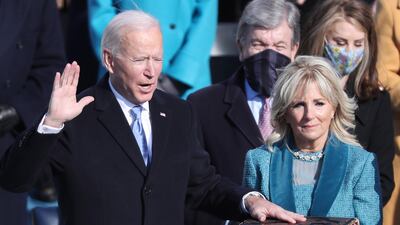
President-elect Joe Biden as he is sworn in as the 46th president of the US. EPA -

President Biden receives his coronavirus booster vaccination in Washington on September 27. Reuters -
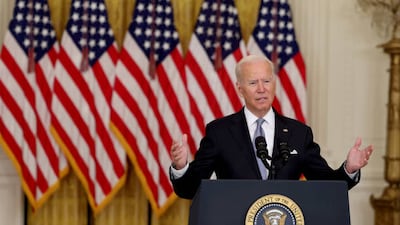
President Biden gives remarks on the worsening crisis in Afghanistan from the East Room of the White House on August 16. Getty Images -
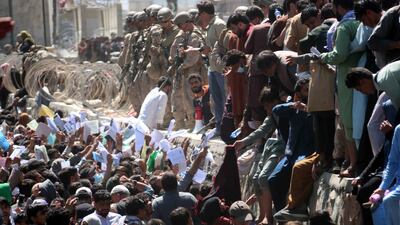
Desperate Afghans struggle to get into the Hamid Karzai International Airport in Kabul in August to escape the Taliban. EPA -

President Biden delivers remarks on the bipartisan infrastructure law during a visit to Dakota County Technical College in Rosemount, Minnesota. Reuters -
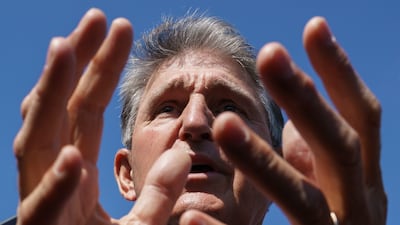
For months, the fate of Mr Biden's presidency seemed to be in the hands of Senator Joe Manchin, a conservative Democrat who rebuffed pleas for support a key spending bill. AP



